If HDMI Black Level is grayed out on your Samsung television, follow these steps to get it working again. 1. Go to Settings > Support. 2. Select Connection Guide. 3. Go to Video Device > HDMI Troubleshooting. 4. Select HDMI Troubleshooting again. 5. Select the HDMI port that is experiencing issues. The TV will diagnose... Continue Reading →
Clearing Up Rec. 2020 (P3-D65 Limited) Confusion
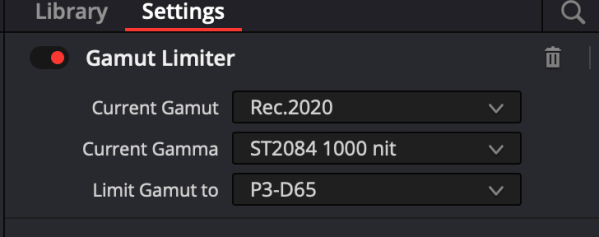
“Using a P3-D65 CST followed by a Rec.2020 CST does not limit the gamut to P3. Since this is a requirement by all studios and clients today, we recommend using a Rec.2020 CST followed by a P3-D65 Gamut Limiter which will constrain the color gamut to P3 within the Rec.2020 container.” — Aby Mathew, Dolby... Continue Reading →
600 Nits Seems To Be The Magic Number
We’ve remarked before how the figure 600 seems to crop up every time a colorist is asked about the peak nits of their projects. Here are a couple more data points. Cullen Kelly: Do you impose a hard speed limit on your projects? Corinne Bogdanowicz: I don't have a hard rule or setting that I... Continue Reading →
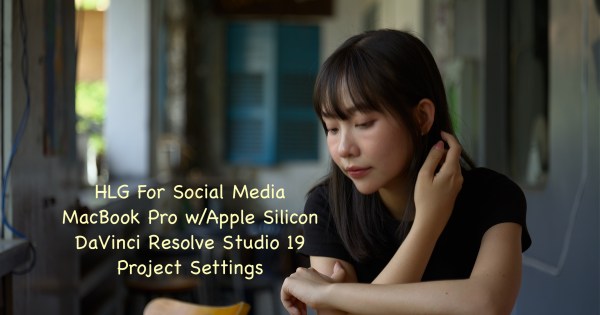
HLG For Social Media Using MacBook Pro With Apple Silicon: DaVinci Resolve Studio 19 Settings
https://youtu.be/VoTrassfzzs The following are our preferred project settings for delivering HLG HDR to YouTube. 1. Display HDR Video (P3-ST2084) 2. Preferences. Decode Options. Decode H.264/H.265 using hardware acceleration. 3. Preferences. Use 10-bit precision in viewers if available. Use Mac display color profiles for viewers. 4. Color Management settings. Color science may be DaVinci YRGB (for... Continue Reading →
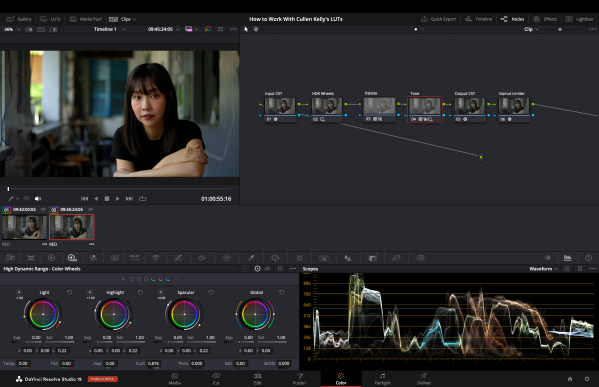
How To Work With Cullen Kelly’s LUTs in DaVinci Resolve Studio 19
The following workflow is for Cullen Kelly's discontinued Core Elements Creative LUT Pack, but is applicable to his Voyager LUT Pack and film print emulation LUTs as well. https://youtu.be/0ERXpfUuRQ4 Description of the Core Elements Creative LUT Pack (discontinued) from Cullen Kelly's website: Create studio-grade cinematic looks Tailor to your vision Use for HDR, SDR, and... Continue Reading →
LG: HDR10 No Longer At The Top Of The HDR Hierarchy
In April, LG published a help guide entitled Dolby Vision vs. IMAX and HDR10: A Comparative Analysis. Here’s some of what the Korean electronics manufacturer had to say about Dolby Vision and HDR10: Dolby Vision “Dolby Vision is a visual technology designed to enhance the viewing experience to unprecedented levels. It empowers visual creatives to... Continue Reading →
Ridiculous Dolby Gaming Ad
https://youtu.be/yUwPaVpbJE8?si=DBh054MPW560Lg3g Dolby released an ad on YouTube showing 'consumers' going wild over the Dolby Atmos audio and picture quality of Dolby Vision gaming. One of the participants exclaims, "I think the depth and color of the blacks are very well represented." Only they're all sitting in an impossibly brightly lit room, the worst possible scenario... Continue Reading →
All Of Our Quick Start Video Tutorials Under One Roof
RAW Convertor doesn't convert the ProRes RAW files into the color space and gamma that they were shot in. Rec709, P3-60 and Blackmagic Design Film are the only options to develop the RAW files, not Slog3 and S.Gamut 3 Cine. Is there a possibility to fix this in a future update or am I maybe... Continue Reading →
Compare Dolby Vision Derived SDR Version To HDR10 Video
https://youtu.be/H_SChOvwIW0 HDR10 version Dolby introduced an improved tone mapping analysis algorithm that first appeared in DaVinci Resolve Studio 18.6. If you'd like to compare the Dolby Vision derived SDR version to the HDR10 video above, click here. As far as we can tell, it only appears to be playable on Dolby Vision enabled devices, because... Continue Reading →
The Benefits Of Shooting 8K
Alister Chapman writes about the advantages of 8K and muses whether The Creator shouldn’t have been shot on the Sony A1 rather than the FX3: “Since the launch of Burano I've become more and more convinced of the benefits of an 8K sensor - even if you only ever intend to deliver in 4K, the... Continue Reading →
Free Download: RED Komodo R3D RAW Sample Footage
https://youtu.be/kKSrUCp4NsA R3D RAW HDR Video Details: Model: Ngô Hài Hà. RED Komodo 6K. Meike super35 50mm T2.1 Cinema Prime. Kolari ND3. 6K 17:9 R3D MQ ISO 400, 24 FPS, T2.1. Edited in DaVinci Resolve Studio 18.6. MacBook Pro (late 2021), LG CX. ISO changed from 400 to 250 in post. No noise reduction. https://youtu.be/89tWTtfnlx4?si=4ZevZsRYfuVj5oiB
A Fundamental Difference Between SDR & HDR
“The cinematographer’s job to do good HDR is don't clip the signal.” Juan Cabrera, Senior Colorist & Founder at LightBenders From On the Calculation and Usage of HDR Static Content Metadata by Michael D. Smith and Michael Zink: “A simple histogram analysis shows the distribution of pixel values within an image and can be used... Continue Reading →
Dolby Vision Profile 20
Profile 20 is the first Dolby Vision profile which supports MV-HEVC and enables the delivery of Stereoscopic (3D) video. All other Dolby Vision profiles only support monoscopic (2D) video, whereas profile 20 is able to carry stereoscopic views and target new devices and use cases. Dolby Vision profile 20 brings forward new capabilities for playback... Continue Reading →
Maxine Gervais & Josh Pines Talk HDR
Evolution of Tech & HDR, a segment from the YouTube series ‘Color Masterclass with Joshua Pines and Maxine Gervais’ produced by Portrait Displays, coincided with Netflix’s release of The Brothers Sun, which was graded by Maxine Gervais. Joshua Pines claims that when HDR was in its infancy, all studios endeavored to make the brightest grades... Continue Reading →
The Brothers Sun: The Worst Cinematography Of 2024?
“I like 20Ks and T12s pounding through windows.” DP C. Kim Miles "The show is one of the first important TV releases of the year 2024 on Netflix after its launch on January 4, 2024. The Brothers Sun received a score of 85% on Rotten Tomatoes..." - The Economic Times After reading interviews with cinematographer C.... Continue Reading →
High Brightness: The Fly In The Ointment
There’s one crucial aspect that researchers who conducted the viewer brightness preference studies we’ve shared overlooked, and that is 24p motion judder. We doubt that participants in the studies would have preferred 4,000 nits over 1,000 nits had they been shown clips of actors walking in front of bright windows, as students do in the... Continue Reading →
Is Shadow Detail Really HDR’s Greatest Advantage?
High Dynamic Range (HDR) has been praised by filmmakers for its shadow detail, but is that truly HDR’s crowning achievement? In this collection of thoughts from colorists, consultants, cinematographers, researchers, industry organizations, studios and manufacturers, we explore whether this obsession with "seeing into the shadows" overlooks HDR’s real potential. The “Shadows” Camp The visual benefit... Continue Reading →
Study Finds Substantial Preference For 4,000 Nits Over 1,000 Nits
Subjective Quality Evaluation of High Dynamic Range Video and Display for Future TV by Philippe Hanhart, Touradj Ebrahimi, Pavel Korshunov and Yvonne Thomas. SMPTE Motion Imaging Journal, May 2015 The following excerpts are from a study carried out at the European Broadcasting Union and École Polytechnique Fédérale de Lausanne in 2015. Why 100, 400, 1000 and... Continue Reading →
Dolby Vision Analysis Tuning Feature in Resolve Studio 18.6
This feature introduces a new and improved analysis algorithm that allows colorists to select the strength of highlight retention and the amount of mapping applied. Users can now choose from a predefined set of spatial filters. Selecting the "Legacy CM4 L1" option matches the analysis of the original CMv4 algorithm. Older projects from software versions... Continue Reading →