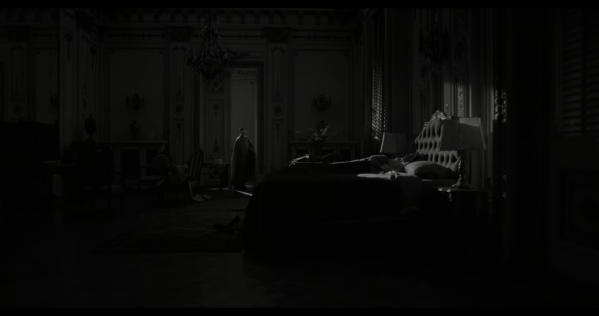
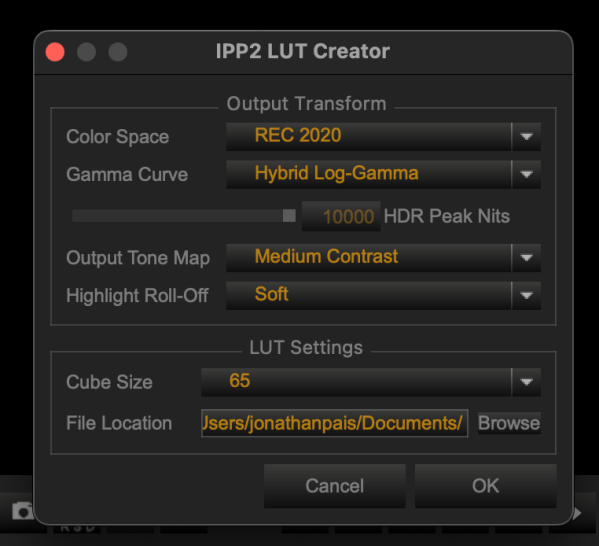
Because there's so much leeway for placing exposure in post, it's all too easy to grade HDR footage so that it ends up too bright and over-saturated. We used to occasionally use the luma/sat curves in Resolve to reduce saturation in either the shadows, the highlights, or both in order to achieve a more 'film-like'... Continue Reading →
DaVinci Resolve 18.6 Audio Update
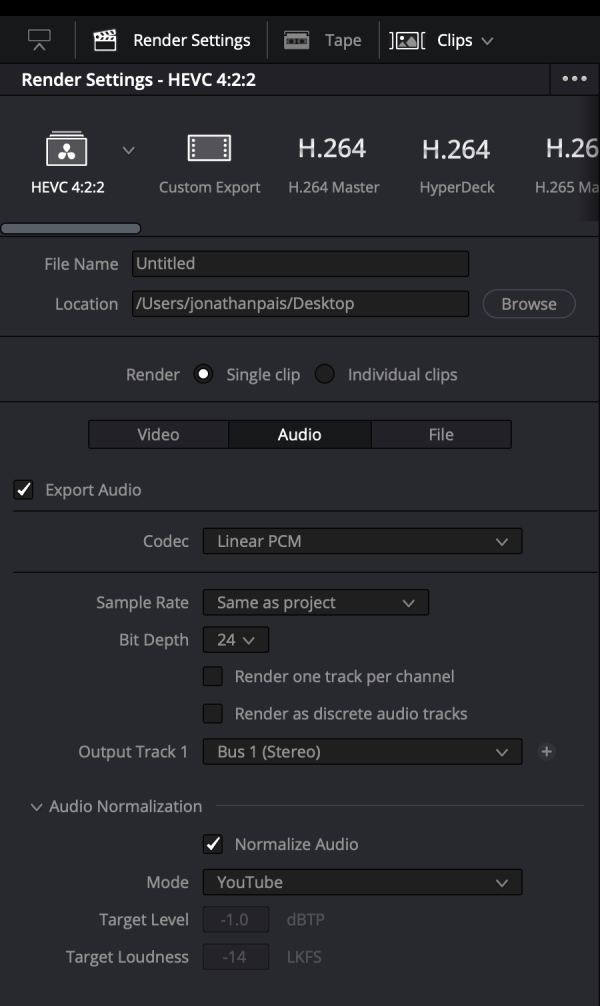
DaVinci Resolve 18.6 adds support for target audio loudness standards by Disney and YouTube with target audio loudness standards on renders: This new feature makes it easy to create renders that comply with specific loudness standards, such as those used for broadcast and streaming. These standards control loudness with a new meter effect, render settings,... Continue Reading →
Samsung Display XCR
The convention in the past 100 years of colorimetry has been to solely measure the response of the achromatic visual pathway when discussing brightness and human visual sensitivity. - Samsung Display “Samsung Display argues that 'perceived brightness' should be used rather than 'luminance' due to how our eyes and brain work. Samsung Display's XCR measurement... Continue Reading →
Variability of Diffuse White Levels in HDR
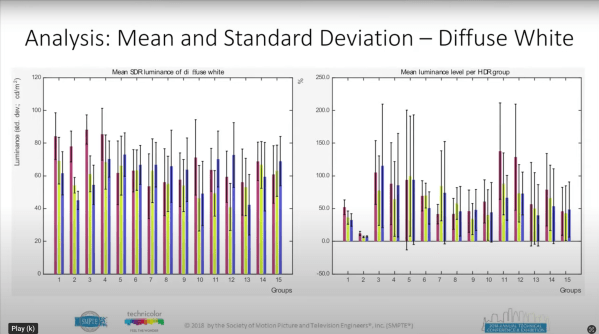
On the left, SDR is very uniform, with mean diffuse white sitting at around 60 nits, while HDR shows high variability. A range of content, from indoor and outdoor sports, stand up comedy, nature programs and talk shows to movies was included. The variability in luminance range is indicative of greater creative freedom in the... Continue Reading →
HDR: Colorist Talks Rubbish
Ever since coming into contact with HDR-loathing Steve Yedlin, Cullen Kelly's discourse on HDR has become more and more detached from reality. "As I just mentioned, the problem is that it's very difficult to get a sense for what color space metric is required for me to deliver HDR to YouTube and what metadata has... Continue Reading →
Contempt
Ed Lachman appears to have nothing but contempt for HDR, so it's unclear why Netflix chose to stream El Conde in Dolby Vision. Just the same, Lachman must be given credit for repudiating the notion that filmmakers had been shooting HDR for over a century without even knowing it. "The technical apparatus of constructing images is being... Continue Reading →
Bad Timing
Not sure when the marketing department over at Blackmagic Design decided to use a Sandisk Extreme Pro to illustrate the ability of their new full frame Cinema Camera to record to external disks, but it seems like unfortunate timing, given that Western Digital is facing multiple class-action lawsuits over its defective portable SSDs.
Brawley BM Cinema Camera Sample Footage Not Playable
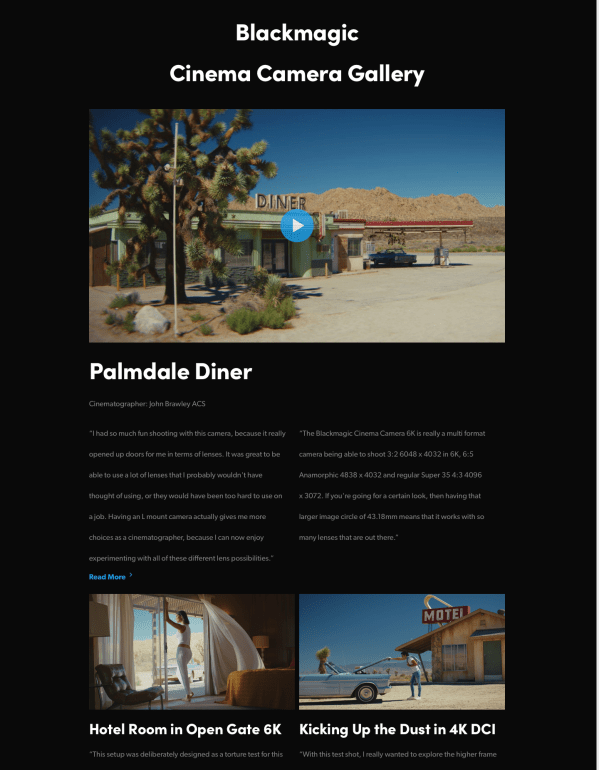
Four of the five graded files we downloaded from John Brawley's Palmdale Diner sample footage are HDR10, but none of them are playable using QuickTime or the IINA player for macOS, because they were mastered in DCI P3 rather than BT2020 (P3-D65 Limited). Picture credit: John Brawley. Girl at Diner in Open Gate 6K When... Continue Reading →
“Since the inception of cinematography, we’ve been recording HDR images with film.” – Bill Bennett, ASC
That may well be, but that doesn't mean we've been creating HDR images (we haven't been) or that we have any idea how to make compelling images in the new format. If filmmakers just shoot like they’ve been doing for over a century and just lift the highlights in post, of course windows, practicals and... Continue Reading →
“We can no more shoot for HDR and SDR simultaneously without serious compromise than we could shoot for 16:9 and protect for 4:3.”
Steven Poster, ASC, President, International Cinematographers Guild IATSE Local 600 Presentation to the ICS at the ASC Clubhouse on 2018-06-07 (excerpt from the presentation, incl. a powerful, incontrovertible statement about the aesthetics of HDR) Little has changed since Steven Poster’s impassioned presentation five years ago. Few are monitoring HDR on set. And at NAB 2023,... Continue Reading →
4:2:0 Indistinguishable From 4:4:4?
Perceptual Effects of HDR Subsampling for Dolby Vision, Blu- Ray and BBC. Georg Schruff, Jan Hoydem, Jan Froehlich. July 2019 A study was conducted to determine the perceptual effect of subsampling in three different HDR standards: Dolby Vision, Blu-Ray and BBC. The results indicated that 4:2:0 subsampled HDR video sequences weren’t distinguishable from 4:4:4 sequences.... Continue Reading →
HDR10 Static Metadata – Again!
We've already shared videos where Dr. Hojatollah Yeganeh, Principal Video Architect at SSIMWAVE Inc., Steven Robertson, software engineer at Google, and Michael Zink, Vice President, Emerging & Creative Technologies at WarnerMedia, have voiced concerns about televisions ignoring static metadata, but we ran across yet another - a presentation given by Tyler Pruitt at SMPTE in 2017... Continue Reading →
Short Takes: The Primary Deliverable Is HDR
From the Color Tour Podcast S4 EP06: Thomas Urbye, Noho, UK, August 7, 2023 Thomas Urbye is the senior colorist and CEO of the Post House ‘The Look’, responsible for shows like Sex Education, Fleabag, Top Boy and Landscapers. They’ve done 20 HDR shows so far, every show they do is HDR, the vast majority being Dolby Vision. “I think what’s interesting... Continue Reading →
Maxine Gervais: I don’t want Dolby to dictate how I work
The other day, Maxine Gervais sat down with Cullen Kelly to discuss her work. My client sees the SDR version first “I’m embracing Dolby, definitely, but in a reverse engineering way; and I think by doing so, it has made my clients embrace HDR way more. And I can give you a hint to my... Continue Reading →
We Overlooked A Crucial Component Of Grading HLG HDR!
While goofing around with specular highlights in HLG, we thought we'd see just how well Phil Holland's philmColor LUTs held up, and as it happens, they're pretty terrific! But it dawned on us that HLG has a boatload less saturation than PQ; so for sure, you'll want to add some in post. But you don't... Continue Reading →
First RED KOMODO 6K HLG HDR Footage & Diffuse White/Specular Highlight Comparison!
“The PQ system was developed by Dolby, a company whose main focus is on the cinema while the HLG system was developed jointly by BBC and NHK, two organizations whose main focus is on television… Television is probably better served by the HLG system that was designed from the ground up by television engineers for... Continue Reading →
Anything Above 100 Nits Is HDR
“The more accurate presentation of specular highlights is one of the key distinctions of HDR.” ITU-R BT.2390-8 Yoeri Geutskens, in a dreadfully misguided article entitled We Need to Talk About HDR, published a few years ago over at FlatpanelsHD in response to Vincent Teoh's scathing critique of The Mandalorian, whose highlights peak at 200 nits,... Continue Reading →
These numbers may surprise you
Many decried SMPTE's revision calling for a 5-nit surround as being too stringent, while Charles Poynton maintained the new standard was too lax. "SMPTE ST 2080-3 calls for a surround luminance of 5 nt (that is, 5% of the 100 nit reference white luminance of ST 2080-1). ST 2080-3's Annex A provides a highly questionable... Continue Reading →
Short Takes: Mark Toia Edits in HDR for SDR Deliverables
“Director and DOP Mark Toia flew to Africa to shoot on the RED cameras a stunning set of visuals that Apple showed during the event. The raw footage is for a documentary Apple wanted to use as a test case for the new FCP pipeline. Toia is a highly successful filmmaker who does vast big... Continue Reading →
Kodak hired more psychologists than chemists
“For a long time, many people have thought, 'Well, film has this S-curve kind of thing, it must be some sort of limitation of the photochemical process'. It isn’t. It was designed into the photochemical process. Eastman Kodak for years actually hired more psychologists than chemists for a period of time. They would go around... Continue Reading →