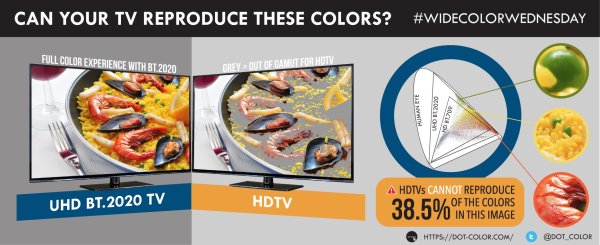
This twitter account has a number of illustrations of colors that can't be reproduced by HDTV (designated in gray). Photo: dot-color.com
Can Your TV Reproduce These Colors?
The number one resource for information about HDR technology, workflows, tutorials, news and opinion.
This twitter account has a number of illustrations of colors that can't be reproduced by HDTV (designated in gray). Photo: dot-color.com
In this excellent seminar, FilmLight's Daniele Siragusano discusses future-proof color management strategies optimized for multi-delivery (SDR and HDR). He's also the first to point out (to the best of our knowledge, anyway), how diffuse white level affects our perception of color. https://vimeo.com/298131298
In A Review of 3D-LUT Performance in 10-Bit and 12-Bit HDR BT.2100 PQ, published in the SMPTE Motion Imaging Journal in March 2020, JD Vandenberg and Stefano Andriani concluded that HDR requires larger LUTs to achieve error-free interpolation comparable to those used for SDR, writing: "Tetrahedral interpolation outperformed all other interpolations for both SDR and HDR... Continue Reading →
One of the biggest issues facing HDR is not so much that flagship TVs by Samsung, Panasonic, LG and Sony aren’t able to display stunning picture quality, but that ordinary people don’t watch movies and TV shows in a room with 5 nits surround luminance, 6500 K bias lighting and walls sitting back 20 feet... Continue Reading →

Just a few highlights from Dolby's webinar Changes to Dolby Vision Licensing New Guidance on Setting the Mastering Display New Recommendations Regarding Full & Video Levels Dolby Vision License In the Legacy Program, components (Trims License, eCMU License and Professional Tools) were bundled together for $2,500 for a period of 12 months. The new program... Continue Reading →
We've written elsewhere that the majority of HDR narrative work has a diffuse white level much lower than that recommended by the ITU and that it's a constantly shifting target. This may frustrate those desperate for hard and fast rules, but this approach has a number of advantages, not the least of which is that... Continue Reading →
“There are filmmakers who I work with whose answer is identical: 'I want the HDR to be identical to the SDR. I want it to have the same dynamic range. I want it to have the same color gamut. I want nothing whatsoever to change. All I want to change is the deliverable itself because... Continue Reading →
Nate McFarlin, currently Senior Content Engineer at Dolby Laboratories, talking about Canon's lineup of production monitors when he was still a Senior Quality Engineer Specialist at Canon USA: "Whenever we announce the next monitor with even higher brightness, there's a whole horde of people that are always extremely excited because now they have so much... Continue Reading →
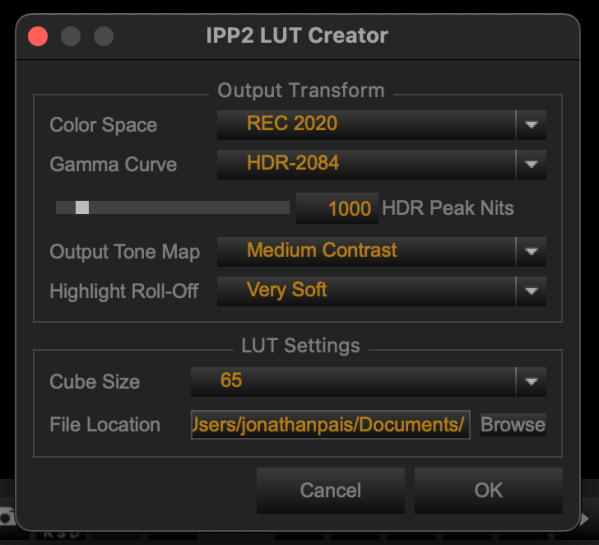
Graeme Nattress was kind enough to answer some questions we had about highlight roll-off in RED's Output Transform LUT. According to the Red.com website, ‘very soft’ highlight roll-off compresses highlights the least, while 'hard' compresses highlights the most. But 'very soft' makes HDR footage resemble SDR and ‘hard’ allows highlights to sparkle. So, what exactly... Continue Reading →
We still can't recommend using a Resolve Color Managed workflow with RED's IPP2 output DRT because it causes lifted blacks that can be seen in the title cards that precede and follow videos made in this manner. This doesn't happen when using RED's output transform LUT in a node-based color managed workflow, which is what... Continue Reading →
One of the most surprising documents we've seen since I began covering HDR was the Technical Specifications for the Delivery of Content to Sky UK. The first of the specs that caught our eye were the minimum camera requirements for scripted HDR content, which stipulate 4:4:4 chroma subsampling, 12-bit color depth and a dynamic range... Continue Reading →

It's been ages since the Dolby YT channel has even talked about HDR, which is as sure a sign as any that there's been a lot of pushback against it in the filmmaking community.
Really liking DaVinci Resolve's Video Collage effect. It might be best to avoid Very Soft and Hard highlight roll off when using RED's output transform LUTs. https://youtu.be/Gmg21dc7_JI

At Display Week 2023, Dr. K. Masaoka demos software that is able to measure 600 patches and plot gamut rings in just sixty seconds. At Display Week 2023, the ever genial Brian Berkeley introduces Dr. Kenichiro Masaoka of NHK, the ‘father’ of BT2020, who demonstrates a new tool that can measure over 600 patches and... Continue Reading →
Cullen Kelly's interested in the texture tools available in BaseLight and HDR4EU thinks you should be, too! “Here's what I would say [about] texture: I feel like I've talked about BaseLight a couple times today. I'll just go ahead and leak to you guys - I am BaseLight curious. I'm a big fan of the... Continue Reading →
Andy Munitz, Professional Audio and PVM-X Series Monitor Sr. Product Manager, Sony, talked with ProductionHUBTV about the PVM 4K HDR monitors during lockdown. “We realized that in the world of monitoring that we're in today - and certainly if production 4K is really prevalent - and so we needed this monitor to be able to... Continue Reading →
With the announcement of the FSI XMP550, a 55” QD OLED with a peak brightness of 2,000 nits which will retail for $19,995 USD, it’s interesting to travel back in time 4 years, when Sony launched their dual layer LCD BVM-HX310, and listen to Bram Desmet, CEO, FSI, share his thoughts on the future of... Continue Reading →

So, we've exposed to the right in order to reduce noise in the image; we've chosen the logarithmic color space of the hero camera as our working color space; and our timeline luminance matches the output color space. How are we to normalize the footage to prepare it for grading? There are a number of... Continue Reading →
The Italian tech website DDay reports: "Antenna's analyst report seems to confirm that Netflix's new policies are working. The number of new users registered to the platform in the USA has in fact skyrocketed, surpassing the peaks reached during the pandemic. Netflix's policy to combat shared subscriptions is working, at least in the US. This... Continue Reading →
 The Daejeon Chronicles