It turns out that Cullen Kelly's a big fan of exposing to the right. Below, screen shots of an image that's been underexposed 2 stops and one that's been exposed to the right by +2 stops. Photo: Cullen Kelly. Underexposed 2 stops Photo: Cullen Kelly. ETTR +2 stops Kelly’s video on ETTR is remarkable for... Continue Reading →
Will the Vision Pro crush all OLED televisions currently on the market?
This could potentially allow viewers for the first time to enjoy HDR content in a virtually perfect environment, free of window light and light bouncing off walls in the room that destroy contrast, preventing us from seeing details in the shadows. Regarding the displays, FlatpanelsHD writes: “DSCC added that for the two micro-OLED displays in... Continue Reading →
Brace yourselves: HDR is coming to the skies, folks.
In an article entitled "4K OLEDs arrive on planes. United will bring 300,000 screens and 67W USB-C to high altitude," Italian tech website DDay.it reports that, "By 2025, United Airlines will install 300,000 4K OLED screens on its aircraft....When Panasonic Avionics introduced Astrova, 4K OLED screens were only available in 13” or 16” cuts. In... Continue Reading →
Apple Vision Pro Screens: 5,000 Nits of Wholesome HDR Goodness
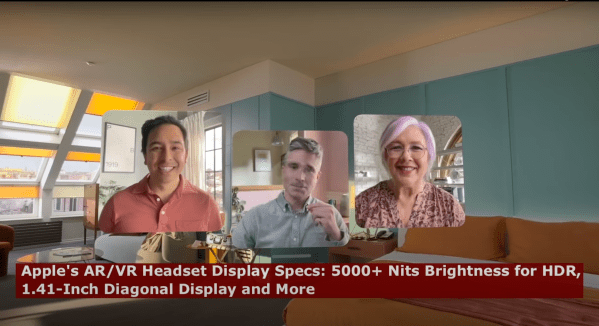
A 100-foot virtual screen with 4K HDR that works with streaming services? Take our money! FlatpanelsHD writes about Apple’s mixed reality headset: “The headset is equipped with two micro-OLED displays that together feature over 23 million pixels. The displays support HDR (High Dynamic Range) and deliver the picture quality you know from OLED TVs. One... Continue Reading →
Dolby Now Leaves DRTs In RCM Up To Colorists’ Discretion
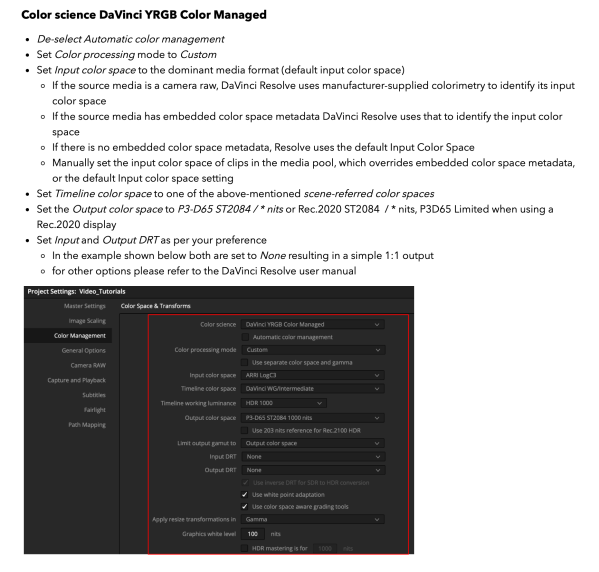
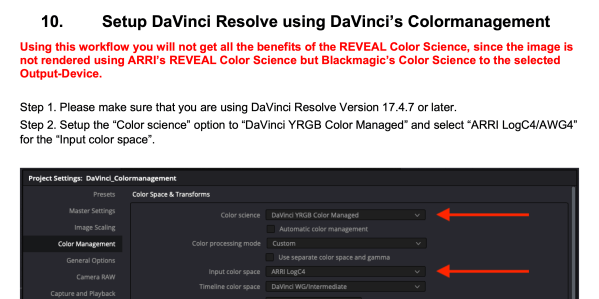
It was around a month ago that we reached out to the super-helpful Nate McFarlin, Sr. Content Engineer at Dolby Laboratories, to ask why it is that Dolby insists upon setting input and output DRTs to NONE in RCM, to which he replied that it was to avoid any of Resolve's color science from being... Continue Reading →
Steve Yedlin: HDR Is Just A Grading Style
Steve Yedlin shares his insights into HDR on the Go Creative Show Steve Yedlin: You know, we already had those problems, we haven't even solved them, but now we're piling more on with all of this HDR stuff, which is, you know, real for the most part, as a format, as a signal format, as opposed... Continue Reading →
ARRI “Impressions” & Signature Lens Showreel 2023 (HDR and SDR Back-To-Back)
Technical note: "The clips were graded in HDR and require the appropriate EOTF to be viewed as intended. For a correct viewing of HDR content on YouTube, we strongly suggest one of the following display devices/ hardware: Apple Pro Display XDR, MacBook Pro with XDR Display, MacBook Air with XDR Displays & iPad Pro with... Continue Reading →
Free KOMODO 6K RAW Sample Footage
Get yourself some RED Komodo OG R3D RAW footage (768.9 MB) to play around with here. Details: Meike 50mm T2.1 s35 Cinema Prime, R3D MQ 6K 17:9, 24 FPS @ ISO 400
It pays to preview your grade on one or more consumer devices
Several months ago, we remarked how our YouTube videos were being 'stretched out' when viewed on an iPhone 12 or later or when watching on a MacBook Pro with XDR display set to reference mode P3-1600 nits. Basically, the image becomes too bright overall. This absolutely destroys the mood of our most recent upload, Ngô... Continue Reading →
Everything we know about timeline color space in one post
We just revised the section on working color spaces in the Monster Guide, so we're sharing it here. When it comes to post-processing, using the fewest number of transforms and working at the highest available bit depth in a native color space greater than the display color space are key to preserving the greatest image... Continue Reading →
“We don’t actually know what the ones and zeros that we’re putting on the drives are actually telling us”
Patrick Inhofer, CEO, Mixing Light, on the perils of grading with today's reference displays: "We're in a situation now where the color volumes we're working at, the nit ranges we're working at, the brightness values we're working at, exceed the ability of any modern display to reproduce. When HDR came out, the specifications were designed... Continue Reading →
Grading with Consumer Displays in Mind
Colorist Eric Weidt recounts how David Fincher would have him tailor the grade in order to align with consumer devices. Eric Weidt: Once, he [David Fincher] came into Los Angeles; he would stop by, because his office is right there... he would stop by, pop in. But really, you know, to him, it always looks amazing on... Continue Reading →
Short Takes: Is 1,000 Nits Enough?
Bram Desmet, CEO, Flanders Scientific, responds, “1,000 nits was enough because it's all we could do. The Dolby Pulsar was really the only display out there that people could really get their hands on that could reliably do over 1,000 nits well. The issue being, you couldn't even buy that, it was basically a lease-only... Continue Reading →
Flanders Scientific XMP550 55″ QD-OLED HDR Mastering Monitor
Flanders Scientific has announced the XMP550 reference mastering monitor featuring a UHD QD OLED panel with a peak brightness of 2,000 nits. The display is equipped with a waveform and vectorscope as well as an adjustable false color mode. The XMP550 also features Auto Calibration: simply plug in any supported probe and the monitor will... Continue Reading →
“HDR is just a standard. HDR doesn’t have any creative implication or aesthetic implication”
"HDR is just a standard. HDR doesn't have any creative implication or aesthetic implication. It's just a standard." Cullen Kelly Kelly used to be one of the most perceptive commentators on HDR, but ever since meeting Steve Yedlin, he's like a completely different person. In his most recent live stream, he says, “The first... Continue Reading →
RED Komodo: ISO & Noise Levels
The following were recorded in R3D Medium Quality with the body cap on the RED Komodo.
If You’re Using DWG, You Must Read This
An astrologer who shoots his content with a Sony mirrorless camera and who follows Cullen Kelly's YouTube channel asked whether it made any difference if he used Resolve Color Management and DaVinci Wide Gamut or a CST (as Cullen demonstrated in his short DaVinci Resolve tutorial) to which we replied: "They should look identical. However,... Continue Reading →
Setting A Speed Limit Should Not Be An Arbitrary Decision
Setting a speed limit shouldn't be an arbitrary decision that's imposed before even looking at the footage. It's critical to understand that as highlights are rolled off, detail, texture and contours are being tossed out and, if carried too far, what remains is no longer HDR, but brighter SDR. Even though the peak luminance of... Continue Reading →
The Alexa 35: ARRI’s Most Digital-Looking Camera
The Alexa 35 is arguably ARRI's most coveted camera to date, but it also the produces the most digital-looking footage of any camera the venerable German manufacturer has yet released. Noise The noise of Alexa cameras is said to have been modeled on scans of actual film grain, resulting in a more pleasing, organic looking... Continue Reading →
Erik Messerschmidt: Why HDR Production Monitors Matter
I didn't find that I was that worried about the toe in general. I was always looking at the highlights, particularly in contrasty situations, so the way that we had the the LUTs built, especially in the black and white version, was when the monitor clipped, the waveform clipped, and the sensor, the camera, told... Continue Reading →