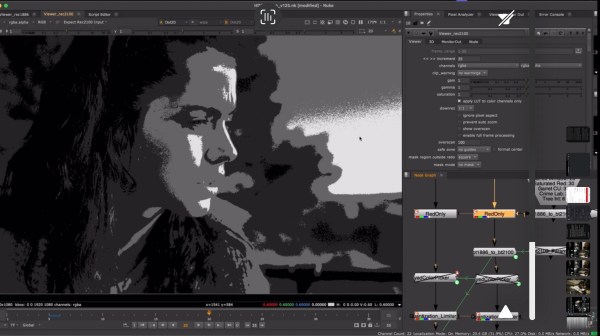
Alfonso Parra’s analysis of the Sony FX3 concluded that: “[…] for optimal noise management, controlling white balance—especially in scenes dominated by critical channels such as blue or red—is more important than the choice of base EI value.” The finding indicates that white balance isn’t only affecting color; it’s also changing the noise structure of the... Continue Reading →
The Limitation Dogma
"The inherent process of printing an image... you are destroying dynamic range. That's the job... This is actually part of what makes images work... I actually want these things to clump together into the bottom, the middle, and the top." — Cullen Kelly Cullen Kelly recently gave a masterclass on the necessity of contrast and... Continue Reading →
A Case Study in Intellectual Surrender
BEFORE: “The move to HDR is as significant as any shift in the history of motion imaging… It represents a fundamental improvement to the way we approach and talk about image mastering, one that better reflects the native language of light and photography.” — Cullen Kelly, pre-Yedlin AFTER: “HDR is just a standard. HDR doesn’t... Continue Reading →
The BT.1886 Fallacy
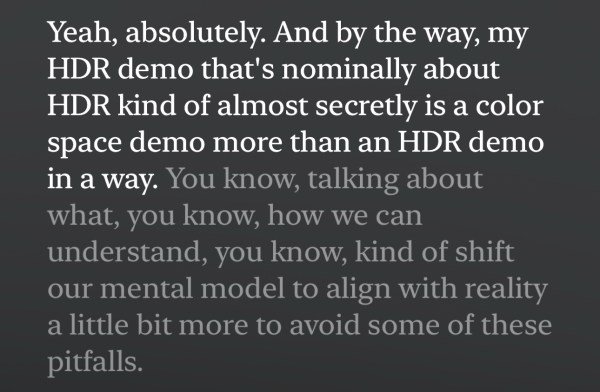
“My HDR demo that's nominally about HDR kind of almost secretly is a color space demo more than an HDR demo in a way.” Steve Yedlin, Team Deakins Podcast This statement is the key to understanding the critical error at the root of all HDR misinformation. The Breakdown 1. The Root Fallacy: BT.1886 is a... Continue Reading →
The SDR-First Workflow Crime
Nearly all misconceptions about high dynamic range (HDR) video stem from SDR misconceptions, chief among them being that BT.1886 is a color space. From this fallacy, an entire ecosystem of bad practices takes root. If you believe BT.1886 is a color space, you’ve got no framework to understand PQ or HLG. You’ll design invalid tests... Continue Reading →
Yedlin: HLG “Inefficient”
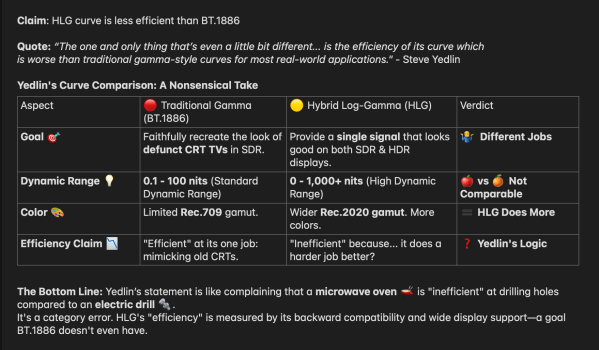
Let’s talk about efficiency. Steve Yedlin, ASC, claims the HLG curve is “less efficient” than traditional gamma (BT.1886). This comparison demonstrates why that claim is a category error. Yedlin compares apples to oranges. They’re designed for entirely different purposes. Efficiency depends on the goal: HLG’s goal—delivering a future-proof, backward-compatible HDR signal—is something BT.1886 was never... Continue Reading →
BT.1886 Color Space Conflation
The Standard: ITU-R BT.1886 defines only a reference Electro-Optical Transfer Function (EOTF). No white point. No color primaries. The Claim: Despite this, color scientist Charles Poynton states: "BT.1886 already has primaries, D65, and [an] EOTF," making it a full "DISPLAY colorspace." Charles Poynton, PhD | LinkedIn comment The definition: As defined by ISO 22028-1, a... Continue Reading →
The Cult of Personality
We’ve just added a new entry to the misinformation “dossier”. It demanded a new category of its own: “The Cult of Personality”. The gaslighting, the mangling of tech specs, the refusal to consult the standards documents, and the scapegoating of manufacturers were all bad enough; but the monetization just might be the worst! Category 8:... Continue Reading →
Steve Yedlin’s 8-Bit PQ Deception
“So, everything right now is 10-bit or higher going to the monitors. And both of these look totally smooth. But what I’m gonna do now is, I’m gonna chunk it to 8-bit. And you see how bad that is? That’s the HDR… I mean, it’s actually terrible. We’ve lost the illusion of a smooth gradient... Continue Reading →
🚨 COLOR SCIENCE FACT CHECK: YEDLIN vs REALITY 🚨
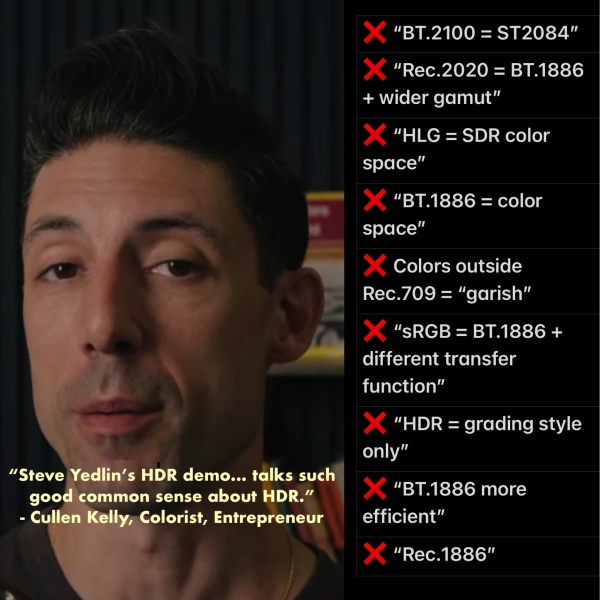
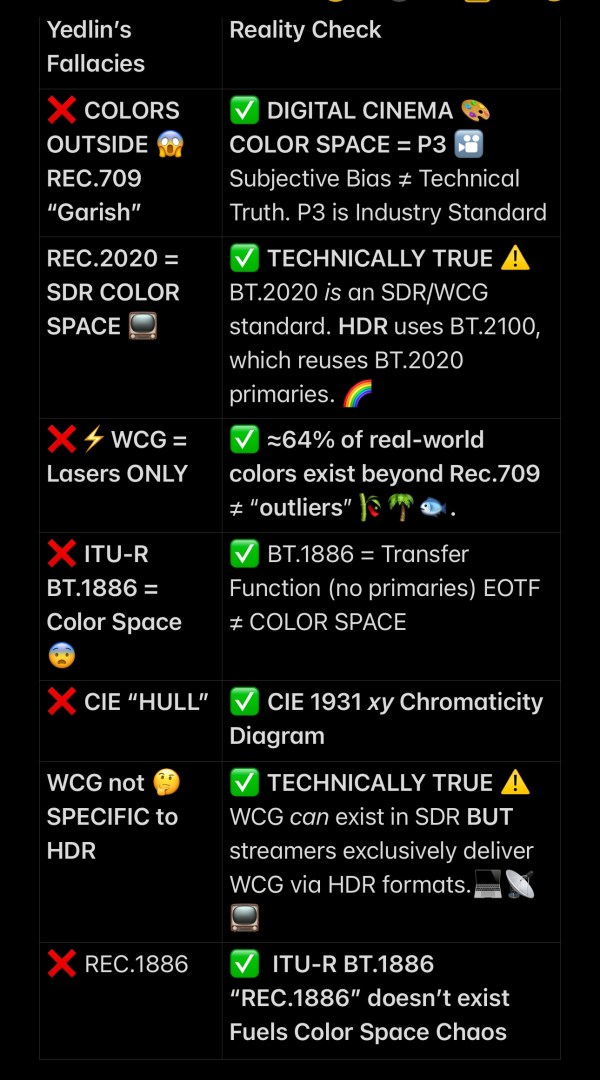
When a famous DP spreads technical myths, we fact-check the claims! Here's the verdict on 7 key arguments from Steve Yedlin's controversial color science presentation: ❌ YEDLIN'S CLAIM:"Colors outside Rec.709 = GARISH"✅ REALITY CHECK:Digital cinema = P3 🎬Subjective bias ≠ technical truth YEDLIN'S CLAIM:"Rec.2020 = SDR color space"✅ TECHNICALLY TRUE ⚠️ BT.2020 is an SDR/WCG... Continue Reading →
Debunking the Debunker: Steve Yedlin’s Color Science Contradictions Exposed
Exposing Steve Yedlin's Contradictions on Color: P3 Workflows vs. Rec.2020 Misrepresentations Steve Yedlin’s "Debunking HDR" presentation misrepresents color science through factual inaccuracies, contradictory statements, and deceptive framing—particularly by attacking Rec.2020 while ignoring industry standard P3-D65. This analysis corrects his errors while emphasizing that creative flexibility—not dogma—should guide color workflows. I. Misrepresenting Color Gamuts &... Continue Reading →
A Diagram Even A 5th Grader Can Understand
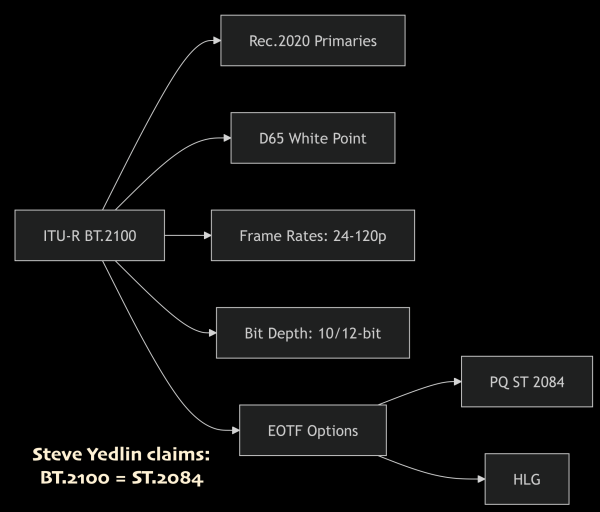
In his long-winded, error-filled rant “Debunking HDR,” disgraced cinematographer Steve Yedlin claims that ITU-R BT.2100 = SMPTE ST2084. That is categorically false: SMPTE ST2084 (PQ) is an EOTF. BT.2100 is the ITU-R standard for UHDTV (HDR/WCG) defining--among other things--Rec.2020 primaries, white point and EOTF options (PQ/HLG). In spite of its dangerous inaccuracies, Yedlin’s presentation has... Continue Reading →
Color Science Gaslighting Bingo
Teaching color science? Arm students with these gaslighting bingo cards. When someone:❌ Conflates EOTFs & color spaces❌ Claims "Rec.2100 = ST 2084"❌ Says "HDR is just brightness!"→ MARK YOUR CARD → OPEN THE SPECS → DEFEND THE CRAFT. 🎯 TOOL TIP: Use the generator to CUSTOMIZE cards for your class!→ Add local jargon (e.g., "¡El... Continue Reading →
Steve Yedlin’s PQ ST2084 Fallacies – Shareable Table
Yedlin’s PQ Myths vs. BT.2390 Reality 💥 Next time someone asserts PQ is logarithmic🧨 Says BT.1886 is more efficient🤯 Claims ST2084 = BT.2100 Show them ITU-R BT.2390 🧐 Full analysis + ITU receipts 📲 Shareable phone-sized table 🎤 PQ discussion begins at ~1:07:00 in Yedlin’s “Debunking HDR” presentation
Claim-Reality Analysis of Steve Yedlin’s Arguments Against PQ (ST2084) Using ITU-R BT.2390
Let’s cut through the noise: Steve Yedlin’s critique of PQ ST.2084 misrepresents its design, testing it in ways it was never meant to be used. Using the ITU’s own playbook (BT.2390), we’ll separate his claims from reality—exposing critical errors that invert the truth about HDR efficiency. Yedlin's Claim on PQ Efficiency Yedlin asserts: "HDR needs... Continue Reading →
Debunking the Myth: HDR Not Responsible for Flat Picture
YouTuber Claim: “The modern obsession with high dynamic range is why we rarely get shots that look this cool anymore.” ❌ (Source: X) Quote: “There is an element to digital cameras that I think is contributing to the grey, sludgy aesthetic and it’s these three little words: High Dynamic Range.” - Patrick Tomasso Reality Check:... Continue Reading →
Dismantling Yedlin’s “No HLG Path” Claim
Fact Check: Yedlin’s HLG Claims vs. Industry Reality While we aren’t taking a position on HLG’s suitability for narrative streaming, we cannot remain silent in the face of persistent industry-wide inaccuracies. We clarify some of these points below. REAL-WORLD ADOPTION CLAIM “There’s no real-world in-use path for images to be encoded in HLG at... Continue Reading →
Lens & Scene: The True Engines of Dynamic Range
The Limits of Dynamic Range: Why Real Scenes Beat Test Charts High dynamic range (HDR) capture is often reduced to a sensor spec. Standard test charts claim to measure DR but fail to assess real-world performance. True dynamic range hinges on two factors charts ignore: how light is arranged in the scene and the lens... Continue Reading →
HDR, Film & Workflow Consistency Myths
During a Team Deakins podcast discussion about HDR, Steve Yedlin characterized established, mainstream HDR color spaces like P3-D65 as undocumented, unstable "hybrid" systems that entail substantial risk, citing an unverified anecdote about oversaturated deliverables. “A lot of times the deliverables are done in sort of hybrid color spaces where they're not using one of the... Continue Reading →
MaxCLL ≠ HDR Quality: Spatial Contrast FTW
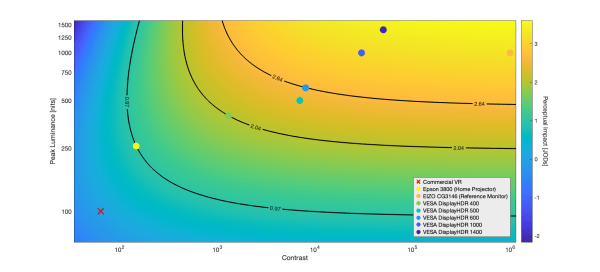
There's a perception going around that higher MaxCLL statistics indicate 'better' HDR. Many confuse the purpose [1] of MaxCLL and MaxFALL metadata—which is to inform display tone mapping—with actual HDR quality. HDR's superiority lies in preserving spatial contrast relationships, not in chasing extreme luminance levels. This conflation of display capability (e.g., the 10,000-nit reference) with... Continue Reading →