One of the most surprising documents we've seen since I began covering HDR was the Technical Specifications for the Delivery of Content to Sky UK. The first of the specs that caught our eye were the minimum camera requirements for scripted HDR content, which stipulate 4:4:4 chroma subsampling, 12-bit color depth and a dynamic range... Continue Reading →
Dolby’s stopped promoting HDR

It's been ages since the Dolby YT channel has even talked about HDR, which is as sure a sign as any that there's been a lot of pushback against it in the filmmaking community.
New Tool Plots Gamut Rings In Just 60 Seconds
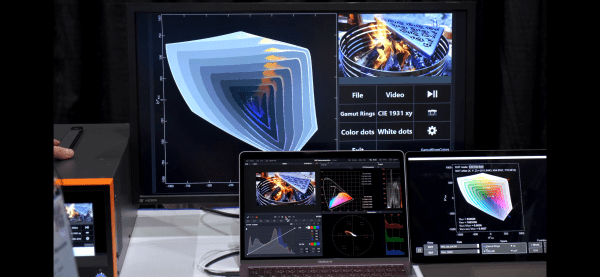
At Display Week 2023, Dr. K. Masaoka demos software that is able to measure 600 patches and plot gamut rings in just sixty seconds. At Display Week 2023, the ever genial Brian Berkeley introduces Dr. Kenichiro Masaoka of NHK, the ‘father’ of BT2020, who demonstrates a new tool that can measure over 600 patches and... Continue Reading →
Cullen Kelly is BaseLight Curious
Cullen Kelly's interested in the texture tools available in BaseLight and HDR4EU thinks you should be, too! “Here's what I would say [about] texture: I feel like I've talked about BaseLight a couple times today. I'll just go ahead and leak to you guys - I am BaseLight curious. I'm a big fan of the... Continue Reading →
Sony Product Mgr: “There are many kinds of scenes that could benefit from 1,000 nits full screen.” 😳
Andy Munitz, Professional Audio and PVM-X Series Monitor Sr. Product Manager, Sony, talked with ProductionHUBTV about the PVM 4K HDR monitors during lockdown. “We realized that in the world of monitoring that we're in today - and certainly if production 4K is really prevalent - and so we needed this monitor to be able to... Continue Reading →
“Top emission RGB OLED is not going to be around a year from now.” 😳
With the announcement of the FSI XMP550, a 55” QD OLED with a peak brightness of 2,000 nits which will retail for $19,995 USD, it’s interesting to travel back in time 4 years, when Sony launched their dual layer LCD BVM-HX310, and listen to Bram Desmet, CEO, FSI, share his thoughts on the future of... Continue Reading →
Making Curves for ETTR Footage

So, we've exposed to the right in order to reduce noise in the image; we've chosen the logarithmic color space of the hero camera as our working color space; and our timeline luminance matches the output color space. How are we to normalize the footage to prepare it for grading? There are a number of... Continue Reading →
RCM: We Tested Some DRTs. Here’s What We Learned

In order to learn how DRTs affect the image, an R3D clip was processed three different ways in DaVinci Resolve Color Management: (1) with input and output DRTs set to DaVinci; (2) with input and output DRTs set to NONE; (3) with output DRT set to RED IPP2 with medium contrast and very soft highlight... Continue Reading →
Will the Vision Pro crush all OLED televisions currently on the market?
This could potentially allow viewers for the first time to enjoy HDR content in a virtually perfect environment, free of window light and light bouncing off walls in the room that destroy contrast, preventing us from seeing details in the shadows. Regarding the displays, FlatpanelsHD writes: “DSCC added that for the two micro-OLED displays in... Continue Reading →
Apple Vision Pro Screens: 5,000 Nits of Wholesome HDR Goodness
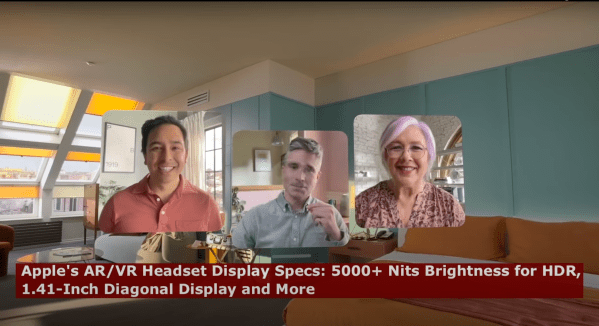
A 100-foot virtual screen with 4K HDR that works with streaming services? Take our money! FlatpanelsHD writes about Apple’s mixed reality headset: “The headset is equipped with two micro-OLED displays that together feature over 23 million pixels. The displays support HDR (High Dynamic Range) and deliver the picture quality you know from OLED TVs. One... Continue Reading →
Dolby Now Leaves DRTs In RCM Up To Colorists’ Discretion
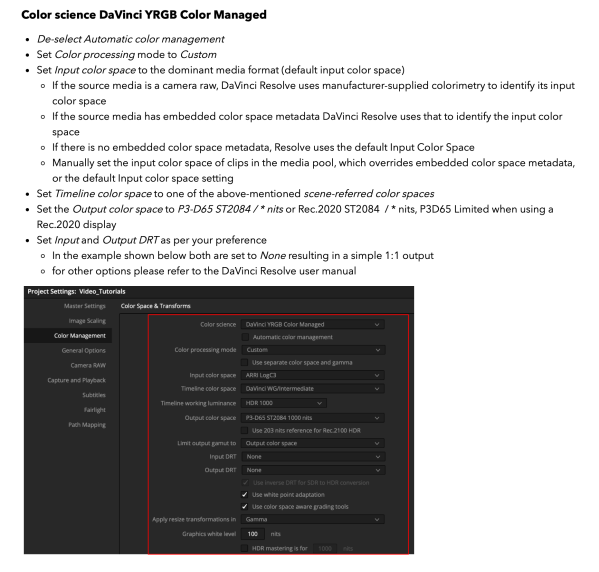
It was around a month ago that we reached out to the super-helpful Nate McFarlin, Sr. Content Engineer at Dolby Laboratories, to ask why it is that Dolby insists upon setting input and output DRTs to NONE in RCM, to which he replied that it was to avoid any of Resolve's color science from being... Continue Reading →
Steve Yedlin: HDR Is Just A Grading Style
Steve Yedlin shares his insights into HDR on the Go Creative Show Steve Yedlin: You know, we already had those problems, we haven't even solved them, but now we're piling more on with all of this HDR stuff, which is, you know, real for the most part, as a format, as a signal format, as opposed... Continue Reading →
It pays to preview your grade on one or more consumer devices
Several months ago, we remarked how our YouTube videos were being 'stretched out' when viewed on an iPhone 12 or later or when watching on a MacBook Pro with XDR display set to reference mode P3-1600 nits. Basically, the image becomes too bright overall. This absolutely destroys the mood of our most recent upload, Ngô... Continue Reading →
Everything we know about timeline color space in one post
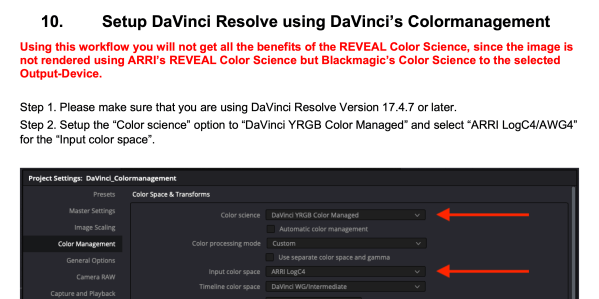
We just revised the section on working color spaces in the Monster Guide, so we're sharing it here. When it comes to post-processing, using the fewest number of transforms and working at the highest available bit depth in a native color space greater than the display color space are key to preserving the greatest image... Continue Reading →
Grading with Consumer Displays in Mind
Colorist Eric Weidt recounts how David Fincher would have him tailor the grade in order to align with consumer devices. Eric Weidt: Once, he [David Fincher] came into Los Angeles; he would stop by, because his office is right there... he would stop by, pop in. But really, you know, to him, it always looks amazing on... Continue Reading →
Short Takes: Is 1,000 Nits Enough?
Bram Desmet, CEO, Flanders Scientific, responds, “1,000 nits was enough because it's all we could do. The Dolby Pulsar was really the only display out there that people could really get their hands on that could reliably do over 1,000 nits well. The issue being, you couldn't even buy that, it was basically a lease-only... Continue Reading →
“HDR is just a standard. HDR doesn’t have any creative implication or aesthetic implication”
"HDR is just a standard. HDR doesn't have any creative implication or aesthetic implication. It's just a standard." Cullen Kelly Kelly used to be one of the most perceptive commentators on HDR, but ever since meeting Steve Yedlin, he's like a completely different person. In his most recent live stream, he says, “The first... Continue Reading →
Setting A Speed Limit Should Not Be An Arbitrary Decision
Setting a speed limit shouldn't be an arbitrary decision that's imposed before even looking at the footage. It's critical to understand that as highlights are rolled off, detail, texture and contours are being tossed out and, if carried too far, what remains is no longer HDR, but brighter SDR. Even though the peak luminance of... Continue Reading →
Erik Messerschmidt: Why HDR Production Monitors Matter
I didn't find that I was that worried about the toe in general. I was always looking at the highlights, particularly in contrasty situations, so the way that we had the the LUTs built, especially in the black and white version, was when the monitor clipped, the waveform clipped, and the sensor, the camera, told... Continue Reading →
 The Daejeon Chronicles