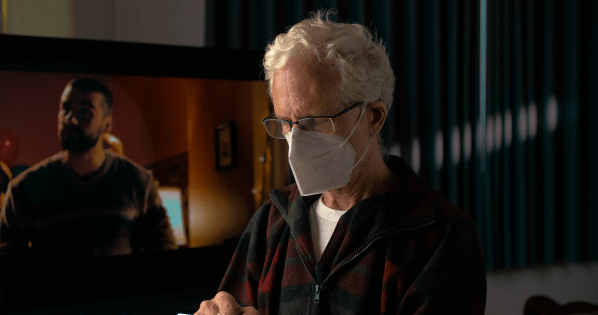
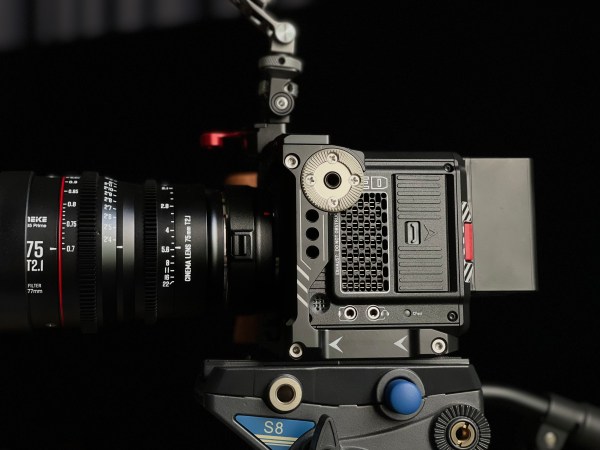
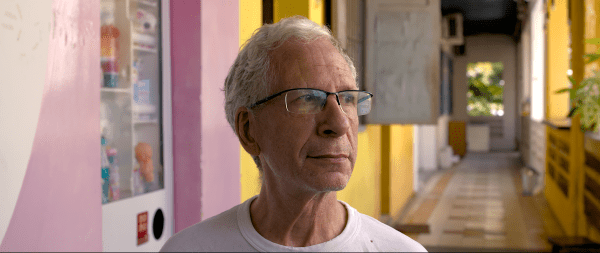
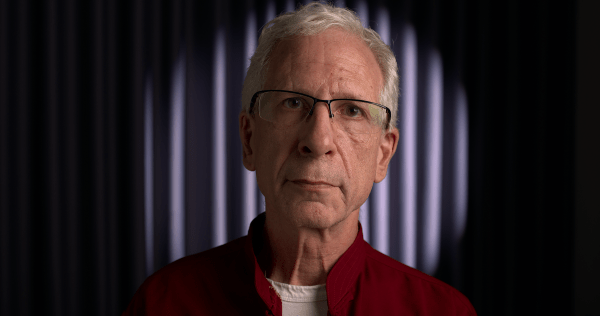
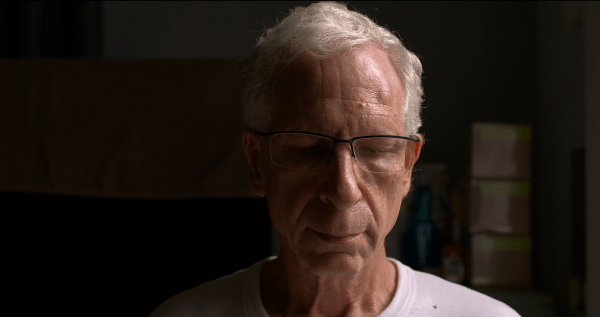
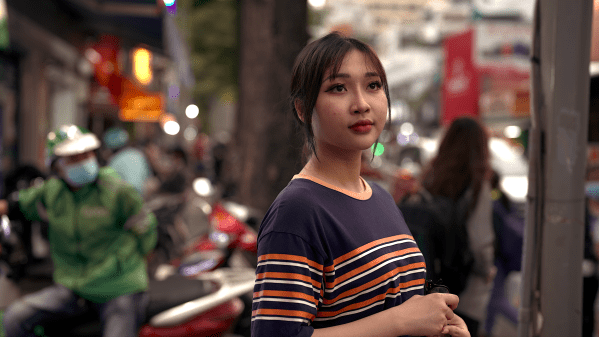
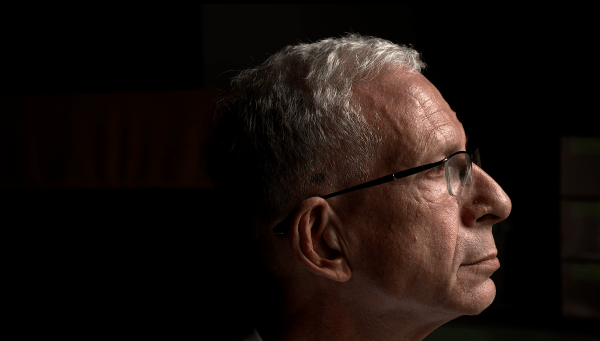
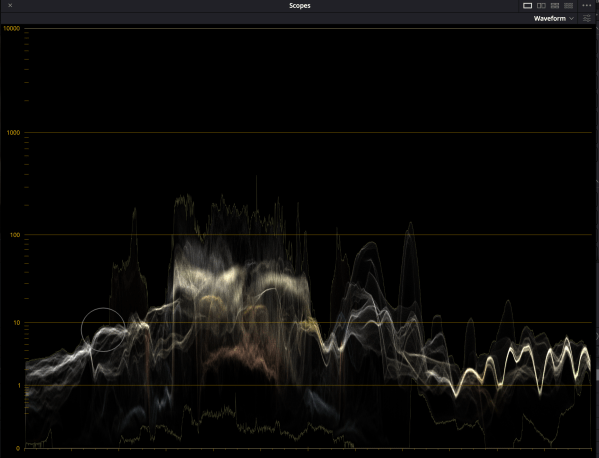
Because of its higher contrast, noise is much more visible in HDR - a fact ignored by camera reviewers - and what may be acceptable in SDR might very well turn out to be unsatisfactory when mastering in PQ ST 2084. CVP shoots their B-roll with the Komodo set to ISO 250 for the cleanest... Continue Reading →
More Komodo Footage
https://youtu.be/XjzeBIt9gLo The video is best watched on an OLED TV. It was shot at 6K 2.4:1, 50 FPS in R3D LQ. RED raw files are a joy to grade, the color and texture of the image are like nothing we've ever experienced. The Canon 35mm macro is a crispy little bugger with pleasant enough rendition... Continue Reading →
RED Komodo First Sample Footage! (re-upload)
The footage was massively overexposed and white balance was off by several thousand degrees Kelvin. Still figuring things out... hehe https://youtu.be/eM9j2VxjBpk
Our First RAW Gimbal Shots
This is our very first video shot on a gimbal with ProRes RAW. To mount the Ninja V on the DJI RS 2, we used a SmallRig monitor mount. With the Sony 50mm f/1.2 GM, it's a fairly hefty combo. Graded in Final Cut Pro. https://youtu.be/AOOrn2IwHWk
P3D65 ST.2084 (HDR) Monitoring for LG OLEDs (WRGB)
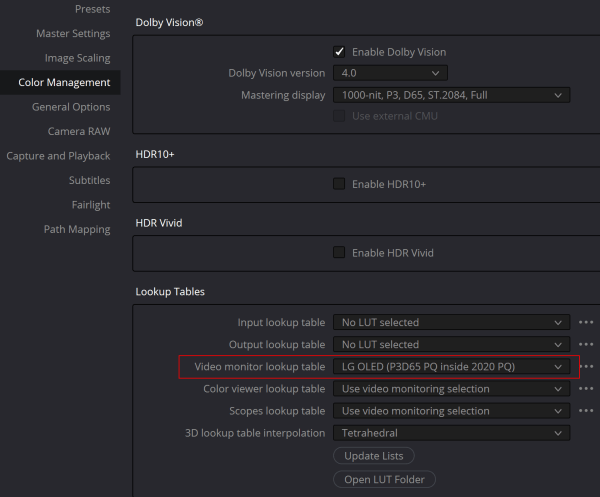
In the past, we've written about LG's hidden menu that allows users to change the working color space, but frustratingly, the P3-D65 option is cosmetic only. The following is word-for-word from Ted Aspiotis' post over at Lift Gamma Gain, where he explains how to set up your LG TV for P3-D65: LG WRGB OLEDs work... Continue Reading →
RED Komodo Post Workflow Added to Monster Guide
The past couple of months have seen extensive updates to our Monster Guide and we're proud to say we've achieved our goal of making the most comprehensive and up-to-date manual covering the HDR10 workflow anywhere on the Web. And today it just got even better with the addition of the RED KOMODO post workflow. REDCODE... Continue Reading →
HEVC High Bitrate vs. ProRes 4444 XQ (HDR)
In this test, we compare HEVC bitrate 39,000 kbps (which ended up being 22.6 Mb/s), HEVC bitrate 80,000 kbps (which turned out to be 46.3Mb/s overall bitrate ) and ProRes 4444 XQ. To compare the clips yourself, open up the videos in three different tabs of your browser. As of today, we officially bid farewell... Continue Reading →
HEVC 10-bit 4:2:2 vs. ProRes 4444 XQ to YT
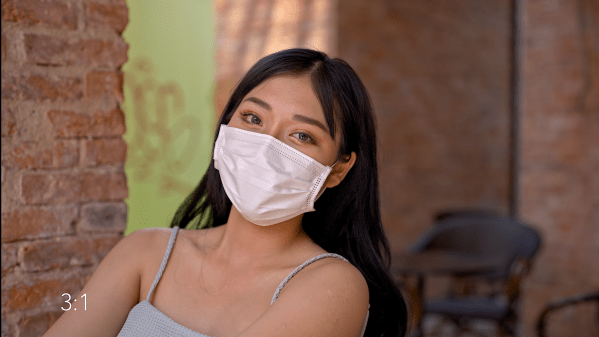
If you don't mind the ginormous file sizes and waiting longer for YouTube to finish uploading and processing your video, ProRes 4444 XQ does offer benefits over HEVC 10-bit 4:2:2 (using the standard bitrate for web publishing in Apple Compressor): more detail and improved contrast as well as richer color. In the sample clip, there... Continue Reading →
Create Textural Depth with Depth Map
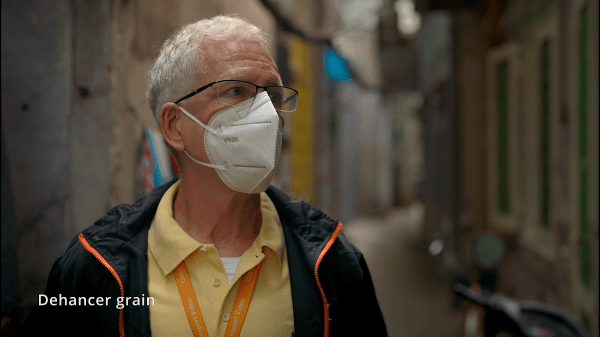
Grain is one of the key components of the film look but few things are more distracting than seeing clumps of film grain dancing around on the talent's face. One solution is to use the HSL qualifier to isolate skin tones and use the keyer to de-emphasize the grain. An even easier way is to... Continue Reading →
The Ultimate Comparison: ProRes 4444 XQ vs. HEVC 4:2:2 vs. HEVC 4:2:0 (HDR)
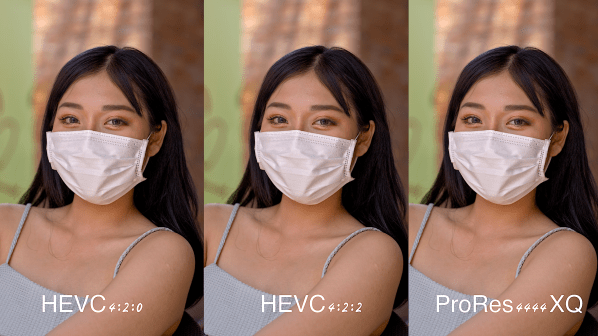
In this short clip, we're primarily interested in how Y'CbCr chroma subsampling affects skin tones in HDR video. Y'CbCr results in hue shifts and luminance errors. From our own testing, it appears to make skin tones yellowish-green, darker and oversaturated. HEVC Main 4:2:2 10 is preferable to HEVC 4:2:0. Download the comparison here. If you... Continue Reading →
Thoughts on Nikolaj Pognerebko’s RAW Convertor (Revised!)
https://youtu.be/if7IzD9tl4w Not a few of us have dreamed of being able to work with native ProRes RAW files in DaVinci Resolve, but realistically, it appears as though that’s not on the horizon. We'd been transcoding to ProRes 4444 with variable success for a while when it was announced last year that a Czech filmmaker by... Continue Reading →
Create Textural Depth II
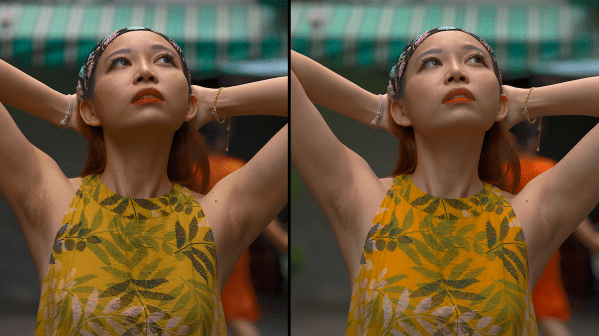
The viewer’s eye can be drawn to the subject in a number of ways. Two of the techniques employed here are color separation, achieved through split-toning, and obscuring the surroundings using a mask and reducing brightness. Another approach is to create textural depth by accentuating the texture in cooler, darker backgrounds while de-emphasizing grain in... Continue Reading →
Projector Central Weighs in on 4:2:0
Over at Projector Central, Michael J. McNamara, former Executive Technology Editor of Popular Photography magazine and a renowned expert on digital capture, storage, and display technologies writes: “Does using 4:2:0 subsampling significantly degrade image quality for movie viewing versus using 4:2:2? Not according to most viewers who've enjoyed any number of 4K UHD SDR and... Continue Reading →
Create Textural Depth!
During an appearance on Cullen Kelly’s Grade School, the brilliant colorist Jill Bogdanowicz revealed a secret to accenting texture without it looking over-processed. While working on Joker, the colorist used Live Grain - which separates out the red, green and blue channels, creating grain that resembles scanned film - to accentuate texture in the cooler,... Continue Reading →
Not A Grade Reveal!
A few caveats: first, the original footage was green and overexposed; secondly, we didn't use the recommended DaVinci Wide Gamut; and lastly, as we do all of our grading before the LUT, the original footage looked nuts when we removed the LUT for the grade reveal, so we normalized it for the video. https://youtu.be/3Bv3RUGbwEc
Massive LUTs Required for HDR
According to at least one study, in order to achieve a comparably error-free 3D-LUT to those used for SDR, a LUT size larger than 55x55x55 is required for 12-bit HDR (Rec.2020 ST2084). "In 10-bit SDR, in order to achieve unnoticeable interpolation errors using the trilinear interpolation method, a 3D-LUT larger than 41×41×41 is necessary. However,... Continue Reading →
DaVinci Resolve Update Fixes HDR Controls Bug
DaVinci Resolve firmware update 17.4.6 addresses an issue that caused the app to crash when using some of the HDR controls with Apple Silicon. Prior to the update, clicking on any of the range indicators in the HDR palette - the small icon to the upper left of each of the HDR wheels that allows... Continue Reading →
Generate MaxCLL and MaxFALL HDR10 Metadata in DaVinci Resolve
As consumer HDR displays have differing peak luminance and contrast capabilities that are not infrequently less than the mastering display, it's necessary to map PQ content to match the capabilities of the target consumer display device. This scaling or mapping is controlled and managed by metadata. According to YouTube's help page, "HDR videos must have... Continue Reading →
ICtCp, or Why We Can’t Have Nice Things
Here at the Daejeon Chronicles, we've tirelessly championed RAW for a long time now, for a multitude of reasons: it responds better to grading than heavily compressed, low bit rate chroma subsampled codecs and is less prone to banding; sharpening, noise reduction and white balance aren't baked into RAW files, giving more flexibility in post;... Continue Reading →