Viewer Comment | Digital Foundry Channel In a recent Digital Foundry episode, during a discussion of a Wccftech article profiling graphics programmer Filippo Tarpini, host Oliver Mackenzie made a staggering number of questionable, misleading, or inaccurate statements. We correct the record. “High brightness displays can display HDR and SDR signals.” False. Only HDR displays can properly... Continue Reading →
The Top-Down Approach
Step #1 in HDR grading is defining the project’s ‘speed limit’ and highlight roll-off. Highlights dictate perceptual hierarchy. Shadows are subordinate. SDR-centric grading cripples HDR’s DNA. Start at the top. 1. What does setting a speed limit mean? Setting a speed limit means defining your target peak brightness (in nits) and highlight roll-off philosophy early... Continue Reading →
Highlights Aren’t Islands
Sony European Imaging Ambassador Alister Chapman uses his platform to promote categorically false claims about HDR: “It's only when you have specular highlights and direct light sources in the scene that are brighter than diffuse white that any differences start to become apparent. The entire image doesn't change, only these highlights do…” - Alister Chapman,... Continue Reading →
The HDR Misinformation Field Guide
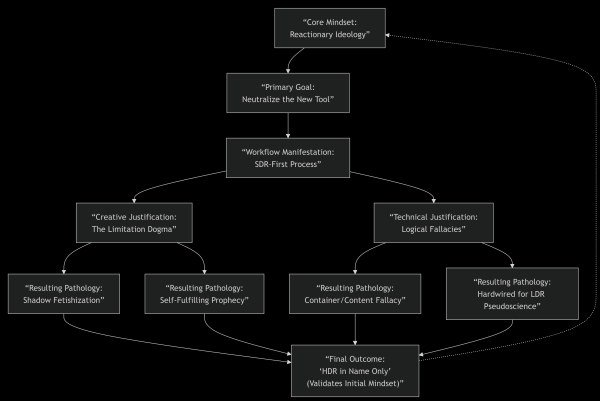
The flowchart above maps the self-reinforcing system of reactionary HDR pathologies. The following sections define and dismantle each weapon in this arsenal. The Reactionary Mindset A reactionary position isn’t simply about preferring old tools: it’s about idealizing the past, viewing change as a detriment and moralizing technology. Direct Quote: “…the things that are actually different... Continue Reading →
The Foundation of Sky’s Technical Specification (Or Why 100 Nits Is Not HDR)
“The only line that can be drawn objectively is SDR’s 100 nits. Anything above that in principle is HDR.” Yoeri Geutskens, “We Need to Talk About HDR”. FlatpanelsHD (Oct. 2020) “It is perfectly acceptable to deliver scenes or projects at 100 nits or less in an HDR delivery.” Kevin Shaw, CSI, LinkedIn comment (Nov. 2025)... Continue Reading →
Sky’s Got A Clause For That
Sky UK's Technical Specification for Delivery of Content represents a rigorous, policy-driven approach to HDR that directly addresses the epidemic of “HDR in name only." The specification is unique in tying technical delivery requirements to creative intent and perceptual impact—a bond other streamers’ specs omit. A strict policy on paper doesn’t guarantee perfect compliance in... Continue Reading →
Sony Ambassador Alister Chapman’s HDR Claims Debunked, Part II
Sony European Imaging Ambassador Alister Chapman uses his platform to promote categorically false claims about HDR. We break them down using the international standards, colorist testimonials, research data, and studio policies. Industry standards, studios and professionals reject the simplistic “HDR = Brighter + More Colorful” claim. The “Brighter, More Colorful” Fallacy QUOTE: “When the first... Continue Reading →
Sony Ambassador Alister Chapman’s HDR Claims Debunked, Part I
Sony European Imaging Ambassador Alister Chapman uses his platform to promote categorically false claims about HDR. We dismantle them one-by-one using the standards themselves. The Data Efficiency Argument QUOTE: “PQ is very wasteful of data as it's designed around theoretical 10,000 Nit displays whereas BT1886 is designed for displays that actually exist.” — Alister Chapman... Continue Reading →
DaVinci Resolve Certified Trainer Spreads Disinformation
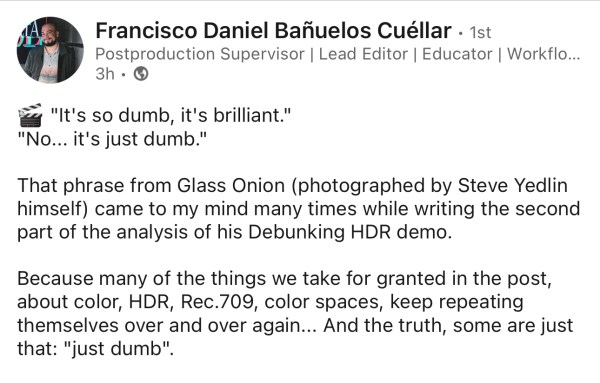
In an article unironically titled Don't repeat these mistakes about color spaces and HDR: insights from the demo "Debunking HDR" by Steve Yedlin (Part 2),” Daniel Bañuelos Cuéllar, a lead editor and post-production supervisor who specializes in HDR workflows and color management, shared some takeaways after watching Yedlin’s presentation. We unpack just a few of... Continue Reading →
Kelly’s “Creative Potential” of HDR: Diagnosis of a Broken Pipeline
"As we've already emphasized this evening, even delineating HDR and SDR is a bit of a false dichotomy… I like to… start with a standard dynamic range rendering [1] of an image within an HDR container and then to slowly lift the veil… and allow my client to say 'Oh! I like that,' or… 'Wow!... Continue Reading →
Conflating Specs & Why Reductionism Is So Seductive
“Display P3 is the color space that Apple computer monitors use. The monitor itself is Display P3, but very often it’s receiving Rec.1886 and just converting it to P3. Rec.2020 is exactly the same as Rec.1886, but with a wider color gamut. sRGB is also exactly the same as Rec.1886, but with a slightly different... Continue Reading →
Kevin Shaw To Filmmakers: “You Don’t Have to Go Above 100 Nits”
Kevin Shaw, CSI protests: “I have never endorsed shooting SDR and delivering HDR,” yet his own public statements show him advocating for SDR aesthetics in an HDR container. The Denial “I am a huge fan of HDR and my belief is and aways has been that good HDR content requires that it is planned shot... Continue Reading →
What If We Were To Accept Yedlin’s Framing?
While our previous analyses rejected Yedlin’s non-standard terminology, we’ll now show that even if we were to accept Yedlin’s framing of BT.1886 as a complete color space comprising Rec.709 color primaries, D65 white point and transfer function, his claims are still untenable. As Yedlin's presentation explicitly anchors its claims to the official ITU and SMPTE... Continue Reading →
Colorist Pushback, Institutional Gatekeeping
The Incident: We shared a post on LinkedIn featuring Sarah Priestnall’s summary of the 2025 SMPTE “Ask the Colorist” panel, which she moderated. Her summary noted that “many DPs are still not lighting or shooting specifically for HDR – often because they don’t have access to HDR reference monitors on set or in editorial. Until that changes, the... Continue Reading →
A New Framework for Evaluating HDR Quality
Groundbreaking Research Validates the Central Role of Contrast (August 2025) New research from Meta and NYU, presented at SIGGRAPH 2025, provides the first unified perceptual model for HDR quality, directly validating the core thesis of MaxCLL ≠ HDR Quality. We argued that HDR’s core strength lies in preserving spatial contrast relationships that SDR compresses—not in... Continue Reading →
Fatal Flaws in Yedlin’s HDR Critique
In this analysis, we expose the foundational error underlying Steve Yedlin's critique of HDR: a systematic pattern of conflating fundamentally different technical concepts. While our previous work documented his conflation of EOTFs and color spaces, this piece identifies the core problem: reducing the HDR format to a mere color space. “When it comes to “formats”... Continue Reading →
Shareable Myth-Buster Table
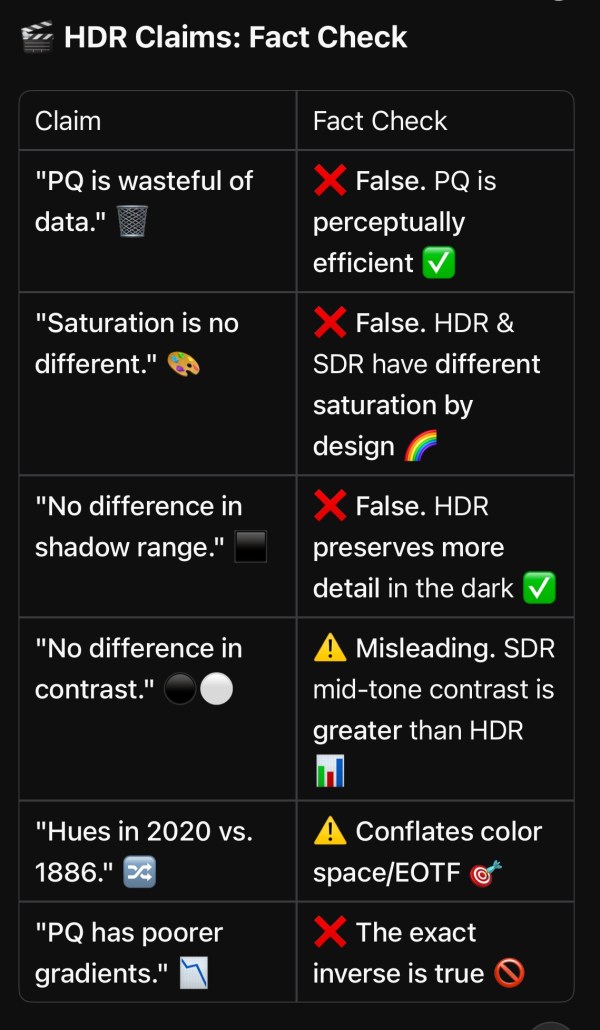
Shareable table to accompany HDR Myths, Terminology-Driven Workflow Errors + Practices.
Steve Yedlin’s Folly
This analysis reveals why Steve Yedlin conflates Rec.2100 with PQ ST 2084, how he overlooks a crucial requirement of WCG, re-examines his "data hog" fallacy, and dismantles his proposed replacement for Rec.2100. The Conflation Image Credit: Steve Yedlin. Debunking “HDR”. BT.1886 is an EOTF, not a color space. SMPTE ST 2084 ≠ ITU-R BT.2100. It... Continue Reading →
Tribalism & The Reactionary Mindset
“Yedlin doesn't seem interested in anything beyond the SDR standard. Which is fine, it's his choice, but his presentation is extremely biased in favor of his preference, often omitting or bending the facts to serve his arguments. This is, functionally, a TED Talk masquerading as a SIGGRAPH presentation, if he wants to walk the walk... Continue Reading →
The Definition of “SDR in an HDR Container”
For Cullen Kelly, HDR is just a container for LDR aesthetics. In a livestream, Kelly explicitly instructs his followers to ignore HDR’s potential: “Many of you guys have probably seen Steve Yedlin's HDR demo... that talks such good common sense about HDR... Fundamentally for me, I don't want HDR versus SDR to determine where my... Continue Reading →