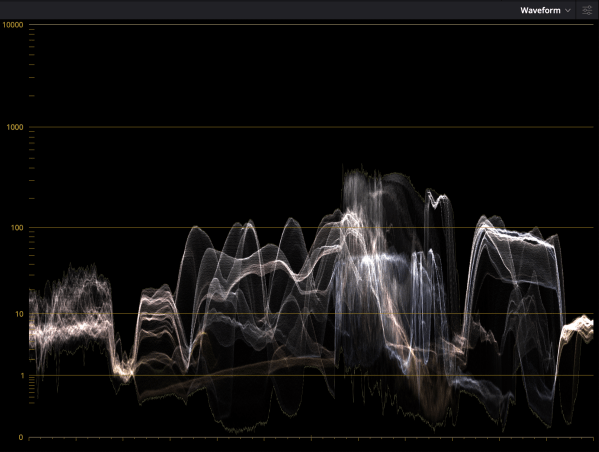
How Should Scopes Appear in HDR PQ?

Concerning the often asked question of how HDR scopes should appear in your NLE, one significant difference is that in SDR, the signal can ordinarily fill out the scopes, say, from 0-1023, while in HDR PQ, the bulk of the signal will usually be bunched up toward the bottom end of the waveform, from 0-200... Continue Reading →

Cullen Kelly Disentangles Print Film Emulation

Part I: The State of HDR Film Emulation LUTs Part II: Moving Beyond Traditional Film Print Emulation Part III: Negative and Print Clarified During an episode of Grade School, a weekly YouTube Live session where he answers questions on all things color grading, Cullen Kelly untangles the confusion surrounding the order of operations, print vs. negative... Continue Reading →

Netflix Outlines Three Approaches To On-Set Monitoring

Acknowledging that HDR monitoring for every display on-set for the entire length of a production is prohibitively expensive for most productions, Netflix proposes three alternatives: CAMERA TESTS (E.G. HAIR & MAKEUP TESTS) Camera tests for hair and makeup are typically the first time images are evaluated and sent through the entire production pipeline. Some productions... Continue Reading →

Resolve 17 Highlight Bug A Feature?

We wrote about this back in August. Supposedly, Blackmagic was on top of it. The highlight tool hasn’t worked properly when using the HDR panel in Resolve 17 since day one. X-Rite WB Card Power Window + Highlight Tool Adjusting Global wheel in HDR tools breaks highlighter. Adjusting Offset wheel in Primaries, highlight behaves normally.

The Hand of God

DP Daria D'Antonio demonstrates an understanding of HDR in her sumptuous work on Sorrentino's semi-autobiographical coming-of-age film The Hand of God, now showing on Netflix. Unfortunately, the brightly lit exterior scenes lit up our entire room, reflecting back onto the screen and ruining the experience - making us wish we could paint the walls black!

HDR Luminance Levels

If you leave the house, walk around and point your camera anywhere, it's all but impossible not to encounter luminance values measuring in the hundreds or even thousands of nits. But turn on the TV and watch a Dolby Vision program on Netflix and 99% of the time, it seems like there aren't any luminance... Continue Reading →

Misleading Advert From Asus

This deceptively titled advert featuring Asus spokesperson Darren Mostyn might lead the viewer to expect to witness some dazzling HDR grading in DaVinci Resolve by an experienced colorist, but we see nothing of the sort. Not only that, but they couldn't even be bothered to shoot the ad in HDR. Watching this video reminds us... Continue Reading →

Picked Up the New Laptop!

One week ago, not a single shop had any 16" M1 Max MacBook Pros in stock and we were told that it would take anywhere from eight to ten weeks to get one; but by some miracle it arrived in just seven days. Using Migration Assistant, Time Machine and a slow portable hard drive, transferring... Continue Reading →

Why HDR Shows Are Too Dark, Part II

One year ago, almost to the day, we published a video entitled Why Are HDR Shows So Dark?, which turned out to be one of our most successful rants on YouTube. We've since identified no fewer than a half dozen different contributing factors, including: most shows continue to be lit in an SDR environment using... Continue Reading →

No Metrics to Describe HDR WCG Displays

As today's consumer displays can attain brightness levels up to fifteen times higher than legacy SDR screens, the traditional 2D color gamut diagram no longer suffices to characterize the behavior of displays, necessitating a third axis to describe luminance. Nevertheless, although color volume plays a far more important role in color reproduction in HDR than... Continue Reading →

HDR Notebooks to Flood Market

Following the praise lavished on Apple's new MacBook Pro lineup featuring Liquid Retina XDR mini-LED displays, industry watchers are now betting on rivals sitting up, taking notice and following suit, increasingly incorporating either OLED or mini-LED displays in their own notebooks. This can only be a good thing, as the 270m notebook market lags deplorably... Continue Reading →

Mind Saturation & Noise Reduction

Saturation While the extended color volume of HDR results in perceptibly more vibrant colors able to retain saturation and brightness without compromise, it pays to be cautious with saturation. Glowing skin and radioactive foliage are indications that saturation is cranked up too high. To assess saturation, use the vectorscope. In order to see the highlight... Continue Reading →

Blog at WordPress.com.

Up ↑