Shocker! In the very first study of its kind, the authors (from the University of Cambridge and Netflix, Inc.) discover that significantly higher streaming bitrates are required to deliver satisfactory HDR AV1 video. D. Hammou, L. Krasula, C. G. Bampis, Z. Li and R. K. Mantiuk, "The effect of viewing distance and display peak luminance... Continue Reading →
DCI HDR Image Tests Might Be Flawed & Why It Doesn’t Matter
Back in January and February 2020, ten double-blind image testing sessions were conducted at Sony Pictures Studios to determine the minimum specifications for peak brightness that would yield "a substantially differentiated HDR viewing experience.” A Sony CLED was used for mastering and viewing since it was the only technology available at the time that could... Continue Reading →
How Not To Expose For HDR
“Conventional exposure theory would suggest that with a camera like the Alexa that is ISO 800 it will reproduce a mid-grey as a mid-grey but if you set up for that in HDR then you are going to find objects in the frame over exposed. Candle flames, for example, tend to lose their color and... Continue Reading →
One of the Most Objectionable Practices in the Industry
"S1 was shot so beautifully. S2 as well but s2 was a bit less grand and more intimate but it worked for the story. S3 felt visually monotonous." "This season was lacking the almost magical enchanting feeling from earlier seasons." "Not what S1 and S2 were like. It’s drastically different and not in a good... Continue Reading →
Announcement: The HDR Creators Handbook
I'm a pretty bad procrastinator, but I just might start work on a tiny handbook which I'm considering calling The HDR Creators Companion - a compilation of the best bits of the thousands of posts I've written on the subject over the past six years. And just as I've always done, I will not be... Continue Reading →
HDR: The 2nd Commandment (updated)
“Frames that have a wider variety of contrast and a higher contrast range from the source media work best in HDR and therefore look best.” Aidan Farrell, colorist, The Farm If the first inviolable rule of HDR is to not clip the signal, the second must surely be that scenes have adequate contrast. We just... Continue Reading →
Dynamic Range & Maximizing Audience Reactions
During a podcast recorded five years ago, Shane Mario Ruggieri, Advanced Imaging Systems Creative Lead, Dolby Laboratories, was asked what kinds of cameras work best for HDR: What cameras do you normally come across when you're working in HDR? Is there any specific camera that's worked really well for you? Are there cameras that are... Continue Reading →
Dolby Vision or PQ10 FTW? Very Unexpected Findings!
When toggling between reference mode HDR Video (P3-ST2084) and Apple XDR Display (P3-1600 nits) with brightness set midway on the MacBook Pro M1 Max (2021), we prefer the latter (Dolby Vision) with the few Apple TV+ shows we watched: Ted Lasso (2020-2023), Black Bird (2022) and Bad Sisters (2022-) - improved contrast, a touch brighter,... Continue Reading →
HDR: The Root Causes of Resentment
Resistance to HDR “For me, there’s OK HDR and even worse HDR. Personally I don’t like it,” Dariusz Wolski, ASC (Napoleon, 2023) The hostility toward HDR in the industry is well-documented. Steve Yedlin (Glass Onion, The Last Jedi) once wrote in a post on X (formerly Twitter), “Seems that filmmakers usually put all their authorship... Continue Reading →
HDR, Eye Discomfort & Field of View
Warning: NSFW Walter Volpatto, Sr. Colorist, Picture Shop, argues that HDR causes discomfort because, unlike in real life where the scene before us occupies our entire field of view, we’re watching TV in a dark room where the picture occupies a much smaller field of view, forcing our pupils to open up, making the image... Continue Reading →
HDR: The Number One Rule
The cinematographer's job to do good HDR is don't clip the signal. That's it. - Juan L. Cabrera, Supervising Colorist, LightBender In HDR video, there is no artifact more repugnant than blown-out highlights. All that is required to avoid them is for the DP not to clip the signal, but many balk at upgrading their... Continue Reading →
Unwatchable
“I'm watching presumed innocent with Dolby vision on an OLED TV. It still looks like shit, washed out, Gray, hardly any contrast.” “Agree - it’s washed out and so dark even on a very bright Mini - LED TV with Dolby vision it looks like shit.” “Googled for this issue and lead me here. Brought... Continue Reading →
Full Range Or Video Levels Revisited
https://daejeonchronicles.com/2024/07/11/solved-samsung-tv-hdmi-black-level-grayed-out/ The other day, we thought we'd hit upon a solution for the grayed out HDMI black level settings on our Samsung S90C QD-OLED, but it still behaves unpredictably when receiving a signal over HDMI and it isn’t always possible to do anything about it. Sometimes HDMI Troubleshooting works, sometimes it doesn’t. For now, if... Continue Reading →
Solved! Samsung TV HDMI Black Level Grayed Out
If HDMI Black Level is grayed out on your Samsung television, follow these steps to get it working again. 1. Go to Settings > Support. 2. Select Connection Guide. 3. Go to Video Device > HDMI Troubleshooting. 4. Select HDMI Troubleshooting again. 5. Select the HDMI port that is experiencing issues. The TV will diagnose... Continue Reading →
Clearing Up Rec. 2020 (P3-D65 Limited) Confusion
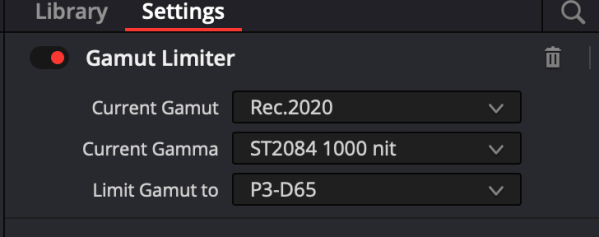
“Using a P3-D65 CST followed by a Rec.2020 CST does not limit the gamut to P3. Since this is a requirement by all studios and clients today, we recommend using a Rec.2020 CST followed by a P3-D65 Gamut Limiter which will constrain the color gamut to P3 within the Rec.2020 container.” - Dolby Labs Matthias... Continue Reading →
600 Nits Seems To Be The Magic Number
We’ve remarked before how the figure 600 seems to crop up every time a colorist is asked about the peak nits of their projects. Here are a couple more data points. Cullen Kelly: Do you impose a hard speed limit on your projects? Corinne Bogdanowicz: I don't have a hard rule or setting that I... Continue Reading →
HLG For Social Media Using MacBook Pro With Apple Silicon: DaVinci Resolve Studio 19 Settings
https://youtu.be/VoTrassfzzs The following are our preferred project settings for delivering HLG HDR to YouTube. 1. Display HDR Video (P3-ST2084) 2. Preferences. Decode Options. Decode H.264/H.265 using hardware acceleration. 3. Preferences. Use 10-bit precision in viewers if available. Use Mac display color profiles for viewers. 4. Color Management settings. Color science may be DaVinci YRGB (for... Continue Reading →
How To Work With Cullen Kelly’s LUTs in DaVinci Resolve Studio 19
The following workflow is for Cullen Kelly's discontinued Core Elements Creative LUT Pack, but is applicable to his Voyager LUT Pack and film print emulation LUTs as well. https://youtu.be/0ERXpfUuRQ4 Description of the Core Elements Creative LUT Pack (discontinued) from Cullen Kelly's website: Create studio-grade cinematic looks Tailor to your vision Use for HDR, SDR, and... Continue Reading →
LG: HDR10 No Longer At The Top Of The HDR Hierarchy
In April, LG published a help guide entitled Dolby Vision vs. IMAX and HDR10: A Comparative Analysis. Here’s some of what the Korean electronics manufacturer had to say about Dolby Vision and HDR10: Dolby Vision “Dolby Vision is a visual technology designed to enhance the viewing experience to unprecedented levels. It empowers visual creatives to... Continue Reading →
Ridiculous Dolby Gaming Ad
https://youtu.be/yUwPaVpbJE8?si=DBh054MPW560Lg3g Dolby released an ad on YouTube showing 'consumers' going wild over the Dolby Atmos audio and picture quality of Dolby Vision gaming. One of the participants exclaims, "I think the depth and color of the blacks are very well represented." Only they're all sitting in an impossibly brightly lit room, the worst possible scenario... Continue Reading →