Here are the revised settings for Sony S-Gamut3.Cine/S-Log3 and ProRes 4444 XQ Rec.2100 ST2084 (from ProRes RAW), the chief difference being no more input or output DRT. Only restrict output color space to P3-D65 if the mastering display is calibrated to P3. Set 'HDR mastering is for' according to the capabilities of the mastering display.
How to save trimmed R3D files in DaVinci Resolve
Go to File > Media Management > Press Start Mission completed! The .RDC folder containing the R3Ds and .rtn as well as the .drt have been saved.
We Need Your Feedback!
The job of color management is to take what the camera saw and transform it into what the display can show. That's Cullen Kelly's definition of color management. And when we perform what is one of the most basic types of color management - simply placing a single CST at the very end of our... Continue Reading →
Nonsense About Display-Referred Workflow
If you even think about this for a second, you realize it doesn't make sense. “If we start with the concept of a display referred workflow, […] it basically comes down to this idea of working in a color space that matches the output display. In other words, the physical device on which the end... Continue Reading →
Scene Referred vs. Display Referred Part II
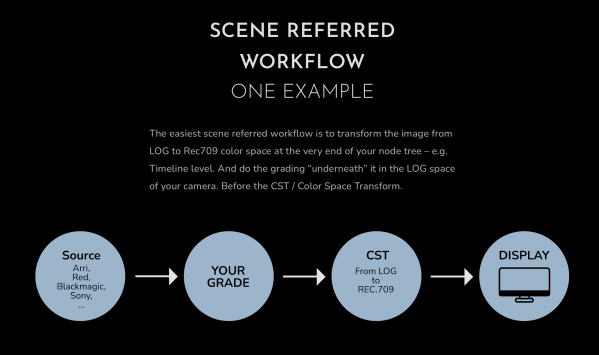
What's the difference between scene-referred and display-referred grading? Stefan Ringelschwandtner, on his website Mononodes, explains it very clearly with simple diagrams. He writes: "The easiest scene referred workflow is to transform the image from LOG to Rec709 color space at the very end of your node tree – e.g. Timeline level. And do the grading... Continue Reading →
What Timeline Working Space Do Dolby Colorists Prefer?
Thomas Graham, Head of Dolby Vision Content Enablement at Dolby Laboratories: Can you all just tell me in the sense of what your timeline working space is that you find suits you best to create HDR imagery? Now I know there's a lot of controversy about working sort of in PQ or working in camera... Continue Reading →
Walter Volpatto on Why He Doesn’t Do Secondaries on Skin
Walter Volpatto on why he doesn't do secondary corrections on skin. "I do not do [a] secondary on the skin. For me, when I do balance, it means that the main actress - balance, color, skin tone - has to be right. Then I do everything else. There is no reason for me to make... Continue Reading →
We Couldn’t Come up With a Title for This Post
Something doesn't seem quite right here. In this video with Armando Ferriera where Shane Ruggieri explains how to work with Sony footage, the renowned authority on HDR does something peculiar... "The first thing that I would do is I would come in - let me turn this this monitor off - I would first come... Continue Reading →
DWG, ACES or Native Camera Color Space?
We've already made it abundantly clear that we're not overly fond of transforming the log color space of our camera to DaVinci Wide Gamut or ACES but that we could understand wanting to bring all of your footage into a common working color space if you're dealing with a multi-camera shoot. It ensures that the... Continue Reading →
Updated RED Komodo Post Workflow
RCM was doing strange things to Red Komodo footage, including making letterboxing and titles gray rather than black so we’ve gone ahead and updated it to a node based transform workflow.