Unlike 99% of productions, Korean War drama Devotion was conceived, monitored and shot in HDR, the show LUT and dailies were HDR, the hero grade was HDR - and it looks simply gorgeous. Photo: Netflix Photo: Netflix Photo: Netflix Photo: Netflix
“Is the Barten Ramp the correct threshold?”
The Barten Ramp is calculated from P. G. J. Barten’s 1999 Contrast Sensitivity Function (CSF), a model that supposedly incorporated most of the important variables in the ability of the HVS to detect contouring in digital display systems. Note this is modeled rather than measured data and the model is based on data that predates... Continue Reading →
“Television Better Served By HLG“
“The PQ system was developed by Dolby, a company whose main focus is on the cinema while the HLG system was developed jointly by BBC and NHK, two organizations whose main focus is on television… Television is probably better served by the HLG system that was designed from the ground up by television engineers for... Continue Reading →
Narrow vs. Full Range
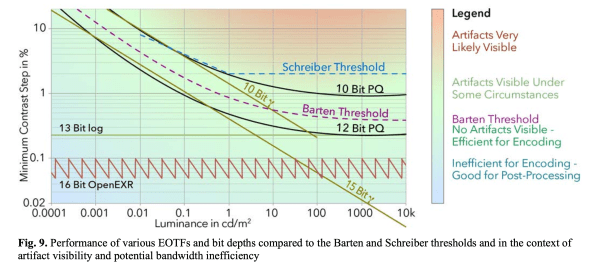
Grass Valley White Paper diagram of the Barten ramp showing the susceptibility to banding of different HDR curves. We can see that full range offers only a very slight advantage over narrow range in guarding against banding artifacts. Photo: Grass Valley
What’s Behind the Window?
Frankly, we'd rather not know. Below, screenshots from a few outstanding examples of HDR filmmaking and one screen grab from a promotional video shot by Erik Messerschmidt for the ARRI Alexa 35. Photo: ARRI. Encounters 'The Swing', DP Erik Messerschmidt Photo: Netflix. 'Devotion', DP Erik Messerschmidt Photo: Netflix. 'The Hand of God', DP Daria D'Antonio... Continue Reading →
Cinema Camera WCG Capability
Shane Mario Ruggieri, in his podcast with Mixing Light, said that not all cameras with high dynamic range can capture very saturated, accurate colors at high luminance levels. The diagrams illustrate the light gathering ability of a few cinema cameras capable of recording between 11 and 12 stops of dynamic range (Imatest). The OG Sony... Continue Reading →
“10 Stops Is Perfectly Good”(Provided You’re Confining Yourself to SDR Levels)
What cameras do you normally come across when you're working in HDR? Is there any specific camera that's worked really well for you? Are there cameras that are problematic? "I remember something that Bill B., the guy who put me in the business, he told me something when I asked him what camera I should... Continue Reading →
Want to enjoy your HDR videos in a bright viewing environment? Shoot HLG!
“With both PQ and HLG, if video content is displayed at the same brightness and in the same viewing conditions as those in which it was produced, it will look the same as it did on the production monitor. The creative intent will be maintained. Indeed, under these conditions PQ and HLG deliver identical looking... Continue Reading →
What Were They Thinking?
Watched a few minutes of the doc Madoff: The Monster of Wall Street and was struck by the number of scenes where those 12K, 5K and 3K lights were just burning holes in the picture. Photo: Netflix Photo: Netflix
shotPrep
Phil Holland's shotPrep is a handy tool for quickly figuring out delivery resolutions for non-standard formats, like 6K 17:9.
Sony Color Management Updates
Here are the revised settings for Sony S-Gamut3.Cine/S-Log3 and ProRes 4444 XQ Rec.2100 ST2084 (from ProRes RAW), the chief difference being no more input or output DRT. Only restrict output color space to P3-D65 if the mastering display is calibrated to P3. Set 'HDR mastering is for' according to the capabilities of the mastering display.
How to save trimmed R3D files in DaVinci Resolve
Go to File > Media Management > Press Start Mission completed! The .RDC folder containing the R3Ds and .rtn as well as the .drt have been saved.
“The most important aspect of any TV system is the OOTF”
In their Quick Start Guide to DaVinci Resolve Studio, Dolby Vision says to set the input and output DRTs to none on the color management page, which is why we're guessing that they wouldn't be overly fond of choosing tone-mapping in Resolve's OFX CST either - but there's no prohibition against OOTF that we're aware... Continue Reading →
What becomes of skin tones when a clip that is mastered to 1,000 nits is viewed on a 4,000-nit display?
a) Luminance levels will all remain unchanged b) Luminance levels will all increase exponentially c) Skin tones will remain unchanged, highlights and shadows will expand and fur will become more saturated d) The picture will fry the viewer's eyeballs e) None of the above According to the Ultra HD Forum, skin tones should be rendered... Continue Reading →
Portrait Displays and MediaTek Collaborate to Launch the World’s First Calman Ready TV Chip
Portrait Displays has teamed up with MediaTek to create the world’s first premium smart TV chip with Calman Ready functionality, greatly simplifying implementation of Calman AutoCal. "On the calibration side, MediaTek Pentonic smart TV chips with Calman Ready integration will support a wide variety of professional calibration and display profiling solutions, from 3×3 color correction... Continue Reading →
Viltrox Full Frame 1.33x Anamorphic Primes
https://youtu.be/jopt-5x32dU How much of the look is attributable to the lenses, how much to post-processing? We could be mistaken, but the lovely video showcasing Viltrox's new full frame T2 1.33x anamorphic primes, which has received a lot of praise - it looks like there's a lot of video effects added to the footage, making it... Continue Reading →
QD-OLED vs. WRGB OLED: Red, Green & Blue Pixel Luminance
"On QD-OLEDs, the peak brightness is the sum total of the red, green and blue outputs.... By contrast, [...] WRGB OLEDs use white subpixel boosting to achieve higher brightness, so if we do the same measurements of red luminance, green luminance and blue luminance on a WRGB OLED television, you will see that they only... Continue Reading →
The 5 Commandments of HDR
These are all taken from an excellent series of articles by Art Adams (now cinema lens specialist at ARRI) on HDR and none of the guidelines will be new to anyone who’s been following our blog, but here goes. TEST, TEST, TEST. Lens and sensor combinations should be tested extensively in advance. Some lenses work... Continue Reading →
HDR Compatible Video Assets
Who wouldn’t like to easily add some lens flares, prism bokeh, light leaks, dust particles or other effects to their HDR videos? Back in the day, if you were an Adobe or Final Cut user, even a novice could quickly throw on some assets or video templates and get really nice results. Rocketstock offers a... Continue Reading →
Nonsense About Display-Referred Workflow
If you even think about this for a second, you realize it doesn't make sense. “If we start with the concept of a display referred workflow, […] it basically comes down to this idea of working in a color space that matches the output display. In other words, the physical device on which the end... Continue Reading →