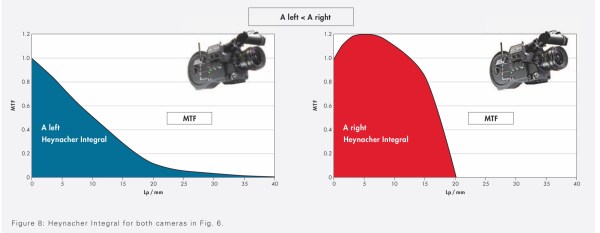
Most of us are familiar with the Nyquist theorem, but have you ever heard of the Heynacher Integral? The following excerpts are from a paper by Dr. Hans Kiening that explains why a scientific approach is necessary to understand the perception of sharpness and not just counting megapixels. Resolution alone is not a predictor of... Continue Reading →
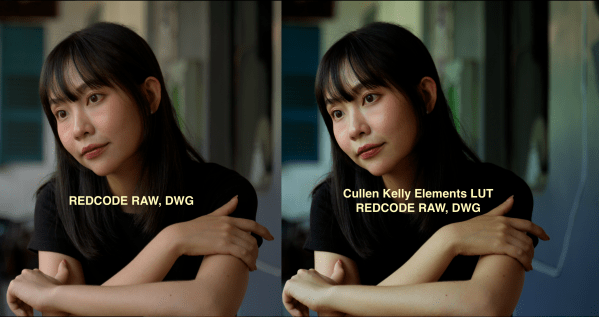
Cullen Kelly: Exposure & Contrast Not Allowed In Look Development
“Look setting can be an integral part of preproduction building monitoring LUTs or in camera look files. Or it can happen after production has wrapped but prior to the main grade starting or combination of those approaches.” Robbie Carman, Colorist, CEO, DC Color We’ve mentioned in the past how much we dislike LUTs and plug-ins... Continue Reading →
Factors To Consider When Choosing A Camera
Imatest is all well and good, but we appreciate that in his reviews, Matthew Allard has been doing rough comparisons of the dynamic range of cameras by exposing a scene for middle gray and looking for highlight clipping using false color. RED cameras have a built-in False Color Exposure mode that we use all the... Continue Reading →
HDR: The Number One Rule
The cinematographer's job to do good HDR is don't clip the signal. That's it. - Juan L. Cabrera, Supervising Colorist, LightBender In HDR video, there is no artifact more repugnant than blown-out highlights. All that is required to avoid them is for the DP not to clip the signal, but many balk at upgrading their... Continue Reading →
Calman adds gamut rings to color volume analysis workflow
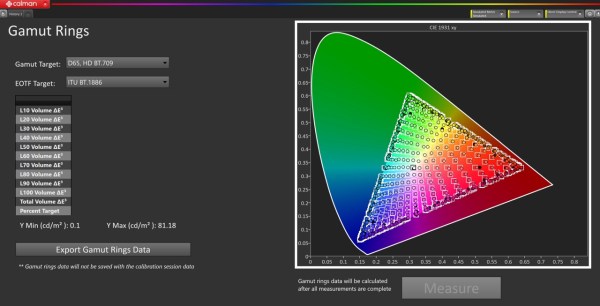
https://youtu.be/9WCrrLzVs9U?si=OAmeUHt82rX4P81i Using Gamut Rings to analyze color volumeAugust 20, 2024 Starting with Calman 2024 R6 (v5.15.6), it is now possible to visualize the three-dimensional color volume of a given display in a two-dimensional view called Gamut Rings. Traditionally CIE 1931 or CIE 1976 chromaticity diagrams that offer a two-dimensional perspective have been used. Calman’s Gamut... Continue Reading →
New Brightness Metric
To the best of our knowledge, Paolo Centofanti at DDay.it is the only TV reviewer measuring color volume using Kenichiro Masaoka’s gamut rings and now TFT Central’s Simon Baker deserves a big round of applause for adopting XCR to measure perceived brightness in his monitor reviews. It’s well worth your time to read the entire... Continue Reading →
Cullen Kelly To Release New Resolve Look Design Plugin
https://youtu.be/Vf7sqod3uqI?si=jvVsHcRsAUnW-rOu Cullen Kelly is about to release a new Resolve look design plugin, Contour. Kelly writes: Contour is built with studio-grade color science that has been battle-tested by some of our industry's top colorists and post facilities. It's all of my 15 years of color science and look development knowledge put into 5 simple modules anyone... Continue Reading →
Unwatchable
“I'm watching presumed innocent with Dolby vision on an OLED TV. It still looks like shit, washed out, Gray, hardly any contrast.” “Agree - it’s washed out and so dark even on a very bright Mini - LED TV with Dolby vision it looks like shit.” “Googled for this issue and lead me here. Brought... Continue Reading →
Full Range Or Video Levels Revisited
https://daejeonchronicles.com/2024/07/11/solved-samsung-tv-hdmi-black-level-grayed-out/ The other day, we thought we'd hit upon a solution for the grayed out HDMI black level settings on our Samsung S90C QD-OLED, but it still behaves unpredictably when receiving a signal over HDMI and it isn’t always possible to do anything about it. Sometimes HDMI Troubleshooting works, sometimes it doesn’t. For now, if... Continue Reading →
Solved! Samsung TV HDMI Black Level Grayed Out
If HDMI Black Level is grayed out on your Samsung television, follow these steps to get it working again. 1. Go to Settings > Support. 2. Select Connection Guide. 3. Go to Video Device > HDMI Troubleshooting. 4. Select HDMI Troubleshooting again. 5. Select the HDMI port that is experiencing issues. The TV will diagnose... Continue Reading →
Clearing Up Rec. 2020 (P3-D65 Limited) Confusion
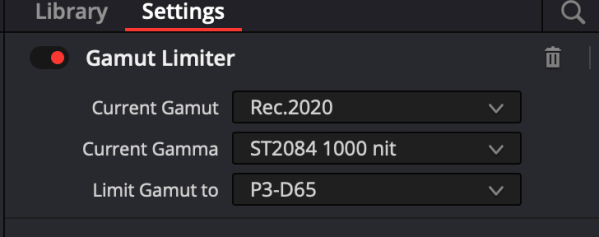
“Using a P3-D65 CST followed by a Rec.2020 CST does not limit the gamut to P3. Since this is a requirement by all studios and clients today, we recommend using a Rec.2020 CST followed by a P3-D65 Gamut Limiter which will constrain the color gamut to P3 within the Rec.2020 container.” - Dolby Labs Matthias... Continue Reading →
Why We Ditched The Sony Bravia XR A95L QD-OLED
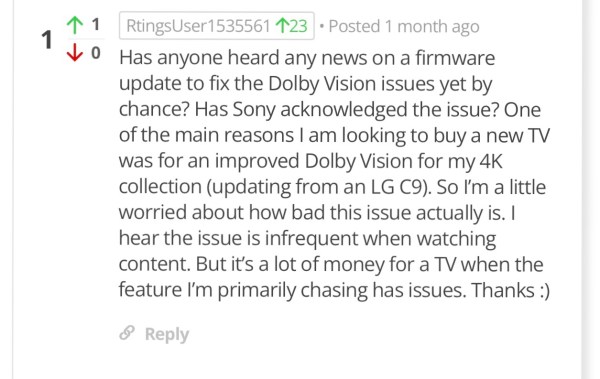
When streaming Dolby Vision content, either with an Apple TV 4K (3rd generation) or using the television's own Apple TV and Netflix apps, the A95L picture had horrific banding and posterization in some scenes. In low light shots, the picture becomes seriously desaturated and takes on a green tint. Sony's processing also adds undesirable sharpening... Continue Reading →
Greyhound Lacks Imagination
After reading an interview with the DP and colorist on the Apple TV+ war drama Greyhound (2020), we were really looking forward to seeing it. But it turned out to be no more than an SDR production from start to finish, with just a bit of gunfire and one scene in which Tom Hanks is... Continue Reading →
Art Adams – ARRI Lens Specialist
Before Art Adams became a spokesperson for ARRI, he was a reliable source of information. But since taking on the job of lens specialist for ARRI, he’s done an about-face on ARRI color science and dynamic range. An oft-quoted article by Art Adams attributed much of ARRI cameras’ resemblance to film to how saturation ‘locked... Continue Reading →
600 Nits Seems To Be The Magic Number
We’ve remarked before how the figure 600 seems to crop up every time a colorist is asked about the peak nits of their projects. Here are a couple more data points. Cullen Kelly: Do you impose a hard speed limit on your projects? Corinne Bogdanowicz: I don't have a hard rule or setting that I... Continue Reading →
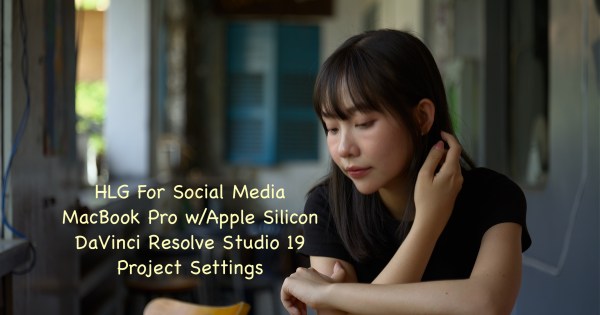
HLG For Social Media Using MacBook Pro With Apple Silicon: DaVinci Resolve Studio 19 Settings
https://youtu.be/VoTrassfzzs The following are our preferred project settings for delivering HLG HDR to YouTube. 1. Display HDR Video (P3-ST2084) 2. Preferences. Decode Options. Decode H.264/H.265 using hardware acceleration. 3. Preferences. Use 10-bit precision in viewers if available. Use Mac display color profiles for viewers. 4. Color Management settings. Color science may be DaVinci YRGB (for... Continue Reading →
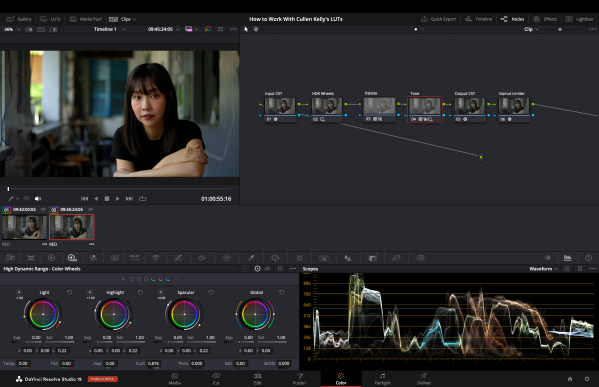
How To Work With Cullen Kelly’s LUTs in DaVinci Resolve Studio 19
The following workflow is for Cullen Kelly's discontinued Core Elements Creative LUT Pack, but is applicable to his Voyager LUT Pack and film print emulation LUTs as well. https://youtu.be/0ERXpfUuRQ4 Description of the Core Elements Creative LUT Pack (discontinued) from Cullen Kelly's website: Create studio-grade cinematic looks Tailor to your vision Use for HDR, SDR, and... Continue Reading →
Pick Up Free Color Grading & Look Design Kit
This kit includes: - Kodak 2383 Film Print LUT for ACES and DaVinci Wide Gamut- Mid-grey Cheatsheet with reference points for 14 different tone curves- An Exposure Chart DCTL that gives a customizeable ramp and step chart for 14 different tone curves inside Resolve- YouTube & Frame.io Export LUT
LG: HDR10 No Longer At The Top Of The HDR Hierarchy
In April, LG published a help guide entitled Dolby Vision vs. IMAX and HDR10: A Comparative Analysis. Here’s some of what the Korean electronics manufacturer had to say about Dolby Vision and HDR10: Dolby Vision “Dolby Vision is a visual technology designed to enhance the viewing experience to unprecedented levels. It empowers visual creatives to... Continue Reading →
Ridiculous Dolby Gaming Ad
https://youtu.be/yUwPaVpbJE8?si=DBh054MPW560Lg3g Dolby released an ad on YouTube showing 'consumers' going wild over the Dolby Atmos audio and picture quality of Dolby Vision gaming. One of the participants exclaims, "I think the depth and color of the blacks are very well represented." Only they're all sitting in an impossibly brightly lit room, the worst possible scenario... Continue Reading →