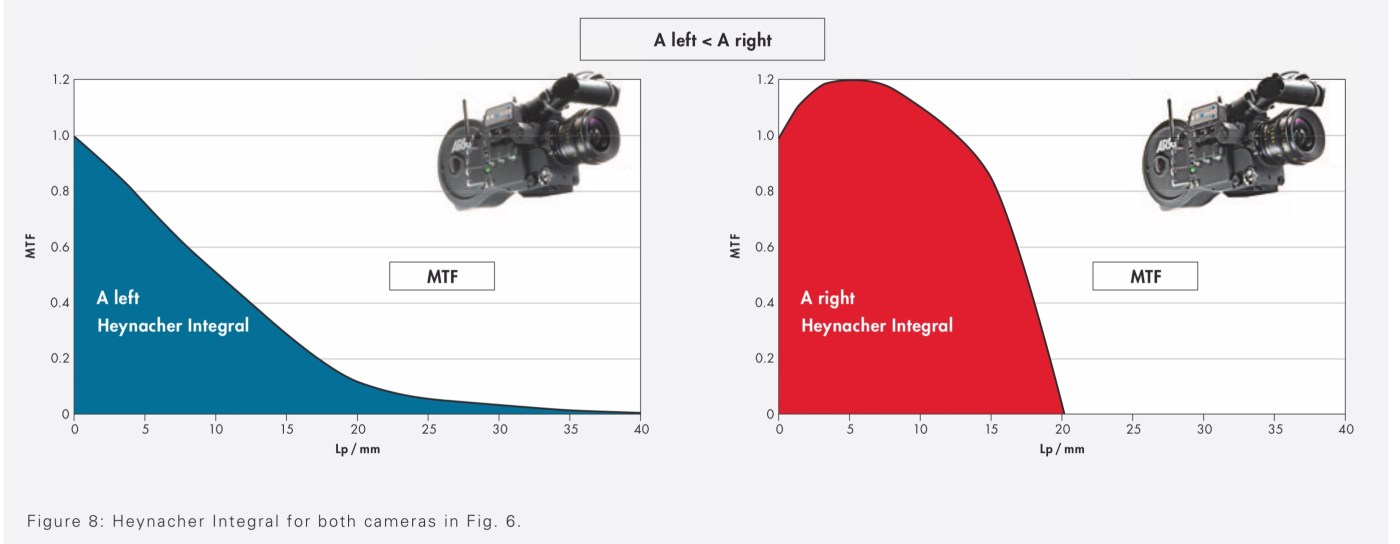
Most of us are familiar with the Nyquist theorem, but have you ever heard of the Heynacher Integral? The following excerpts are from a paper by Dr. Hans Kiening that explains why a scientific approach is necessary to understand the perception of sharpness and not just counting megapixels. Resolution alone is not a predictor of image sharpness. It’s written in a livelier style than we’re accustomed to from ARRI, and it introduced us to the Heynacher Integral, something you can show off with at cocktail parties!
“The resolution limit describes how much information makes up each image, but not how a person evaluates this information. Fine details such as the picket fence in the distance are irrelevant to our perception of sharpness – a statement which can easily be misunderstood, the human eye, in fact, is well able to resolve extremely fine details. This ability is also valid for objects at a greater distance. The decisive physiological point, though, is the fact that fine details don’t contribute to the subjective perception of sharpness. Therefore, it’s important to clearly separate the two terms resolution and sharpness.”
“The coarse, contour-defining details of an image are most important in determining perception of sharpness. The sharpness of an image is evaluated when the coarse details are shown in high contrast.”
“A plausible reason can be found in evolution theory: “A monkey who jumped around in the tops of trees, but who had no conception of distance and strength of a branch, was a dead monkey, and for this reason couldn’t have been one of our ancestors,” says the palaeontologist and zoologist George Gaylord Simpson.”
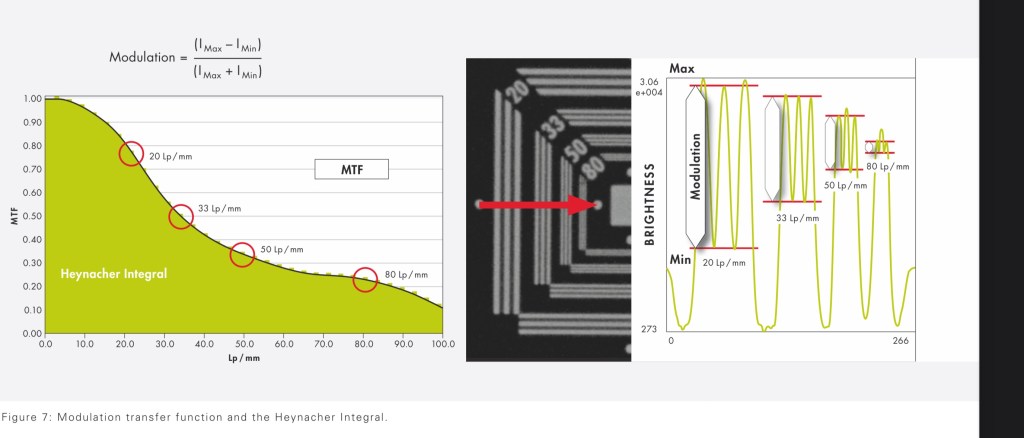
“In the 1970’s, Erich Heynacher from Zeiss provided the decisive proof that humans attach more value to coarse, contour-defining details than to fine details when evaluating an image. He found that the area below the MTF curve corresponds to the impression of sharpness perceived by the human eye (the so-called Heynacher Integral). Expressed simply: the larger the area, the higher the perception of sharpness.” – Dr. Hans Kiening, “4K+ Systems, Theory Basics for Motion Picture Imaging”, Arnold & Richter Cine Technik, April 01, 2008. ARRI
“This was published around 2008, I believe. By then ARRI figured out that, in order to maximise sharpness and minimise aliasing/Moire, one has to maximise Heynacher Integral (the area under the MTF line). Since then, when you look at any ARRI digital camera, this understanding seemed to play a significant role in ARRI’s sensor engineering (relatively low resolution, high MTF design).” – Pawel Achtel, ACS, Cinematography Mailing List, Sept. 21, 2023


Leave a Reply