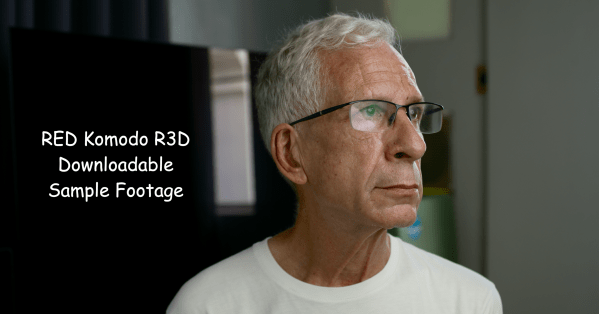
Colorist Eric Weidt recounts how David Fincher would have him tailor the grade in order to align with consumer devices. Eric Weidt: Once, he [David Fincher] came into Los Angeles; he would stop by, because his office is right there... he would stop by, pop in. But really, you know, to him, it always looks amazing on... Continue Reading →
Short Takes: Is 1,000 Nits Enough?
Bram Desmet, CEO, Flanders Scientific, responds, “1,000 nits was enough because it's all we could do. The Dolby Pulsar was really the only display out there that people could really get their hands on that could reliably do over 1,000 nits well. The issue being, you couldn't even buy that, it was basically a lease-only... Continue Reading →
“HDR is just a standard. HDR doesn’t have any creative implication or aesthetic implication”
"HDR is just a standard. HDR doesn't have any creative implication or aesthetic implication. It's just a standard." Cullen Kelly Kelly used to be one of the most perceptive commentators on HDR, but ever since meeting Steve Yedlin, he's like a completely different person. In his most recent live stream, he says, “The first... Continue Reading →
Setting A Speed Limit Should Not Be An Arbitrary Decision
Setting a speed limit shouldn't be an arbitrary decision that's imposed before even looking at the footage. It's critical to understand that as highlights are rolled off, detail, texture and contours are being tossed out and, if carried too far, what remains is no longer HDR, but brighter SDR. Even though the peak luminance of... Continue Reading →
Erik Messerschmidt: Why HDR Production Monitors Matter
I didn't find that I was that worried about the toe in general. I was always looking at the highlights, particularly in contrasty situations, so the way that we had the the LUTs built, especially in the black and white version, was when the monitor clipped, the waveform clipped, and the sensor, the camera, told... Continue Reading →
Lift, Gamma, Gain
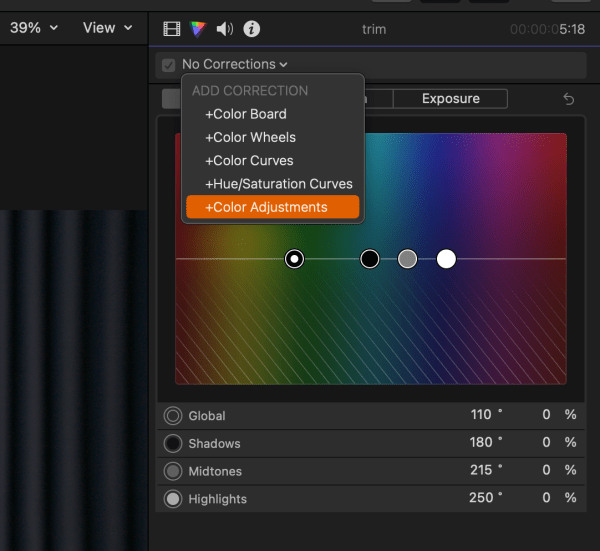
"It is also worth bearing in mind that the traditional lift, gamma, and gain operators are particularly unsuitable for acting on ST 2084 image data, where 0-1 represent zero to 10 000 cd/m2. Highlights, in particular, can swing uncontrollably into extreme values as a result of small changes. Modern grading systems offer alternate grading operators... Continue Reading →
ΔE ITP for the evaluation of HDR WCG displays
The current metric for evaluating displays, ΔE2000, has been under-predicting perceptual color differences, particularly when used for the evaluation of HDR and WCG displays. Charles Poynton argues that the industry should transition from CIE L* and CIE LAB to ΔE ITP. Poynton writes: A proposal has been made to use CIE LAB to quantify HDR gamut.... Continue Reading →
Priorities

Polly Morgan, who recounts how she ‘fought tooth and nail’ with Sony to be able to add grain to the excessively clean, digital looking Alexa Mini LF footage, was evidently very proud of herself for being able to collaborate on the Dolby Vision master of the excruciatingly dull Where the Crawdads Sing (Netflix), whose HDR, with highlights... Continue Reading →
Spotlight On Erik Messerschmidt, ASC: HDR Monitoring, Lighting Ratios, ETTR
"I used to embrace the romantic idea of a dramatic underexposure and very thin negative and I have gone the other way." Filmmaker Magazine: With the early Red cameras—back in the Epic days—I remember people talking about how you needed to expose to the right on the histogram because if you underexposed you were in... Continue Reading →
Dolby Engineer Answers Our Most Pressing Questions!
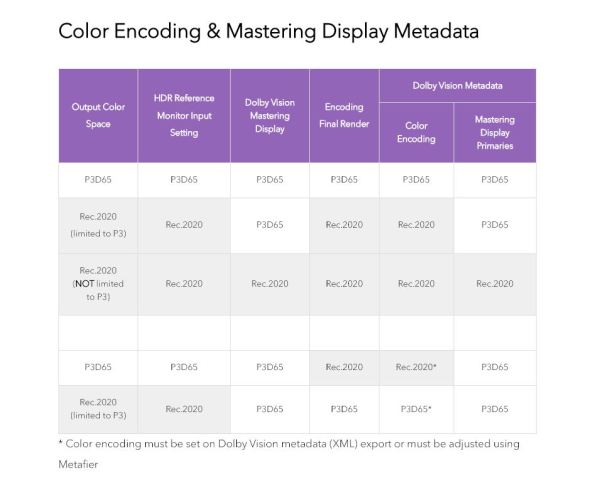
Update: Dolby changes stance on DRTs. We asked Nate McFarlin, Senior Content Engineer, Dolby Laboratories, a couple questions that have been troubling us for a while now: (1) Why exactly is it that Dolby insists on input and output DRTs being set to NONE in a Resolve Color Managed workflow; and (2) When mastering Rec2020... Continue Reading →
Colorist: We Don’t Need A Display That Mimics The Sun’s 1.6 Billion Nits

First, we had a prominent colorist proclaim, "That's the conventional wisdom that I hear a lot, like, the conventional wisdom would be like, 'oh, if you're doing a 1000-nit master, your brightest stuff in your image should be a thousand nits, you should have plenty of like speculars and highlights and things in your grade... Continue Reading →
Italian Tech Website Publishes Color Volume Gamut Rings Results Of Flagship TVs
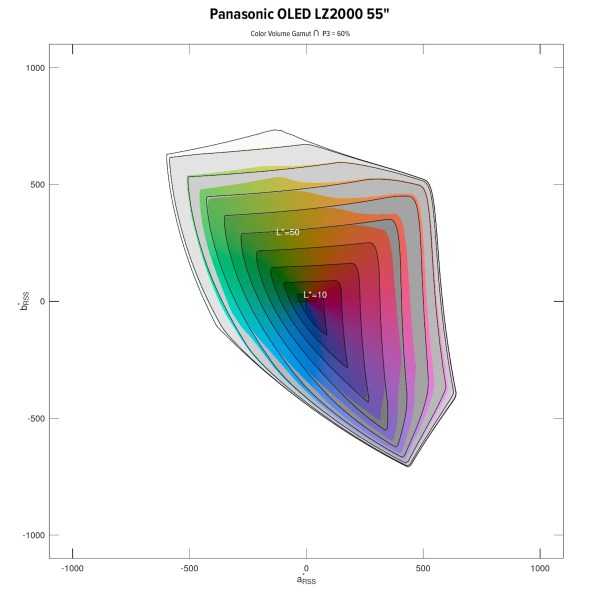
A member over at avsforum shared gamut rings color volume results for Panasonic, Sony, LG and Samsung TVs from Italian tech website DDay.
Familiarity with HDR may increase appetite for greater luminance
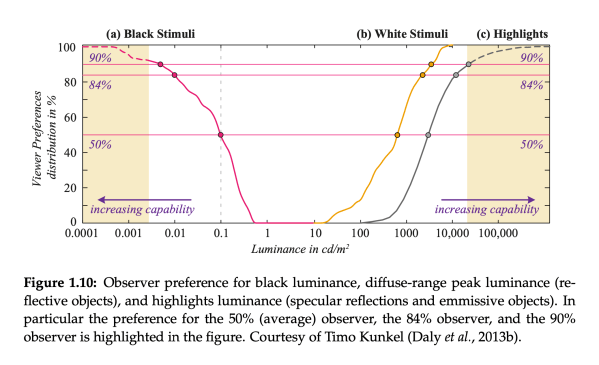
“The average observer preference for dark luminance is 0.1 cd/m2 and diffusive white luminance 650cd/m2 (contrast of 6500:1). Note that state-of-the-art consumer TVs exhibit a peak luminance and contrast range close to the average observer preference. However, the 90-percentile observer preferred a dark luminance of 0.005 cd/m2 and a diffusive luminance of 3 800 cd/m2... Continue Reading →
Dolby Engineer: Some of our partners are using LG TVs for mastering Dolby Vision
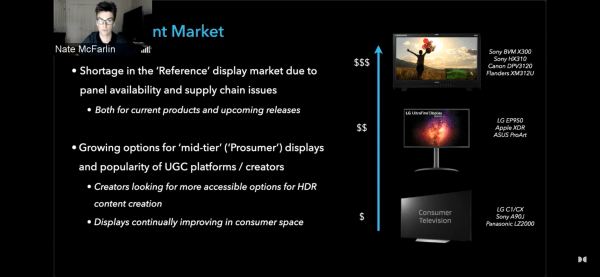
Just the other day, Nate McFarlin, Senior Content Engineer, Dolby Laboratories, NY, wrote: "Dolby doesn't approve specific displays for content creation/grading. We'll always recommend you use the highest quality (reference-grade) display as possible, but we have plenty of clients and partners that use other display options for their work (including LG TVs). Ultimately, it's up to... Continue Reading →
LG Display CTO: Luminance Is The First Priority

Reiji Asakura visited LG Display in Korea in September of last year and took the opportunity to ask CTO Yoon Soo-young whether he felt RGBW OLED was inferior to QD-OLED. “The problem is not whether the light source is white or RGB, but whether the spectrum of light emitted from the display is finally the... Continue Reading →
HDR Comparison: LG G2 vs. LG G3
Vincent Teoh compares the LG G2 and LG G3. Shot with the Sony a7s III and graded in DaVinci Resolve using an M1 Max MacBook Pro and LG 32EP950. The monitoring setup looks awfully familiar! https://youtu.be/ppxGIU18Cx8
TCL Launches 5,000-Nit QD-MiniLED TV In China
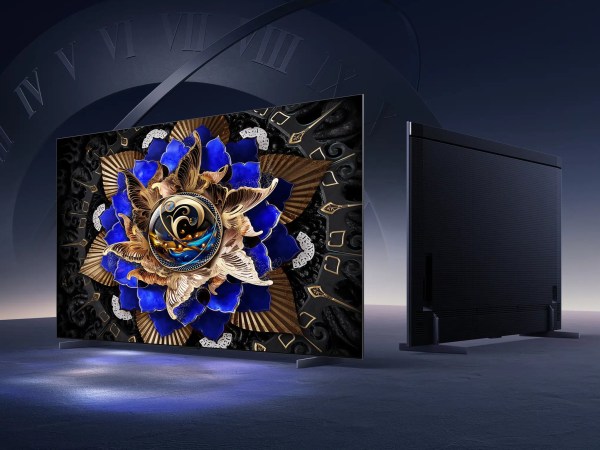
The TCL X11G Smart TV is sold exclusively in China and is available in 75-in ($2,905), 85-in ($4,067) and 98-in ($6,537) sizes. The 4K television boasts 5,184 zones, a whopping 5,000 nits of HDR goodness and supports Dolby Vision IQ, HDR10+ and HLG. No word yet whether it will be available in other countries.
LG Releases Fix For C3 and G3 OLED TV Auto-Dimming. Don’t Rejoice Just Yet.

Just five days ago, HDTVTest was the first to report that LG had overhauled the service menu on their 2023 lineup of OLED TVs, preventing consumers from disabling TPC and GSR in order to stop unnecessary auto-dimming. In response to HDTVTest's video, as well as to outcry from the online community, LG hastily released a... Continue Reading →
Sony Engineer: External Metadata Not Necessary To Preserve Creative Intent
Toshiyuki Gura, Chief Distinguished Engineer, Sony, declared at the 2018 IEEE Broadcast Symposium that external metadata isn’t necessary to preserve creative intent. https://youtu.be/CfNatefiAP8 Which isn’t all that surprising, given that SMPTE defines HDR10 metadata, but not what televisions should do with it. Other manufacturers also ignore static metadata, applying instead their own tone mapping on... Continue Reading →
 The Daejeon Chronicles