Grass Valley White Paper diagram of the Barten ramp showing the susceptibility to banding of different HDR curves. We can see that full range offers only a very slight advantage over narrow range in guarding against banding artifacts. Photo: Grass Valley
What’s Behind the Window?
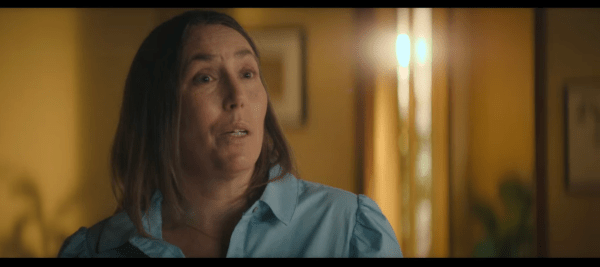
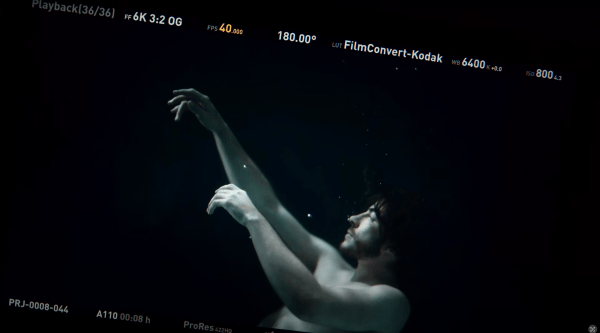
Frankly, we'd rather not know. Below, screenshots from a few outstanding examples of HDR filmmaking and one screen grab from a promotional video shot by Erik Messerschmidt for the ARRI Alexa 35. Photo: ARRI. Encounters 'The Swing', DP Erik Messerschmidt Photo: Netflix. 'Devotion', DP Erik Messerschmidt Photo: Netflix. 'The Hand of God', DP Daria D'Antonio... Continue Reading →
Cinema Camera WCG Capability
Shane Mario Ruggieri, in his podcast with Mixing Light, said that not all cameras with high dynamic range can capture very saturated, accurate colors at high luminance levels. The diagrams illustrate the light gathering ability of a few cinema cameras capable of recording between 11 and 12 stops of dynamic range (Imatest). The OG Sony... Continue Reading →
“10 Stops Is Perfectly Good”(Provided You’re Confining Yourself to SDR Levels)
What cameras do you normally come across when you're working in HDR? Is there any specific camera that's worked really well for you? Are there cameras that are problematic? "I remember something that Bill B., the guy who put me in the business, he told me something when I asked him what camera I should... Continue Reading →
Want to enjoy your HDR videos in a bright viewing environment? Shoot HLG!
“With both PQ and HLG, if video content is displayed at the same brightness and in the same viewing conditions as those in which it was produced, it will look the same as it did on the production monitor. The creative intent will be maintained. Indeed, under these conditions PQ and HLG deliver identical looking... Continue Reading →
What Were They Thinking?
Watched a few minutes of the doc Madoff: The Monster of Wall Street and was struck by the number of scenes where those 12K, 5K and 3K lights were just burning holes in the picture. Photo: Netflix Photo: Netflix
Sony Color Management Updates
Here are the revised settings for Sony S-Gamut3.Cine/S-Log3 and ProRes 4444 XQ Rec.2100 ST2084 (from ProRes RAW), the chief difference being no more input or output DRT. Only restrict output color space to P3-D65 if the mastering display is calibrated to P3. Set 'HDR mastering is for' according to the capabilities of the mastering display.
What becomes of skin tones when a clip that is mastered to 1,000 nits is viewed on a 4,000-nit display?
a) Luminance levels will all remain unchanged b) Luminance levels will all increase exponentially c) Skin tones will remain unchanged, highlights and shadows will expand and fur will become more saturated d) The picture will fry the viewer's eyeballs e) None of the above According to the Ultra HD Forum, skin tones should be rendered... Continue Reading →
The 5 Commandments of HDR
These are all taken from an excellent series of articles by Art Adams (now cinema lens specialist at ARRI) on HDR and none of the guidelines will be new to anyone who’s been following our blog, but here goes. TEST, TEST, TEST. Lens and sensor combinations should be tested extensively in advance. Some lenses work... Continue Reading →
HDR Compatible Video Assets
Who wouldn’t like to easily add some lens flares, prism bokeh, light leaks, dust particles or other effects to their HDR videos? Back in the day, if you were an Adobe or Final Cut user, even a novice could quickly throw on some assets or video templates and get really nice results. Rocketstock offers a... Continue Reading →
Enable RGB 4:4:4 On LG CX
Both DaVinci Resolve and Dolby Vision certified trainers insist on full data levels for HDR video monitoring and delivery. Here's how to set up your LG CX. 1. Settings > All Settings > Additional Settings 2. HDMI Ultra HD Deep Colour 3. Assign to input 4. Go to Home Dashboard 5. Gear icon > Edit... Continue Reading →
Eric Weidt On Grading Mindhunter
There's next to nothing online about HDR color grading, so this marvelous presentation by Eric Weidt, where the colorist talks about his collaboration with director David Fincher on Mindhunter, is a real treat. Incredible that Film Light thought it worthwhile enough to deliver in HDR. Turn the lights down and enjoy! https://youtu.be/QDDY4B-D15g Scott Miller, Senior... Continue Reading →
What Timeline Working Space Do Dolby Colorists Prefer?
Thomas Graham, Head of Dolby Vision Content Enablement at Dolby Laboratories: Can you all just tell me in the sense of what your timeline working space is that you find suits you best to create HDR imagery? Now I know there's a lot of controversy about working sort of in PQ or working in camera... Continue Reading →
We Couldn’t Come up With a Title for This Post
Something doesn't seem quite right here. In this video with Armando Ferriera where Shane Ruggieri explains how to work with Sony footage, the renowned authority on HDR does something peculiar... "The first thing that I would do is I would come in - let me turn this this monitor off - I would first come... Continue Reading →
Tips for Better Looking HDR Videos
https://youtu.be/L5Wo473X4-g You've balanced your clips and corrected skin tones, now what? Go from the HDR camcorder look to the film look in four easy steps. Additional strategies not mentioned in the video include (1) pinning black levels above zero with the HDR wheels to prevent footage from looking too 'crunchy'; (2) you can and should... Continue Reading →
A Remarkable HDR Short Film
Now this is something truly unique. Be sure to follow the link in the description to learn how the video was made. https://youtu.be/4upX2OGsfbY "I hope you enjoyed this litte tech demonstration. If you experienced strong banding, it is in the nature of the underwater shots that really make them look horrible with 8-bit and the... Continue Reading →
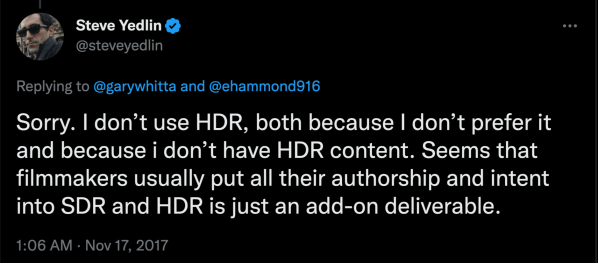
Steve Yedlin’s LG C2 settings, the myth of 100-nit SDR and HDR authorship
Glass Onion: A Knives Out Mystery, the highly anticipated sequel to Knives Out (2019), with cinematographer Steve Yedlin again at the helm, is out on Netflix this Friday, so those of you planning to watch it might be interested in the DP’s preferred settings on his LG C2 OLED TV, which he says allowed him... Continue Reading →
Panasonic S1/S1H Open Gate
We came across this thread over in the EOSHD forums: Can't make decent HDR grade from Panasonic S1 V-Log. What am I doing wrong? “I'm attempting to make a rec.2020 PQ grade from footage shot on the S1 in 6K open gate 200Mb/s long-GOP 420 V-log mode. I'm cutting in Resolve Studio and no matter... Continue Reading →
HDR: Lens Choice Critical
When it comes to HDR, two issues stand out from the rest if a cinematic look is what we're after, the first being 24p judder, a characteristic of motion pictures that cinephiles embrace and which worked well enough in theaters with 2K 48-nit projection but which becomes extremely objectionable on today's higher brightness, higher contrast... Continue Reading →
HDR Troubleshooting Guide/Checklist
Are you shooting RAW? If not, why? Are you recording as much data as necessary while neither clipping highlights nor crushing shadow detail? Are you using the appropriate scopes and tools for judging HDR exposure? If you're shooting with a camera that uses EI (where ISO is just metadata), are you halving your ISO? Noise... Continue Reading →