"To be honest, the full gamut of 2020, I don't think we're ever going to see it. 95% of the Pointer's gamut, which covers most of the naturally reflected colors in nature - trees, fruits, skin tones and everything - it's about P3, it's slightly larger than P3. Those primaries of 2020 gamut and with... Continue Reading →
DCI: Colorists Have An Aversion To Colors Beyond P3
When the DCI (Digital Cinema Initiatives), a joint venture of Disney, Paramount, Sony Pictures Entertainment, Universal and Warner Bros. Studios, published its recommendations for next-gen HDR theatrical presentation in High Dynamic Range D-Cinema Addendum Version 1.0, a black level of 0.005 cd/m2 and peak brightness of 300 cd/m2, for an overall contrast ratio of 60000:1,... Continue Reading →
Is A Camera With 10 Stops Of Dynamic Range HDR?
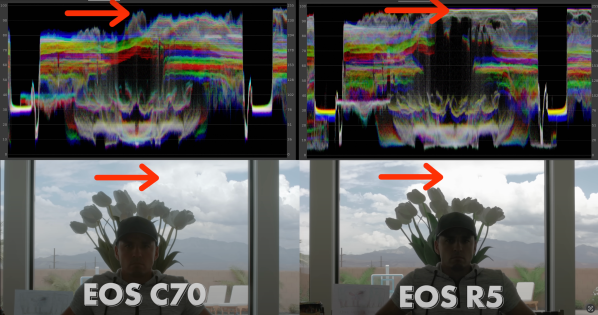
Standards for HDR have been established by various industry organizations for displays but as yet, no similar initiative has been undertaken in the camera industry, though manufacturers almost without exception make exaggerated claims for the dynamic range of their cameras. It is said that photochemical film is capable of 13+ stops, though this varies greatly... Continue Reading →
Michael Zink
You might well wonder how one mortal could possibly wear so many hats, but Michael Zink is Vice President, Emerging Technologies at WarnerMedia, President & Chairman @ UHD Alliance, Education Vice President @ SMPTE, and Co-Chair, UHDTV Committee, Motion Imaging Technology Council (MITC) of the American Society of Cinematographers. In other words, he's someone worth... Continue Reading →
Outlier Pixels: What Are They & How Do They Impact The Viewer Experience?

A while back, we wrote: "Michael Zink and Michael Smith received the Journal Certificate of Merit for their paper "On the Calculation and Usage of HDR Static Content Metadata,” published in the SMPTE Motion Imaging Journal in August 2021. After analyzing over 200 titles from Warner Brothers' catalogue, they proposed a method for calculating the... Continue Reading →
HDR Test Video

We just compared the 16" MacBook Pro (2021) to the LG CX with this test video by Florian Friedrich and it was quite an eye-opener! The difference in color volume is similar to comparing Samsung's QLED to the LG C1 OLED in the header picture and the one below (Sony BVM-HX310 mastering monitor, center). Why... Continue Reading →
BBC study of tolerance to program brightness shifts

Subjective tests reported by the BBC investigated viewer tolerance to sudden changes in overall brightness for HDR television, using the mean pixel display luminance as a measure of brightness as described in [2]. This measure has been shown to correlate well with subjective ratings of the overall brightness, but there may occasionally be a scene... Continue Reading →
HDR Luminance Levels: Why The Critics Are All Wrong

Discussions surrounding the brightness levels of HDR often talk about brightness as if there were some fixed, immutable number beyond which the picture becomes unwatchable (for many, that number is 48 nits!), whereas studies conducted by Dolby and DCI both showed conclusively that viewers overwhelmingly prefer brighter picture levels than are currently available in home... Continue Reading →
HDR: Power Windows
In this post, we look at how to deal with overly bright highlights. Whatever speed limit you decide on for your project, pay close attention to how rolling off highlights affects the texture, detail and vividness of the image. Download the original clips here. https://youtu.be/BuyX4s-rsUE The strongest highlights are 638 nits and the laptop display... Continue Reading →
Major Motion Picture Studios Statement on HDR Brightness Levels
There has never been a push for or a requirement by any of the major Hollywood studios or leading streaming content providers that HDR shows hit a peak luminance of 1,000 nits. In the case of digital projection or direct view displays, there’s never been a requirement that movies hit system peak brightness either. “It... Continue Reading →
Why more care has to be exercised when shooting/grading/delivering HDR than SDR
Clipped highlights that can be rolled off in SDR are unsightly in HDR. HDR is more prone to unsightly banding artifacts. Streaming bitrates must be higher to avoid blocking artifacts. Noise becomes much more of a nuisance in the shadows. Overstauration can make your picture look like cheap camcorder footage. The higher local contrast of... Continue Reading →
HDR used to make the audience uneasy: a good strategy?
During Eric Weidt’s presentation (FilmLight’s Colour On Stage), where he discussed his collaboration with David Fincher on Mindhunter, the colorist talked about how the overhead neon tubes in the shot of a couple shopping at a grocer’s were overpowering, which is why he ended up decreasing the intensity, but that the extended brightness of HDR... Continue Reading →
Is taking advantage of HDR in just one or two scenes of a film a good strategy?
All Quiet On the Western Front (Netflix) had a couple of powerful scenes on the battlefield at night, the small fires burning on the distant horizon, flares in the sky (VFX) and the glint of soldiers’ helmets in the blackness created a very strong impression. As did the brightness of daylight as a few surviving... Continue Reading →
Cullen Kelly: Set A Speed Limit Of Around 250 Nits
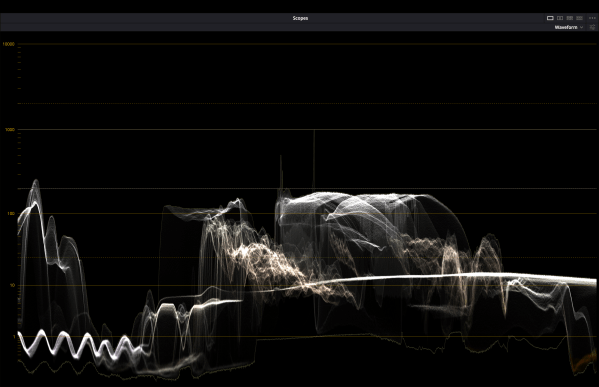
During a live stream, Cullen Kelly said that 1,000-nit specular highlights are unpleasant to look at and that windows should be closer to middle gray. Do you agree? Can intense specular highlights serve an expressive purpose? "HDR is fairly new, and as typically happens with new technologies, we have impartial parties really, really pushing for... Continue Reading →
Cinematographers on HDR
Match the quotes to the DP “[HDR is] a dream for any cinematographer, any creator of images... I think every cinematographer will have an interest in high dynamic range, because it’s the way that we want to capture images, so later we can do whatever we want in [digital color grading]. We need all the... Continue Reading →
MiniLED – How many dimming zones are necessary to a achieve contrast ratios comparable to OLED?

According to this study, when seated at the minimum viewing distance, 4X as many zones are required for an 85" 8K TV as compared to a 55" 4K TV; but when seated at the optimum viewing distance (at which the display occupies a 40° field of view)), the number of zones remains the same for... Continue Reading →
No, It Doesn’t

Forum member, EOSHD https://youtu.be/wEf8FmPMJxM It appears that many in the online community obstinately refer to ETTR as overexposure, which it is not. Overexposure is pushing highlights too far, to the point of clipping, at which point they are unrecoverable. Exposing to the right maximizes dynamic range while minimizing noise in the shadows.
Devotion is a Feast for the Eyes

Unlike 99% of productions, Korean War drama Devotion was conceived, monitored and shot in HDR, the show LUT and dailies were HDR, the hero grade was HDR - and it looks simply gorgeous. Photo: Netflix Photo: Netflix Photo: Netflix Photo: Netflix
“Is the Barten Ramp the correct threshold?”
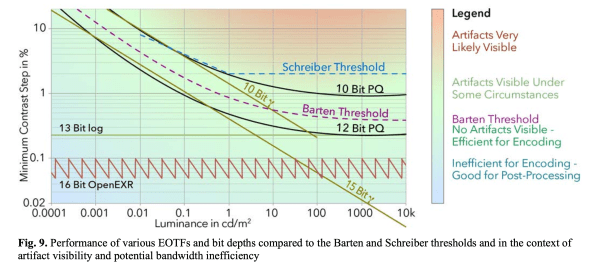
The Barten Ramp is calculated from P. G. J. Barten’s 1999 Contrast Sensitivity Function (CSF), a model that supposedly incorporated most of the important variables in the ability of the HVS to detect contouring in digital display systems. Note this is modeled rather than measured data and the model is based on data that predates... Continue Reading →
“Television Better Served By HLG“
“The PQ system was developed by Dolby, a company whose main focus is on the cinema while the HLG system was developed jointly by BBC and NHK, two organizations whose main focus is on television… Television is probably better served by the HLG system that was designed from the ground up by television engineers for... Continue Reading →
 The Daejeon Chronicles