Can you share with the group how HDR came into your life? What was your experience, your first impressions and especially how, and if they have changed at all, with the other projects you've done? A.S.: I was hired on Ozark, on season 2. I was finishing another show and I was alternating with Ben Kutchins... Continue Reading →
Adjusting Custom Curve for ETTR Footage

Cullen Kelly has contributed a tutorial entitled How to Fix the Dreaded “Video Look” Using DaVinci Resolve to the Frame.io Insider blog where he shares several tips that we've used with great success since following him on his YouTube channel Grade School; but we advise against making an S-Curve as he recommends if you're exposing to the... Continue Reading →
Working Color Space: REDWideGamutRGB/Log3G10, ACES or DaVinci Wide Gamut?
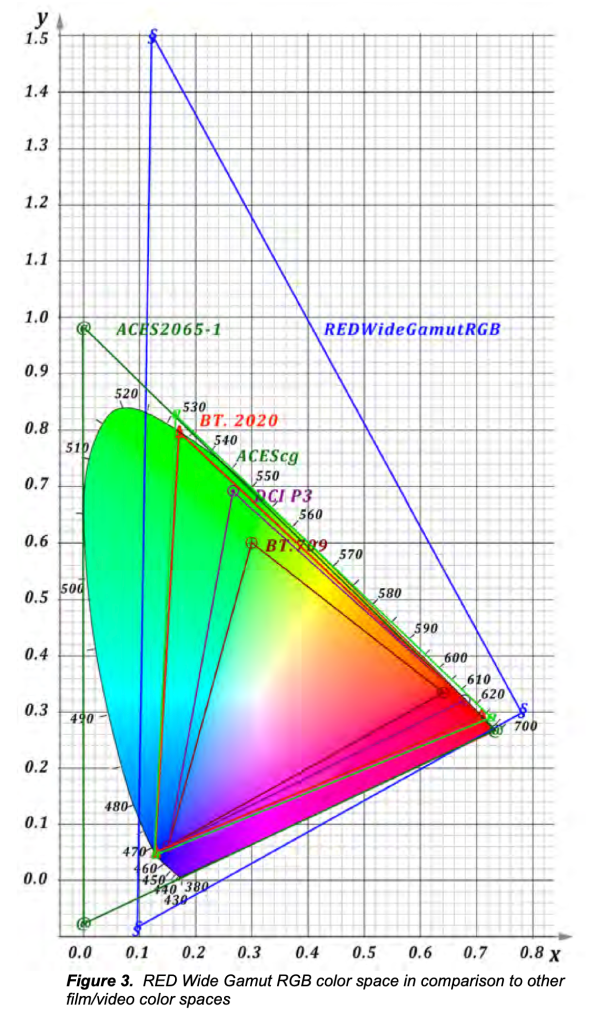
When it comes to post-processing, using the fewest number of transforms and working at the highest available bit depth in a native color space greater than the display color space are key to preserving the greatest image quality. So, should you be changing your timeline color space to DaVinci Wide Gamut Intermediate or not? Three... Continue Reading →
RED Komodo-X TBA

Phil Holland writes: Summary of likely things or known things:- Locking RF Mount- Front Side Record button- Very likely still a top screen- Very likely compatible with DSMC3 monitors now, but not confirmed- Very likely CFexpress Type-B media- Unknown Battery Mount- Very likely 6K resolution, S35 or S35+ sensor with higher unknown framerates. Likely 60fps... Continue Reading →
Budget For Highlights: SDR vs HDR
We’ve written a lot about specular highlights, how there should be enough headroom above diffuse white and how studies have shown participants prefer specular highlights appreciably brighter than diffuse white, by as much as 3X or even more. Just how does that figure compare to SDR video? “In traditional imaging, the range allocated to these... Continue Reading →
Colorist: We Don’t Need A Display That Mimics The Sun’s 1.6 Billion Nits

First, we had a prominent colorist proclaim, "That's the conventional wisdom that I hear a lot, like, the conventional wisdom would be like, 'oh, if you're doing a 1000-nit master, your brightest stuff in your image should be a thousand nits, you should have plenty of like speculars and highlights and things in your grade... Continue Reading →
DaVinci Resolve 18.5 Beta Adds Support For Sony XAVC RAW Controls

Not sure how this is even possible, but Alister Chapman writes: “In addition Black Magic design have just released the public beta of DaVinci Resolve 18.5. With this update you can now use the Raw controls in the Grading room to control the ISO/White Balance/Tint etc of S-Log3 footage from the FX series cameras. This... Continue Reading →
Why We Got Rid Of The Asus PA32UCX

Re-reading an article we'd written back in 2019, we were reminded of just one of the reasons we ditched the Asus PA32UCX - it was impossible to find an affordable way to calibrate the thing. In 2020, Calman would at last release their own 3D LUT calibration, but at the time, it was for Rec.709... Continue Reading →
Apple To Phase Out LCDs and miniLEDs By 2026

According to Omdia, Apple will be completely phasing out LCDs and miniLEDs from its mobile devices by 2026. source
How To Use Cullen Kelly’s Exposure Chart DCTL For 18% Middle Gray

Pick up your free 18% Middle Gray Chart here.
Gamut Rings Greatly Overemphasize Light Areas of Color Volume
“Arbitrarily placing the HDR peak intensity white at L=100 grossly distorts the Lightness curve, and would not be a good Lightness predictor.” Chris Lilley, W3C, 2020 Charles Poynton and David A. LeHoty argue that the color volume metrics used to calculate gamut rings are flawed, greatly overestimating actual coverage, allowing manufacturers to make exaggerated claims... Continue Reading →
Why a 10% test pattern is so signifcant

The luminance just falls off a cliff beyond the 10% window on this display, so it must be useless for grading HDR, right? Actually, it's still used to this day by LA-based post-production houses and around the world for mastering shows for Amazon, Netflix, Disney et al. Read on. Photo: Brian Florian
DaVinci Resolve 18.5 Public Beta Color Page Additions
Per-Timeline Resolve Color Management Timelines using custom settings now allow you to override color management settings on a per timeline basis. This allows setting of independent timeline and output color spaces per timeline along with other color management properties. Any existing custom timelines are automatically initialized to color management settings from the project. Set Composite... Continue Reading →
Samsung Display: The Display Industry Must Switch From P3 To BT2020
From the '2023 OLED Korea Conference' at UBI's '2023 OLED Korea Conference' held in Incheon on the April 13th: “Quantum Dot (QD)-OLED production has exceeded 90%,” said Seonho, vice president of strategic marketing, large-scale Samsung Display. Samsung Display raised the QD-OLED production rate to more than 85% in the first half of last year.“To implement... Continue Reading →
We Try Out The Ninja V + Komodo

After nearly a year, we finally got up the nerve to connect our Ninja V to the RED Komodo and to our great surprise, it didn't fry the SDI port! While our tinkering around with the Atomos Ninja V & Komodo didn’t produce great art it did allow us to discover that, although RED’s creative... Continue Reading →
Sony Announces New Virtual Production Tool Set
From Sony’s press release: Sony Electronics Inc. is announcing a new Virtual Production Tool Set to help improve pre-production and on-set workflows. The new tool set works with the Sony VENICE, Crystal LED and other HDR-enabled LED walls to improve performance and help solve common virtual production challenges such as color matching and moiré to... Continue Reading →
Italian Tech Website Publishes Color Volume Gamut Rings Results Of Flagship TVs
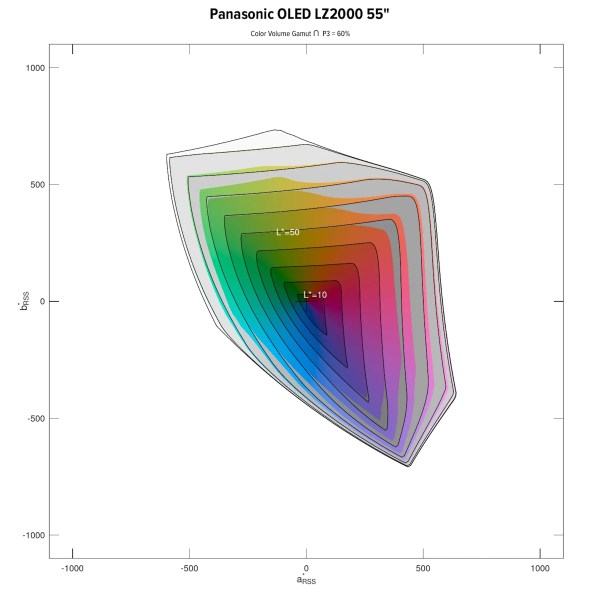
A member over at avsforum shared gamut rings color volume results for Panasonic, Sony, LG and Samsung TVs from Italian tech website DDay.
Familiarity with HDR may increase appetite for greater luminance
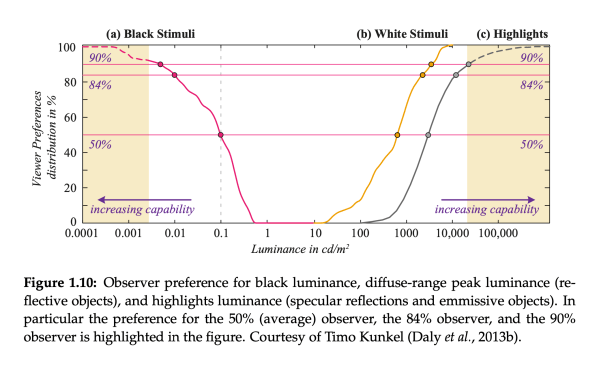
“The average observer preference for dark luminance is 0.1 cd/m2 and diffusive white luminance 650cd/m2 (contrast of 6500:1). Note that state-of-the-art consumer TVs exhibit a peak luminance and contrast range close to the average observer preference. However, the 90-percentile observer preferred a dark luminance of 0.005 cd/m2 and a diffusive luminance of 3 800 cd/m2... Continue Reading →
Dolby Engineer: Some of our partners are using LG TVs for mastering Dolby Vision
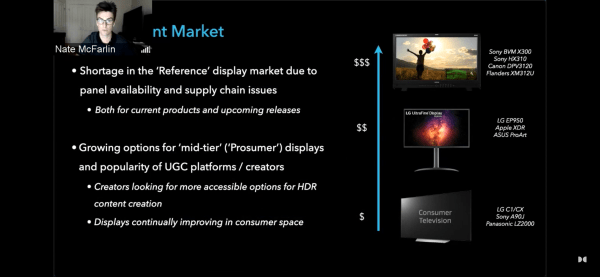
Just the other day, Nate McFarlin, Senior Content Engineer, Dolby Laboratories, NY, wrote: "Dolby doesn't approve specific displays for content creation/grading. We'll always recommend you use the highest quality (reference-grade) display as possible, but we have plenty of clients and partners that use other display options for their work (including LG TVs). Ultimately, it's up to... Continue Reading →
LG Display CTO: Luminance Is The First Priority

Reiji Asakura visited LG Display in Korea in September of last year and took the opportunity to ask CTO Yoon Soo-young whether he felt RGBW OLED was inferior to QD-OLED. “The problem is not whether the light source is white or RGB, but whether the spectrum of light emitted from the display is finally the... Continue Reading →

