
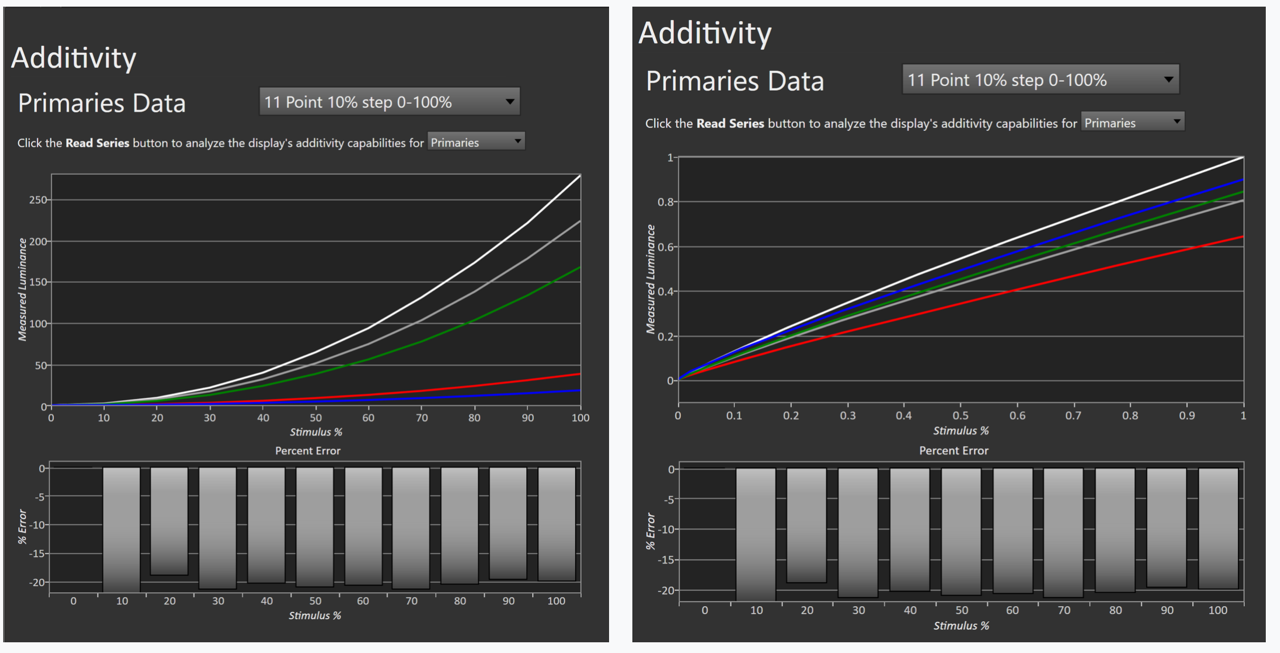
In this video, David Abrams, Sr. Product Manager, Portrait Displays, demonstrates how to use Calman’s new additivity feature using Sony’s A95L QD-OLED, an additive display technology, as an example.
“Some displays exhibit specific characteristics that don’t follow traditional display color physics. This could be due to the manufacturing of the panel itself or processing within the video pipeline. In this instance, more device characterization must occur to achieve an accurate calibration. This usually means that more measurements must be taken of the display before calibration, as the display behavior throughout the color volume is unknown and not predictable with a small dataset.”
“The most common issues encountered on display devices are those that exhibit non-additive characteristics. A display is considered “non-additive” when the energy output of its primary color components measured individually does not sum together to equal the same energy output of color combinations. For example, the peak primaries do not sum to peak white, or the combination of red and green does not equal yellow.”
“Calman’s display additivity feature lets display partners, reviewers, and calibrators alike identify how predictable a display device is for outer and inner gamut color reproduction. This information is key for quantifying calibration quality, comparing technologies, identifying problems, or evaluating settings before calibrating a display.”
 The Daejeon Chronicles
Leave a Reply