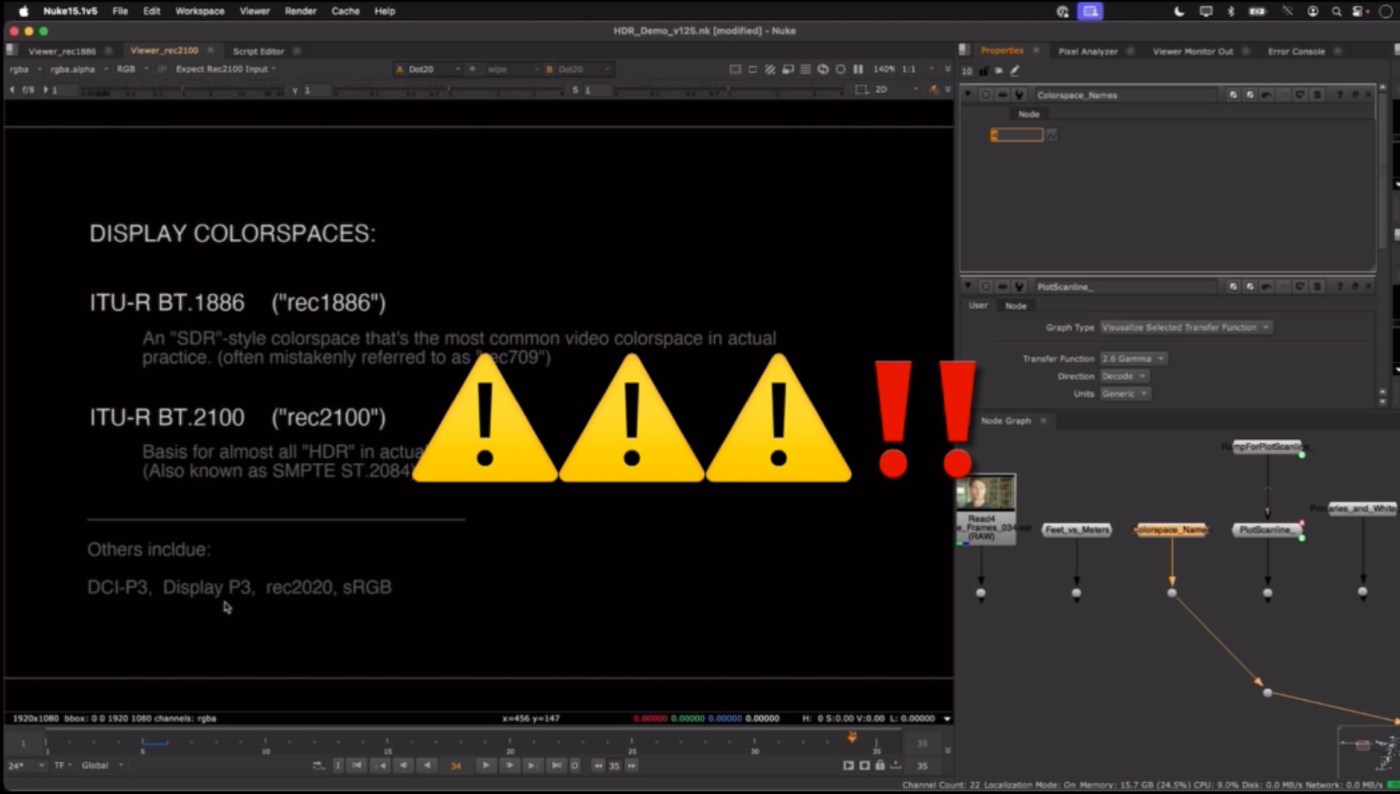
“My HDR demo that’s nominally about HDR kind of almost secretly is a color space demo more than an HDR demo in a way.” Steve Yedlin, Team Deakins Podcast
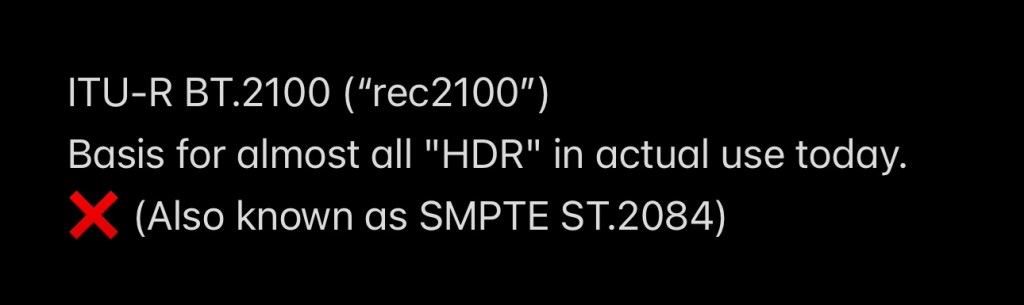
In the above clip, from his presentation “Debunking HDR,” cinematographer Steve Yedlin claims that ITU-R BT.2100 = SMPTE ST2084 [1]. That is categorically false. SMPTE ST2084 (PQ) is an EOTF. BT.2100 is the ITU-R standard for UHDTV (HDR/WCG), defining–among other things–Rec.2020 primaries, white point and EOTF options (PQ/HLG).
COLOR SPEC MAYHEM
Yedlin’s presentation is a MASTERCLASS in color spec chaos. Every single entry under “DISPLAY COLORSPACES” in the above clip is misclassified!
Yedlin’s representation claims to list “COLORSPACES,” yet:
BT.1886 → Transfer function
BT.2100 → The ITU-R standard for UHDTV (HDR/WCG) defining a complete video system including transfer functions (PQ or HLG), bit depth, white point and BT.2020 color primaries.
ST.2084 → PQ (EOTF)
Not a single one is a stand-alone color space!
In the following clip from the same presentation, Yedlin makes a number of outlandish claims:
“Display P3 is the color space that Apple computer monitors use. The monitor itself is Display P3, but very often it’s receiving Rec.1886 and just converting it to P3. Rec.2020 is exactly the same as Rec.1886, but with a wider color gamut. sRGB is also exactly the same as Rec.1886, but with a slightly different transfer function.” – Steve Yedlin
REALITY CHECK
- Rec.1886 does not exist. ITU-R BT.1886 exists. Using “Rec.1886” contributes to industry-wide confusion.
- Display P3 is a color space. BT.1886 is a transfer function. One cannot simply “convert” BT.1886 to Display P3 in the manner described.
- Rec.2020 is a color space. BT.1886 is an EOTF. It has no primaries. Therefore, Rec.2020 cannot be “BT.1886 + wider gamut”
- sRGB is a color space. BT.1886 is a transfer function. Therefore, sRGB ≠ BT.1886 + “a slightly different transfer function.”
SOURCES: ITU-R BT.2020, ITU-R BT.1886, IEC 61966-2-1
- Yedlin’s Conflation of Standards In his presentation, Steve Yedlin explicitly equates Rec.2100 (ITU-R BT.2100) with SMPTE ST 2084, stating: “We’ve got Rec.2100. Again, Rec.2100 is the short name [points to Rec.2100 with cursor].The full name is ITU-R BT.2100 [points to ITU-R BT.2100 with cursor], and it’s pretty much the only implemented HDR standard – especially when we’re talking about what people actually see in a final, as opposed to mastering. There are some other codified formats, but this is really the only one that’s really implemented. So, it’s pretty much the basis for all HDR that we’re actually using. And this one is also known as SMPTE ST2084 [points to SMPTE ST2084 with cursor]. And that’s because two different standards bodies have codified the exact same color space. This [pointing cursor at ITU-R BT.2100] is the International Telecommunications Union. And this [pointing cursor at SMPTE ST2084] is the Society of Motion Picture and Television Engineers.” This is factually incorrect:
Rec.2100 defines HDR parameters (color primaries, EOTF, bit depth). SMPTE ST 2084 defines only the Perceptual Quantizer (PQ) EOTF. ST 2084 is one component of Rec.2100, not a synonym. (Source: Yedlin’s “Debunking HDR”)
 The Daejeon Chronicles