Shocker! In the very first study of its kind, the authors (from the University of Cambridge and Netflix, Inc.) discover that significantly higher streaming bitrates are required to deliver satisfactory HDR AV1 video.
D. Hammou, L. Krasula, C. G. Bampis, Z. Li and R. K. Mantiuk, “The effect of viewing distance and display peak luminance — HDR AV1 video streaming quality dataset,” 2024 16th International Conference on Quality of Multimedia Experience (QoMEX), Karlshamn, Sweden, June 18 to 20, 2024, pp. 193-199
The first publicly available dataset that measures the effect of display peak luminance and includes HDR videos encoded with AV1. Our results indicate that the effect of both viewing distance and display luminance is significant, and it reduces the visibility of coding and upsampling artifacts on dimmer displays or those seen from a further distance.
Source Sequences
50 HDR10, 4K (3840 x 2160) / 1080p (1920 × 1080) video sequences from various sources which included natural camera-captured, animated and computer- generated (gaming) content were selected. All sequences are characterized by a bit depth of 10 bits, a YUV 4:2:0 chroma sampling, SMPTE ST2084 (PQ) EOTF, and BT.2020 primaries.
Encoding Space
(see paper)
Experimental procedure
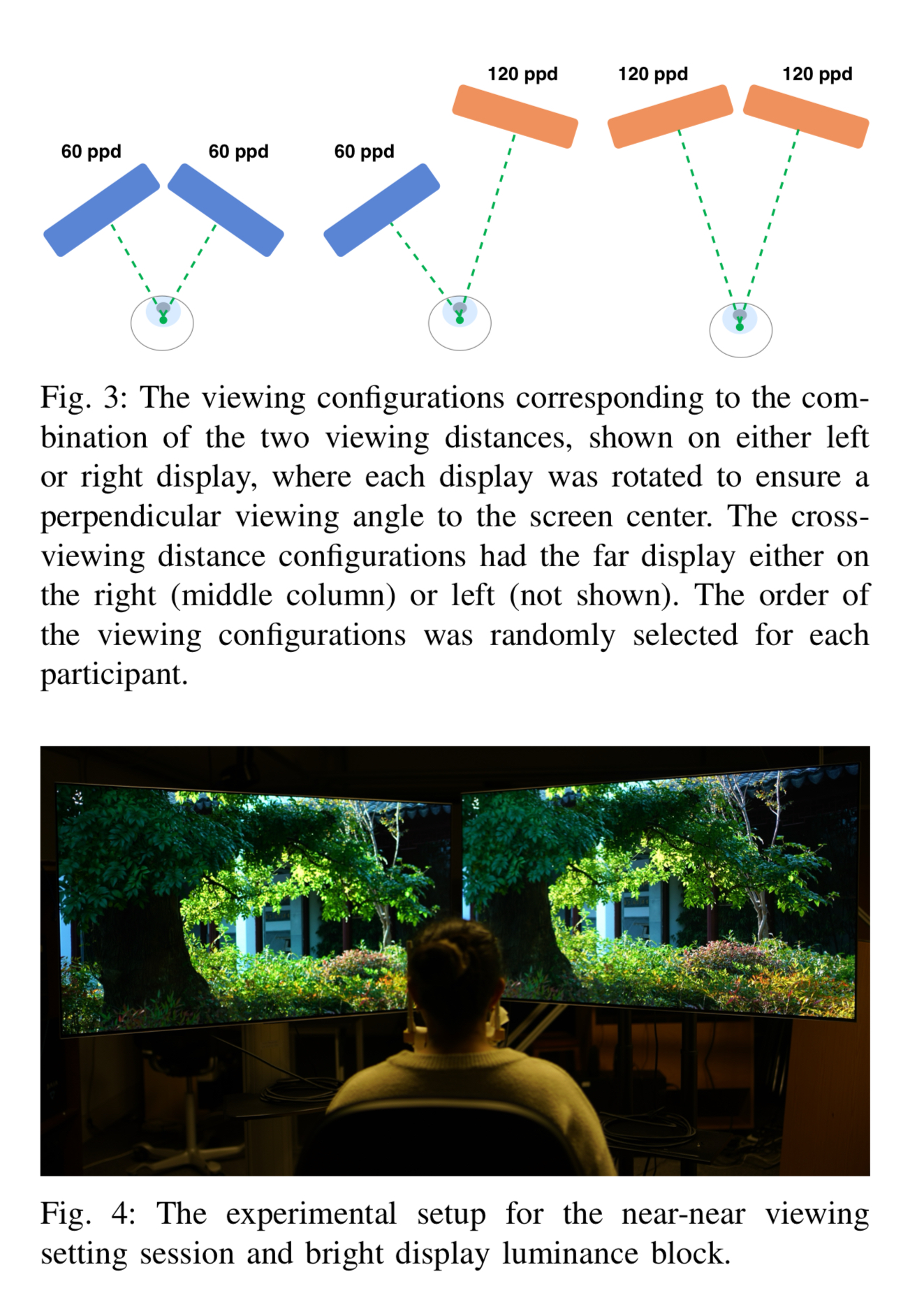
Following the BT.2100-2 recommendations for HDR viewing, two viewing distances were considered in the experiment: 1.6 and 3.2 of display height (an effective resolution of approximately 60 ppd and 120 ppd), as well as two display luminance levels: a bright display (peak luminance of 700 cd/m² and a mean luminance of 51 cd/m² as measured from a color patch covering 5% of the display using the Konica Minolta Chroma Meter CS-200) and a dim display (peak luminance of 600 cd/m² and a mean luminance of 5.6 cd/m²). The dimmer simulated using an OpenGL fragment shader that reduced the luminance of all pixels by a factor of 8 (in a linear RGB color space). The experiment was conducted in a controlled environment within a dim room, maintaining an ambient illumination of approximately 0 lux throughout the experiment.
Participants
A total of 30 volunteers (16 females and 14 males) participated in the experiment, aged between 13 and 52 years (median age of 24 years and mean age of 26 years), where 8 of them were familiar with HDR. 25 of the participants completed all four sessions, resulting in a total number of 25762 pairwise comparisons. All participants had normal color vision, as indicated by the Ishihara test, and all of them had normal or corrected to normal visual acuity of at least 20/25, as measured by the Snellen test.
The effect of viewing distance and display luminance
[O]bservers are less likely to notice the drop of quality at lower bitrates or lower resolution when the video is shown from a further distance or at a lower luminance level.
CONCLUSION
In this paper, we introduced a new HDR-VDC dataset capturing how the quality of streamed 4K HDR10 AV1 video varies across two viewing distances and two display luminance levels. The most important observation is that both viewing distance and display peak luminance significantly affect the visibility of streaming distortions. This amounts to very substantial differences in bitrate required to deliver the desirable quality, which depends on the viewing conditions. We hope that this dataset will help to test and develop quality metrics that account for the viewing conditions and bring attention to the important problem of controlling display peak-luminance and viewing distance in video quality studies.
 The Daejeon Chronicles
Leave a Reply