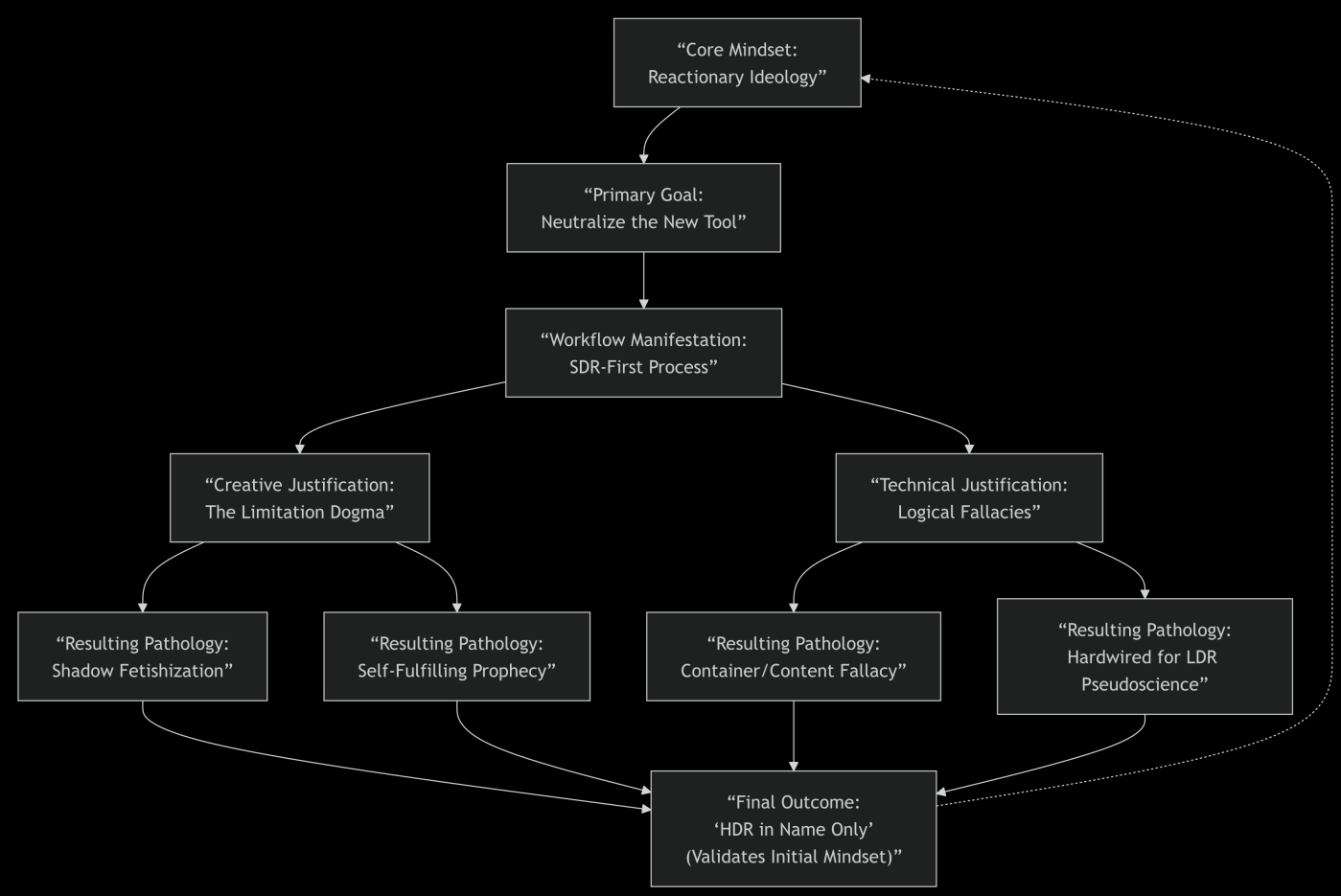
The flowchart above maps the self-reinforcing system of reactionary HDR pathologies. The following sections define and dismantle each weapon in this arsenal.
The Reactionary Mindset
A reactionary position isn’t simply about preferring old tools: it’s about idealizing the past, viewing change as a detriment and moralizing technology.
Direct Quote:
“…the things that are actually different about HDR compared to SDR are all detriments, not advantages. They’re only dressed up as advantages by misinformation.” Steve Yedlin, Debunking “HDR” (2025)
A reactionary stance is inherently limiting.
An artist who sees a new tool like HDR as an opportunity might think: “How can I use this expanded range for more powerful storytelling?”
A reactionary thinks: “How do I make this new tool behave exactly like the old one? How do I neutralize its inherent properties to conform to my existing ideology?”
The Self-Fulfilling Prophecy
A self-reinforcing system of failure.
Direct Quote:
“Marketing. It’s all marketing. It’s all a way to sell something.” – Ed Lachman, interview in The Film Stage (Nov. 2024)
The cycle is closed-loop:
1. Belief: “HDR has no creative value.”
2. Method: Use a workflow that deliberately nullifies its creative tools.
3. Result: Produce a deliverable that has no creative benefit.
4. Confirmation: “See? HDR added nothing. It’s all marketing.”
The Limitation Dogma
“HDR breaks with centuries of Western visual codes.”
Quote (Translation):
“[HDR] provokes a break from the visual code that has prevailed for centuries in the culture created around the representation of images.” – Edi Walger, “Conceptos clave para comprender Debunking HDR”. LinkedIn (June 2025)
Direct Quote:
“Go find me a painting where you can discern more than five to six stops of dynamic range… that’s generally not the way we absorb a painting… that’s actually part of what makes those paintings so captivating.” – Cullen Kelly, Colorist, Entrepreneur, Livestream, Grade School, YouTube (Aug. 2025)
Rembrandt didn’t choose limited dynamic range—he worked around it. Kelly’s theory of “captivating limitation”—which he presents as objective truth—is nothing but a post-hoc justification for technical limitation. The Old Masters didn’t sit around praising the “captivating” limitations of their pigments.
Elevating limitations to virtues is the core error of the SDR-first mindset.
“Hardwired for LDR” Pseudoscience
“As a species, humans are programmed for low dynamic range (LDR) imagery.”
Direct Quote:
“For eons, as a species, we’ve been obsessed with taking real world high dynamic range scenes and reproducing them on low dynamic range display devices.” Joshua Pines, Chief Color Scientist, Picture Shop. “A Rebel’s History of Color in Cinema,” Portrait Displays YouTube channel. (Sept. 2023)
High dynamic range is the human visual system’s default condition; SDR is the aberration. The prevalence of LDR imagery has historically been due to technical constraints, not a biological imperative.
Pseudoscience attempts to ground the reactionary position in false biology.
Shadow Fetishization
A complete rejection of HDR highlights.
Mike Chiado, CTO, Company 3, reduces HDR to shadows, rejects highlights:
“For us, HDR isn’t about bright, it’s about dark. That’s what we enjoy about it. Everybody keeps making brighter and brighter TVs… but we don’t go up there. Our stuff doesn’t go up there. It blinds people.” – Mike Chiado, CTO, Company 3, quoted in What Hi-Fi? (Feb. 2024)
Joshua Pines, Color Scientist, Picture Shop, echoes this:
The visual benefit of HDR is “mainly about increased shadow detail.” – Joshua Pines, Color Scientist, Picture Shop, quoted at the HPA Tech Retreat (Feb. 2016)
Steve Yedlin’s ‘Debunking HDR’ demonstration eviscerated the industry’s shadow fetish: extreme shadow manipulation in HDR (e.g., lifting blacks 1000x) is “just a minor, minor decision in the rendering.”
The Logical Fallacy
Conflating the contents with the container (e.g., “100-nit video in an HDR container is High Dynamic Range”.
Direct Quote:
“The only line that can be drawn objectively is SDR’s 100 nits. Anything above that in principle is HDR.” Yoeri Geutskens, “We Need to Talk About HDR”. FlatpanelsHD (Oct. 2020)
The content’s dynamic range is established at the time of creation and encoding. The container doesn’t magically generate the missing dynamic range. The video remains LDR content formatted for an HDR pipe.
All the above are designed to (a) protect outdated workflows, (b) neutralize consumer expectations and (c) create plausible deniability.
 The Daejeon Chronicles
Leave a Reply