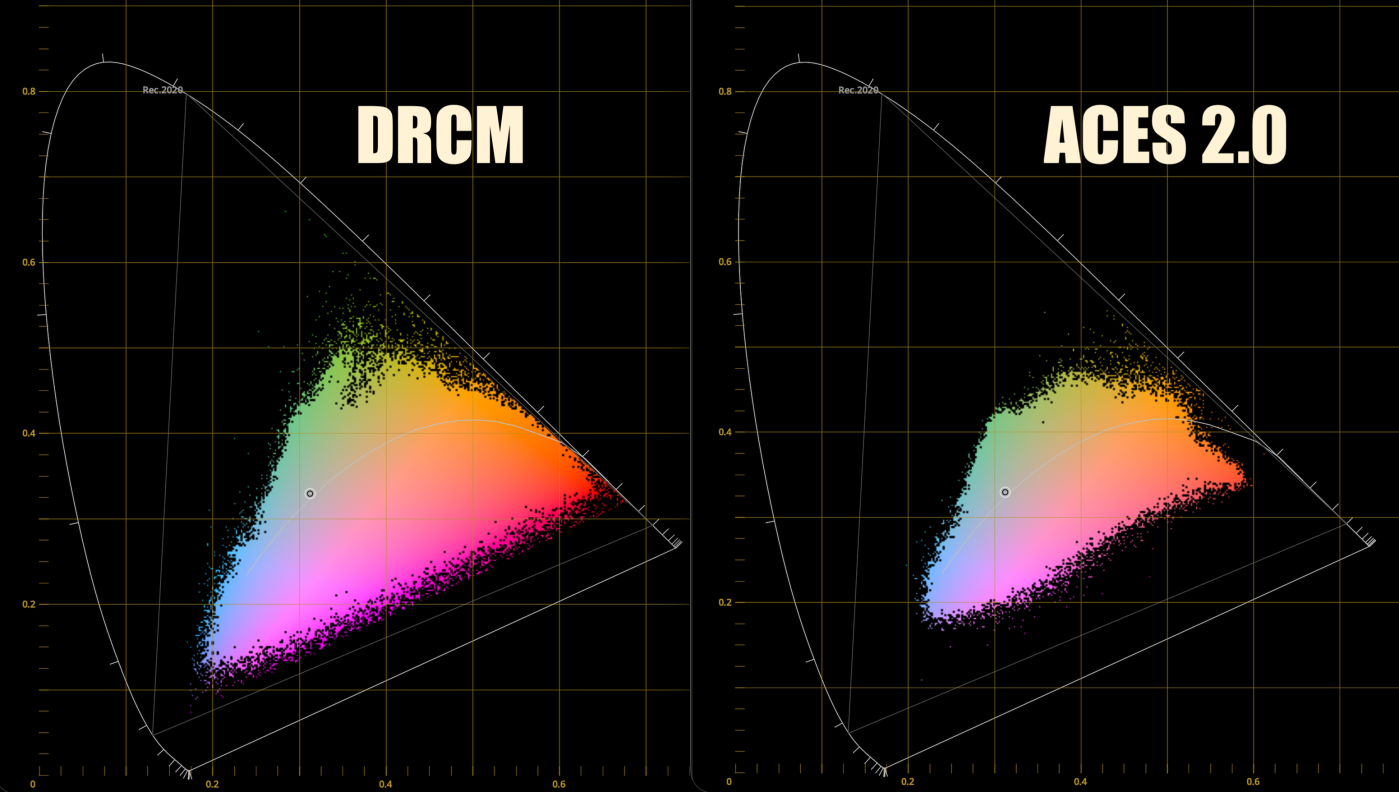
The following two premises by Alex Fry, co-chair of the ACES 2.0 working committee, reflect the prevailing industry standard ‘top-down’ approach that makes HDR the primary creative canvas:
1. “The HDR version is the definitive version of the film.”
2. “The SDR version is a derivative of the HDR version.”
However, his third premise flips this logic on its head—describing an SDR-centric approach that undermines HDR’s potential:
3. “Most of the creative decisions get made in SDR… then those creative decisions need to transition and hold true into the HDR domain [1].”
Translated: the “true” creative intent is the SDR; the HDR is just another spec to be adhered to. This is the guiding philosophy of ACES 2.0 as expressed by one of the leading figures in its development.
“My message will be that HDR is its own aesthetic, and that we must monitor and shoot for it on set, with SDR conversions being accomplished in post production under the supervision of the cinematographer. I believe that we can no more shoot for HDR and SDR simultaneously without serious compromise than we could shoot for 16:9 and protect for 4:3. It just won’t work. I expect to hear complaints about the cost of monitoring for HDR. My response to that is simple: ‘You’re spending millions of dollars on a production and yet you’re willing to risk it all over the cost of HDR monitoring?’”
— Steven Poster, ASC (2018)
That philosophy has direct, measurable consequences for the image. Graphics programmer Filippo Tarpini confirmed that ACES 2.0, in its default state, “is fully focused on maintaining a contiguous and conservative look between SDR and HDR.” He noted that in testing, “Highlights completely desaturate to the point where they never have any color. That’s simply not how our eyes work, and it looks off. Most importantly, it doesn’t take much advantage of the wider gamut of HDR displays.”
Rendering engineer Jean-Michel Gilbert affirmed that this is not a bug, but a feature: “Yes it’s by design. There were a lot of arguments in the ACES next meetings about whether SDR or HDR should be the master target and the SDR champions won.”
For an HDR colorist, the implications are profound. It means that if you adopt the ACES 2.0 framework and use its default output transform, you’re baking in a set of choices designed to restrain the HDR image to ensure it doesn’t deviate too far from its SDR counterpart.
As Gilbert grimly predicted, the result of this industry-wide standardization may be that “a lot of movies will have worse HDR in the coming years compared to previous years,” a sentiment Tarpini echoed, suggesting “we are in for some further years of bad HDR!”
A Promising Case Study
“Historically, our productions prioritized SDR (Standard Dynamic Range) theatrical masters, with HDR versions as secondary. Sole Mates reversed this priority by regularly reviewing work in HDR and providing HDR capabilities to artist workstations in color-critical departments such as lighting. This marks a departure from the traditional practice of confining HDR to later stages, such as final color grade.”
— Netflix Animation, SIGGRAPH 2025
In his discussion with befores & afters at SIGGRAPH ‘24, Fry cited a technical constraint: “Linux is our primary desktop platform that we do all of our compositing, lighting and all texture painting on, and the OS has no meaningful support for HDR. So, for now, with the platform that we’re working under, it’s just not a reality on the desktop.”
Netflix Animation’s Sole Mates case study demonstrates that HDR-first workflows are achievable even within Linux-based pipelines. They addressed UI challenges via Qt and OCIO, developed tailored ACES 2.0 display transforms for varying monitor capabilities, and concluded that “HDR provided early artistic freedom…Artists embraced the solutions.”
- This marks a notable reversal from Fry’s own position years ago. In a 2017 GDC presentation about the Frostbite Engine, he was unequivocal: “HDR is the reference in Frostbite; SDR is just an artefact of the display mapper.” He urged developers to “master your content in HDR and treat the HDR as a reference version by all means… try to master your game in the widest possible space. Master in HDR and then produce every version of that as an artefact.” He concluded: “It’s in all of our interest to try and drive the adoption of HDR. It is a lot better.” (Fry, GDC 2017)
References:
Ian Failes, “Getting your VFX head around ACES 2.0”, Interview with Alexander Fry at SIGGRAPH Asia 2024, befores & afters (April 16, 2025)
Alex Fry (Frostbite Team, Electronic Arts) “High Dynamic Range Color Grading and Display in Frostbite”, GDC (2017)
Alex Fry, High Dynamic Range Color Grading and Display in Frostbite, GDC Festival of Gaming, YouTube (Aug. 9, 2019)
Steven Poster, ASC, International Cinematographers Guild IATSE Local 600 Presentation to the ICS at the ASC Clubhouse (2018-06-07)
Filippo Tarpini LinkedIn post (Mar. 3, 2026)
Michael De Caria, Manuel Macha, Iain Northcott, and Steve Agland. “Blinded By The Light: A Case Study Of HDR Integration In Animation Production”. SIGGRAPH Talks ’25: Proceedings of the Special Interest Group on Computer Graphics and Interactive Techniques Conference, Article No. 22, Pages 1-2. 10 August 2025
 The Daejeon Chronicles