
ACES 2.0’s goal of “invertibility” to make HDR match SDR is philosophically flawed. It leads to compromised image quality and enables a workflow where creatives avoid engaging with HDR.
Invertibility
In 2024, the ACES Project Co-chair announced a breakthrough—ACES 2.0 was finally “invertible”:
“the number one item that we collected during our ‘listening tour’ was that the new ACES 2.0 had to be invertible. And thus, we finally have it! I hope that makes sense.” —Annie Chang, ACES Project Co-chair, ACES Central (July 2024)
“Creative colour film pictures are not invertible. Black and white film are not invertible. X-Ray pictures are not invertible. The idea that a picture can be ‘inverted’ at all is part and parcel of a larger and suffocating conceptual framework. If I said ‘invert Starry Night’ you’d bust out laughing at me, yet folks utter it with a straight face.”
—Troy Sobotka, ACES Central (May 2023)
Daniele Siragusano mocks the demand for invertibility:
“I agree 100% with Troy. The desire for invertibility comes from those who want to avoid using the process in the first place. It is a naive wish, chasing rainbows, a daydream of an unrealistic utopia. It is seductive and leads to the wrong working paradigm and bad habits.” —Daniele Siragusano, Image Engineer, FilmLight, ACES Central (May 2023)
For Siragusano, the desire for invertibility is symptomatic of a failure to engage with the process. If you can grade in SDR and “invert” to HDR, you never have to learn HDR’s grammar. You never have to make creative decisions for HDR. This attitude is exemplified by Joshua Pines, who frames the “problem” as HDR and SDR looking different. His solution: make them the same:
“One of the problems is they look different. So, if you’re doing a movie or an episodic, it’s like, can you simultaneously think about making two things that look different? Usually there’s a vision, right? There’s a creative intent that you want preserved across all the things. So what we wound up having to do is to sort of cater to both… Here are two different ways: one is very similar to your SDR, and here’s another one that looks like a party at a rave out in the desert. I think over time, they’re really coming back closer together. HDR and SDR, they really don’t look like they’re in different worlds.”
—Joshua Pines, Color Masterclass with Joshua Pines & Maxine Gervais | COLOR MATTERS S2.E8 | Portrait Displays YouTube channel (Jan. 17, 2024)
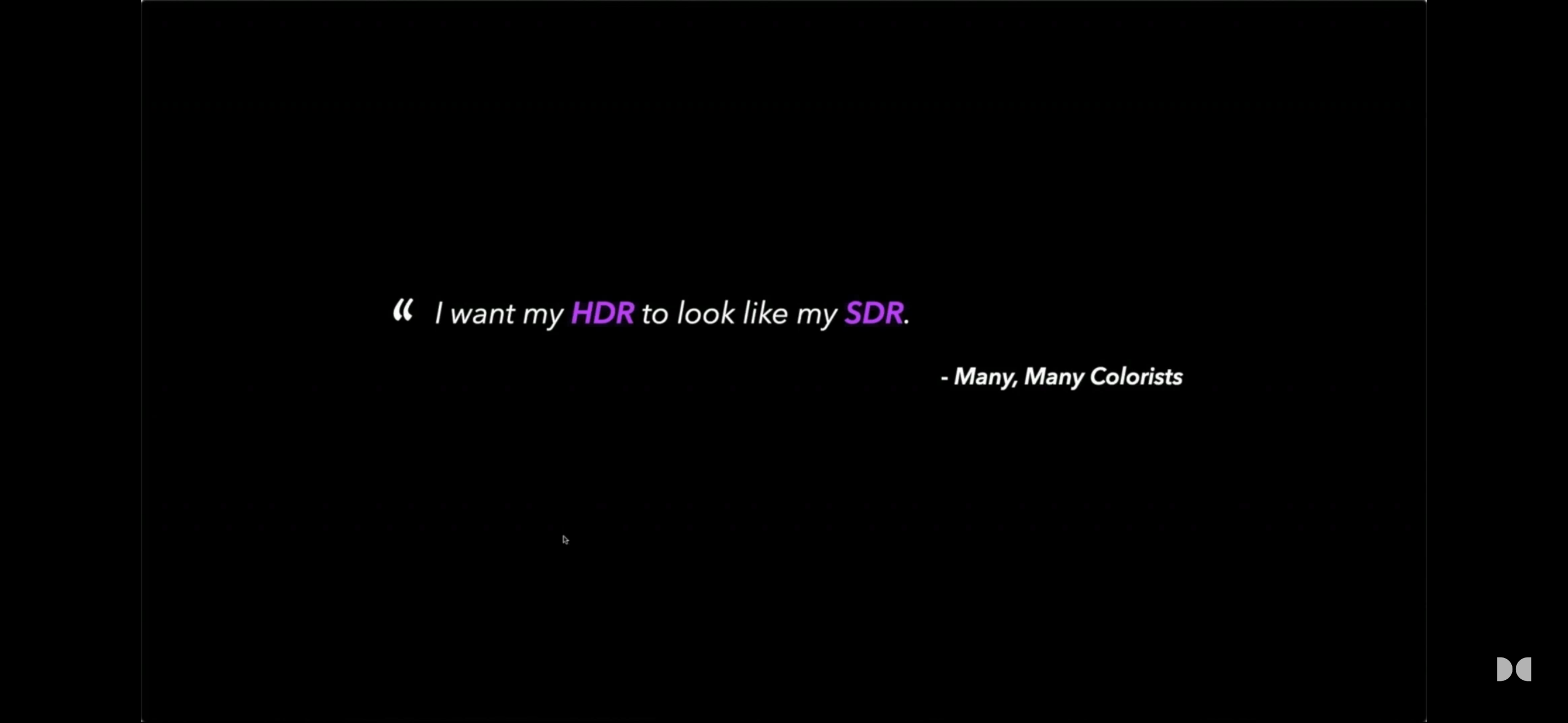
This view is not fringe. Dolby’s own experience confirms it:
Partial ACES
Because ACES is perceived as a high-end industry standard, it’s often used as a marketing buzzword-even when actual color management follows traditional methods, as when a production skips ACES on set and uses it only in post-production:
“It doesn’t change anything. For me, it hasn’t changed anything in terms of how I work on set… We were monitoring in Rec.709 on set. In terms of monitoring with ACES on set at that time, we felt that that was a bridge too far… I monitor in Rec.709 and that’s it.” —Jamie Cairney, BSC, Sex Education Season 2 – A Deep Dive Into The End-To-End ACES Workflow, Academy ACES YouTube channel (Mar. 31, 2021)
“For Universal Pictures (for now), we prefer that our live action productions do, at the minimum… 4, 5 and 6 [VFX, Titles & Graphics, Final Color; Archival Masters] in ACES. …We let the production decide whether they want to do 2 and 3 [On-set; Dailies / Editorial]—those are optional on our ‘ACES shows.’” —Annie Chang, ACES 2.0 Co-chair, ACES Central (May 2022)
“the most significant ingredient in many ways is stage 5 [Final Color] and that would be enough to make a show ACES.” —Kevin Shaw, CSI, ACES Central (May 2022)
This echoes Shaw’s HDR philosophy: “it doesn’t really change anything but the grading pass”. The results of this attitude are predictable:
On the hazards of not monitoring in HDR & ACES from the outset:
EXHIBIT A – Rand Thompson (REDUSER.NET, May 2023)
“You could include a Creative RWG/LOG3G10 LUT along with whatever Chosen IPP2 Output Transform you wanted and shoot with that. Then a DIT would probably make CDL corrections that were according to the DP or Director and pass those CDLs along to the Colorist to add to the Post Production Grade for further color grading… Now, however, you would be starting from a Look with different Tonality and Color Rendition that neither the DP, Director and DIT had started out with or agreed to in Production nor what the DIT had made CDL correction for. So now it’s up to the Colorist to make it resemble the look that was established in Production which will be very hard if not impossible to achieve.”
EXHIBIT B – Miga Bär (ACES/CML Filmmaker Panel, Camerimage 2022)

“The example that you see here is two test images processed through RED’s IPP2 color science, which is a nice pleasing look to start with; but if this is what you’re viewing on set and your colorist is going to start an ACES – and I’m going to flip back and forth a few times – then this is the first image that you’ll see in your grading suite. It’s relatively easy to see and to immediately acknowledge that you’re gonna light differently on set for the one and the other. Neither of them are wrong, neither of them are necessarily the best option, but it’s the starting point that your colorist will have in their grading suite, so you want to make sure that on set you’re monitoring that same starting point so at the very least, even if you do not build a look, make sure that you receive from your colorist something that replicates their pipeline so that you’re viewing that on set as a starting point.”
—Workflow Consultant Miga Bär, Protect Your Creative Intent with ACES (Academy ACES YouTube, Feb. 8, 2023)

EXHIBIT C – James Kersley-Cregeen (FilmLight Panel, Camerimage 2024)
“I have one anecdote coming from another colorist who said they spent, it was a two-day HDR grade and then they had half a day for the SDR Dolby Vision trim pass. The first day of the grade – it was the first time anybody had seen anything in HDR, first of all, which is fairly normal, but also it was the first time they’d seen it using ACES as the color pipeline, and it had more saturation, more contrast than what they were expecting. They said it was too contrasty, too much saturation. And because they’d been looking at flat, log images in an edit suite for a year. So then they spent the first day at the grade taking all the contrast and saturation out. They then came in on the second day to review what they’d done the day before and went ‘it’s a bit flat, so let’s pull all the contrast and saturation back in’. And they basically ended up two days later having spent thousands of pounds to get back to where they started. None of that time was creative, none of that time was improving the product, none of that time was enhancing the look and feel of the show.”
—James Kersley-Cregeen, Production Technologist, Netflix (Look Development in Documentary Filmmaking, FilmLight YouTube, Mar. 11, 2025)
While Netflix doesn’t mandate ACES, they consider it a holistic end-to-end color pipeline that includes the following:
Full ACES
- Your production used ACES on set, in VFX, Digital Intermediate and final Mastering
- Your production used ACES Input Transforms, Academy-published ACES Output Transforms, and delivered master digital image files conforming to Society of Motion Picture and Television Engineers (SMPTE) standard ST 2065-4
— Academy of Motion Picture Arts and Sciences, “Information on ACES and How to Determine if It Was Used on Your Production”
 The Daejeon Chronicles
Leave a Reply