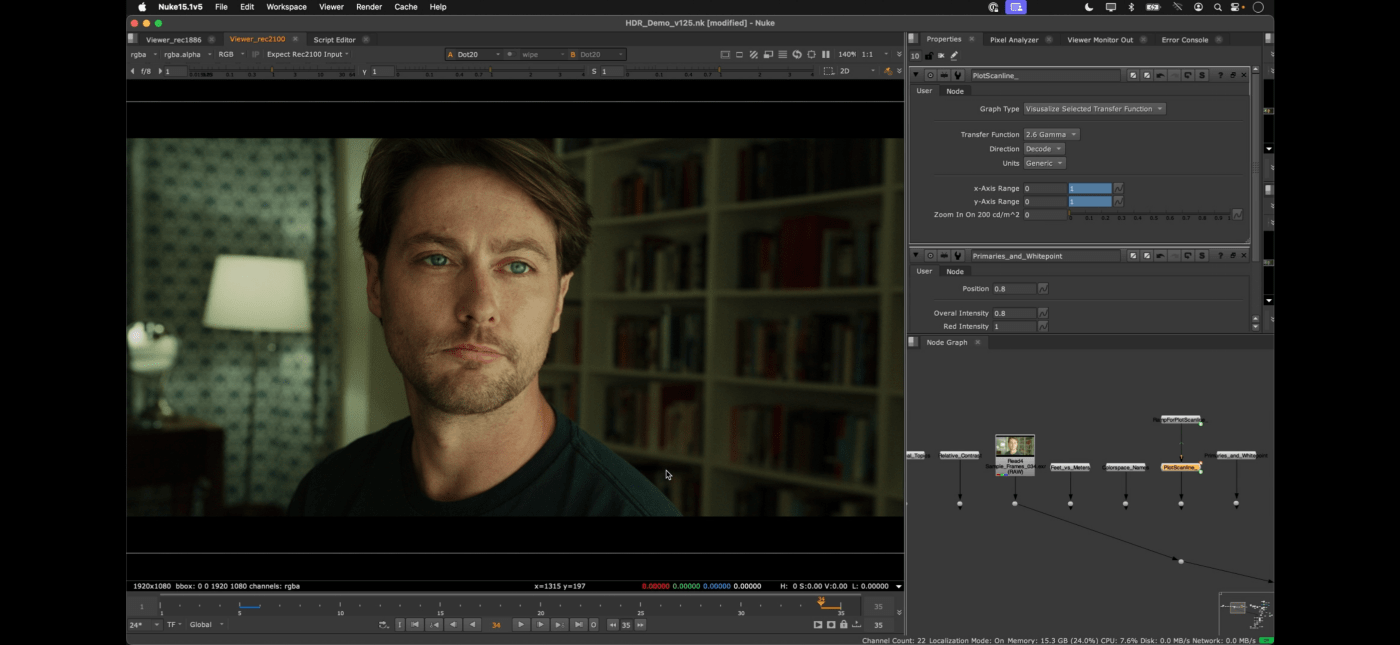
Steve Yedlin Wages War On HDR
“When it comes to “formats” (i.e. colorspaces) as opposed to hardware, with the exception of one thing (how we use the excessive screen brightness available) which is a trade-off more than an advantage, the things that are actually different about HDR compared to SDR are all detriments, not advantages. They’re only dressed up as advantages by misinformation.” – Steve Yedlin, ASC
When acclaimed cinematographer Steve Yedlin declared HDR’s advantages “detriments dressed up by misinformation” at a closed-door FotoKem presentation attended by industry luminaries like Roger Deakins, Netflix’s Joseph McCormick, and leading color scientists, he ignited a powder keg in imaging circles. This critique isn’t merely technical dissent – it challenges fundamental workflows and creative intent, not to mention billions in technological investment. Yet Yedlin’s arguments demand rigorous examination. We unpack the claims, evidence, and critical omissions in the conversation.
Debunking “HDR”
Cinematographer Steve Yedlin spoke for over two hours to a receptive group of devotees at FotoKem, endlessly repeating himself and introducing questionable terminology like “punching through the ceiling” to describe HDR highlights, ensuring that we’ll be hearing this problematic phrase ad nauseam from his legion of fans for years to come. His skeptical tone and dismissive demeanor; his inaccurate framing of BT.2020 as a mastering color space rather than industry standard P3-D65 [1]; claiming that HDR is a grading style only that has no aesthetic value worth pursuing; arguing that SDR in an HDR container is still HDR; and his failure to acknowledge that there already exists an HDR format better suited than PQ to viewing in non-reference viewing environments if that’s your priority (HLG) and on and on… undermine the credibility of his position.
- This is the same person who loses it when BT.1886 is referred to as Rec. 709!
HDR Is Nothing More Than A Grading Style
Since Yedlin so casually distorts the truth, contending that HDR is no more than a grading style, let’s not overlook present-day SDR practice: few things are more objectionable than flat lighting, low contrast grading, detail destroying diffusion filters, piling on heaps of fake grain, premature highlight roll-off and lifted shadows, all in a misguided attempt to emulate an imaginary, dated analogue film look.
HDR is an end-to-end process, from capture and post-production to storage, distribution and display. In order to be successful, the color, contrast and highlight and shadow detail, as well as the compositional choices that make effective use of HDR need to be evaluated on set, thereby ensuring that the look/emotional impact travels through all the way to the final deliverables.
At one point during the presentation, Yedlin remarked how difficult it was to make out the face in a shot after brightening up the window in the room, which is ludicrous, because (1) a bright face against a bright window looks inauthentic; (2) some of the most powerful moments in narrative HDR are when a character’s face is intentionally obscured or silhouetted, e.g., Na Baek-jin emerging from shadows makes him appear all the more menacing in Weak Hero S2:E3 (24:10); and (3) cinematic means not over-lighting shots.
“On the subject of how dark is too dark, there was an aspect that I found very appealing in making the short film: The characters have amazing designs, angular faces, and caricatural facial features (longer nose longer, overly spaced eyes) which gave a new dimension to portrait lighting.”
“The nature of their stylization made it so that they all have a big supraorbital bulge which in early lighting phases systematically put all their eyes into shadow. We thought that was gorgeous. In a way, that situation also made us realize that for this film, we would not light the faces.”
Jean Baptiste Cambier, CG Supervisor, Blur Studio, discussing dramatic lighting in Bad Travelling (Season 3, Love, Death + Robots, 2022)
HDR Is All Marketing
Yedlin claims that HDR is nothing more than marketing, yet sound and color were also dictated by studios and demanded by audiences. During the emergence of the sound era, actors and actresses who couldn’t transition from the silent era were supplanted by those who could memorize and recite dialogue in a voice pleasing to audiences.
Speaking of marketing, the marketing budget for Yedlin’s “Star Wars: The Last Jedi” is estimated to have been around $150 million.
In attendance: cinematographers Roger Deakins ASC BSC, Kramer Morgenthau ASC and John Brawley ACS, colorists Dave Cole, Phil Beckner, Aidan Stanford, Cullen Kelly, Jesus Borrego and Raphaëlle Dufosset, DIT Robert Howie, digital workflow consultant James Ellis Deakins, editor Abraham Zeiger, visual effects producer Kate Morrison-Lyons, Netflix’s Head of Creative Technologies Joseph McCormick, Blackmagic Design’s Head of Imaging Technologies Hook Stowers, FotoKem’s color science expert Joseph Slomka, and software developer Eric Cameron.
All attendees have been eerily silent on social media since the bizarre spectacle – and tellingly, not a single trade journal considered the event newsworthy. Even at the liftgammagain and Blackmagic forums, only a dozen or so of the most notoriously conservative members showed any interest, but after a week or so, it quickly evaporated.
Case Study: Weak Hero Class 2 (2025)
For all of his supposed expertise, Yedlin’s approach reveals severe limitations when compared to movies and TV shows where filmmakers understand that HDR requires different lighting ratios from SDR.
Take the Korean drama Weak Hero: Class 2 (2025), for example: the color, lighting, texture, photography, skin tones and above all, the highlights, are all arguably superior to those of Yedlin’s instantly forgettable Glass Onion (Netflix, 2022), with its coarse texture, flat lighting and unnatural, dead looking highlights. The Korean drama uses aggressive highlight contrast: overhead fluorescents and a table lamp piercing the sterility of Na Baek-jin’s minimalist office; sunlight glaring off skin. Its visual tension dwarfs Yedlin’s Glass Onion – proof that HDR thrives when lighting ratios expand. Both were shot on the Alexa Mini LF.
It’s hardly surprising that Yedlin’s work pales in comparison to films shot by DPs who embrace HDR workflows, since he puts all of his authorship into SDR and for him, HDR is just another add-on deliverable.
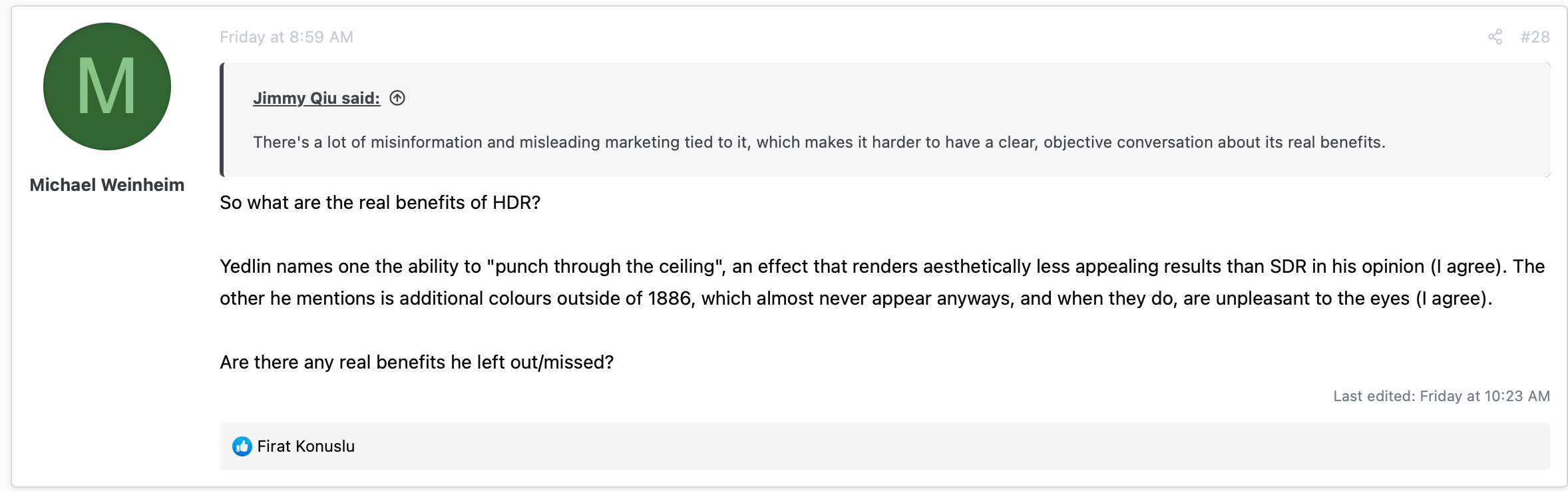
Steve Yedlin’s Technical Assertions Warrant Scrutiny
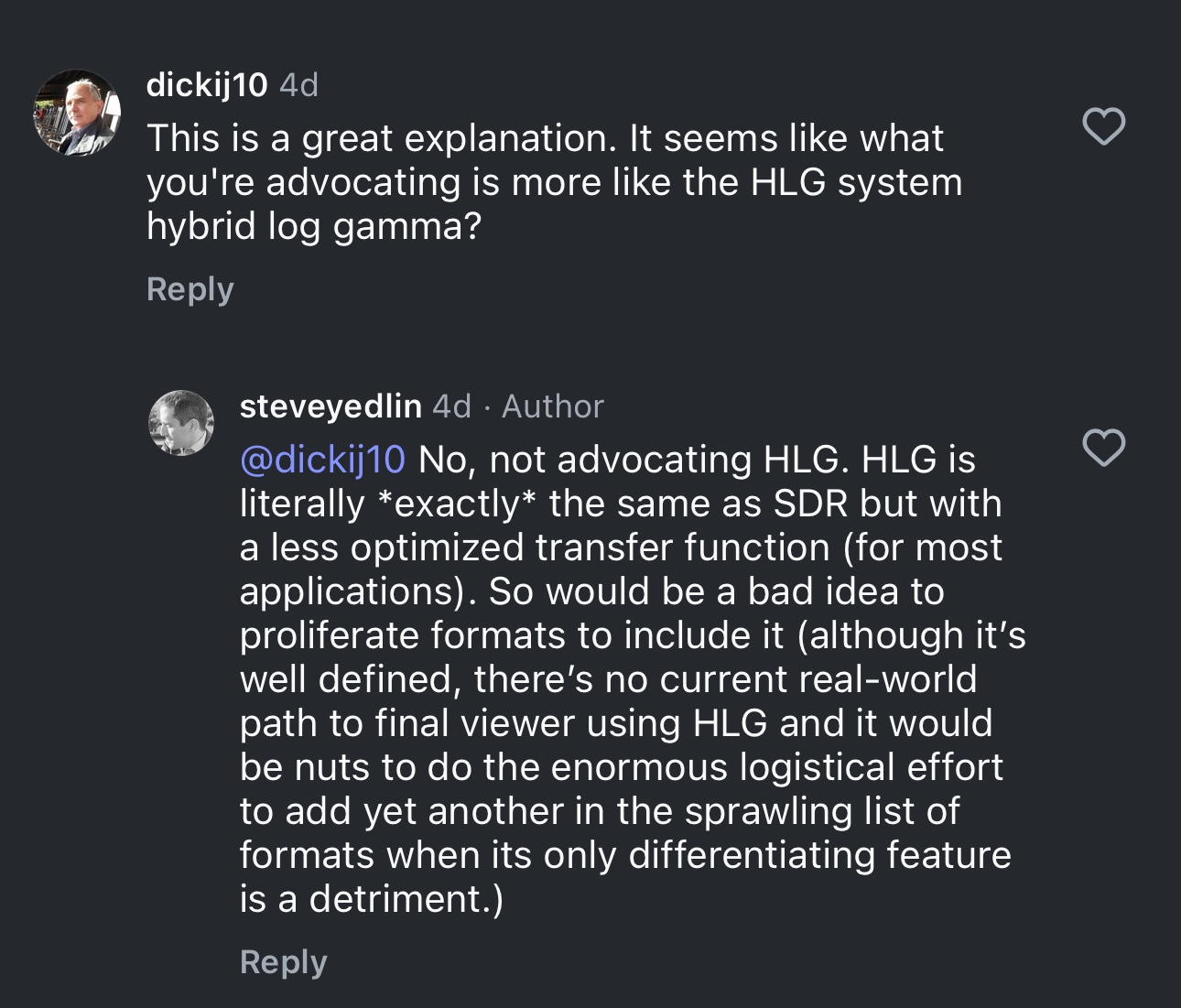
On Instagram, Steve Yedlin claimed that HLG’s only differentiating feature is a detriment and that utilizing it would be a logistical nightmare, even though (1) it is absurd to argue that HLG’s transfer function is inferior to BT.1886; (2) virtually all devices – smartphones, laptops, tablets and televisions – support HLG; (3) rendering an HLG version from a finished Dolby Vision master is trivial; and (4) he never explains how the ability to maintain creative intent in different viewing conditions is somehow a disadvantage. At least he’s consistent, because according to Yedlin, “the things that are actually different about HDR compared to SDR are all detriments, not advantages.” Yedlin never clarified what he meant by “HLG’s only differentiating feature,” so your guess is as good as ours.

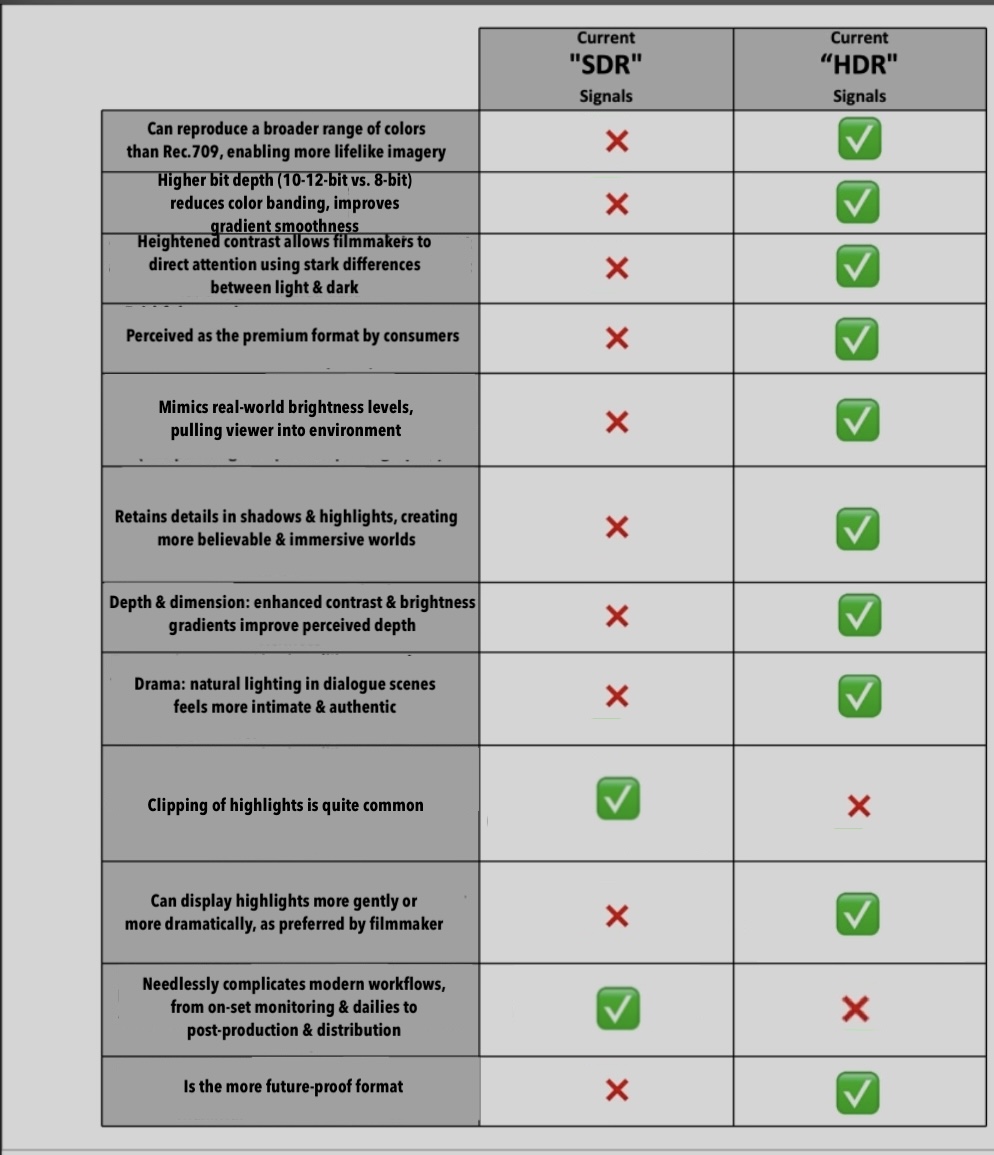
SDR is not supported in HDR workflows, as it was defined in the age of the now-defunct CRT and has a maximum dynamic range of a paltry six stops. Not only that, but fully gamma functions exhibit banding in HDR which, alongside highlight clipping, is among the most disagreeable artifacts in video. In fact, it’s SDR that has no place in modern HDR workflows and that needlessly complicates on-set monitoring, dailies, post-production and distribution.
Check out the 2-1/2 minute tutorial that explains how to deliver an HLG version from a Dolby Vision master.

Yedlin’s Shadow Experiment: The Lie That Poisoned HDR

At 1:46:00, Yedlin performs a live execution of the industry’s shadow fetish, obliterating the myth that shadow detail is HDR’s primary advantage.
“I’m going to make a change here. See that change? I can see it. I’m not saying it’s not there. It’s kind of subtle, right? It’s getting a little milky. So, based on that definition that they’ve got going there, that is a one thousandfold change in the contrast of this shot. [snickering in the audience]. Because the white is staying the same and the black is going from .0001 to .1. We see why that’s absurd.” – Steve Yedlin, ASC
Industry Reaction: The audience’s laughter reveals uncomfortable cognitive dissonance. Yet no one discusses this pivotal moment because admitting its validity would force DPs to confront their workflow delusions.
The Yedlin Paradox: Even while debunking shadow myths, Yedlin’s own work (Glass Onion) exhibits highlight aversion: flat skies & clipped speculars. His presentation becomes a shield for traditionalists to dismiss HDR entirely.

According to Yedlin, the ability to reproduce highlights is HDR’s sole ‘advantage’.
Fact-Checking A Few of Steve Yedlin’s Claims
CLAIM: SDR Can reproduce subtler increments of luma and chroma at a given bit depth than HDR.
FACT-CHECK: If content is authored and displayed strictly within SDR parameters (e.g., 8-bit Rec. 709), it can appear smooth on compatible displays.
However, HDR is technically superior to SDR in reproducing subtler increments of chroma and luma, thanks to its higher bit depth, wider dynamic range, and perceptual encoding. Yedlin is engaging in pure sophistry. As Yedlin is well aware, an increase of bit-depth is essential to minimize banding artefacts that might arise with the increase of dynamic range.
CLAIM: HDR can display highlights either gently/artfully or more caustically, as preferred by filmmaker but there is community pressure to use only a caustic style.
FACT-CHECK: None of Apple TV+’s recent shows – Murderbot, The Studio, Carême, Your Friends & Neighbors, Dope Thief, Wolfs, Presumed Innocent – have any HDR intent whatsoever and are graded at SDR levels. The same goes for most Netflix Originals.
The DCI issued a statement years ago declaring that brightness levels are solely up to the filmmaker and colorists have confirmed that studios don’t dictate peak brightness levels.
Similarly, Netflix leaves decisions about peak luminance levels up to filmmakers:
“Netflix executives make no demands regarding dynamic range, brightness values, contrast reproduction, etc. Instead, they leave the implementation of HDR up to the filmmakers.” ASC, 2019
Although numerous studies of viewer preferences have indicated that highlights much brighter than possible on current TVs were required to satisfy the majority of participants, in the professional community, most advocate for restraint; and Yedlin supplies no proof for the assertion that there is ‘community pressure to use a caustic style’ of HDR grading. Be that as it may, Yedlin greatly underestimates the artistic value of highlights. When used creatively to enhance storytelling, PQ enables this in ways that SDR is physically incapable of.
CLAIM: Yedlin writes about SDR that overall luminance (not just little areas of the frame) can take full advantage of a monitor’s maximum physical brightness, while HDR cannot.
FACT-CHECK: We confess to not understanding what on earth Yedlin is talking about here. Why would anyone want to master full screen 10,000 nits, or whatever it is he’s talking about.
CLAIM: Only SDR is capable of faithfully reproducing relative contrast as authored by filmmakers. (if monitor is capable).
FACT-CHECK: We don’t broadcast BT.1886; we broadcast Rec.709. When combined, Rec.709 and BT.1886 create an OOTF (Opto-Optical Transfer Function) that injects contrast absent from the original signal. Consumer devices seldom follow BT.1886 – the transfer function and contrast can be anything. Conversely, PQ (SMPTE ST 2084) preserves absolute light relationships by design. So, it’s the opposite of what Yedlin contends, not only on the consumer side of things, but also in the grading suite. – Samuel Bilodeau, Sr Product Manager, Dolby
Cult of Technical Illiteracy
“And by the way, my HDR demo that’s nominally about HDR kind of almost secretly is a color space demo more than an HDR demo in a way.” Steve Yedlin, Team Deakins Podcast
Yedlin hopelessly confuses his ardent fans into thinking that BT.1886 is a color space, as he did a couple years back during an interview on the Go Creative Show:
“Let’s compare two different color spaces. You know, like a Mac computer uses Display P3 color space and most HD TVs or HD monitors are gonna use A COLOR SPACE CALLED REC.1886 – which is colloquially, and incorrectly, called 709, but whatever – these two color spaces for every single color, except for just a few of the most garish colors, like in a neon sign or something like that – they’re capable of reproducing the exact same colors. Capable of. So, when you convert between the two, it should look exactly the same.”
This mixing up of color spaces and transfer functions spreads like a contagion. Which is how we end up with a DaVinci Resolve certified trainer and postproduction supervisor with over a decade of experience writing nonsense like this:

On a Team Deakins podcast, DP Steve Yedlin once more calls BT.1886 a color space:
“It would just be the math and just, boop, just do it and they’re all the same. But the problem is that’s not how it is. With Dolby Vision, what’s happening is…
It’s almost ironic the way it works is we do it in so-called SDR. Doesn’t matter what we’re doing it in because it’s just meters or feet. We’re just making the colors we want, and then we’re writing them down in the color space called Rec.1886.
You could say you’re doing it in a color space, but really that’s just you’re writing down, so that what you chose as color is written down and recorded in Rec.1886, which could be DCI-P3, but whatever, it doesn’t matter [1]. It gets written down. Then we’re converting that correctly to Rec.2100, which is the HDR color space.
And actually, in the mastering, they actually use a hybrid color space for that, but it’s going to eventually then get converted to Rec.2100, which is the standard HDR thing that all the consumers get. So that actually converts correctly to the HDR.” – Steve Yedlin, ASC. Team Deakins Podcast, 11 June 2025
The conflation of EOTFs (like BT.1886) with color spaces (like P3) is a fundamental error in virtually all of Yedlin’s discourse. This technical illiteracy leads to absurd conclusions like “HLG’s transfer function is inferior to SDR” – a claim dismantled by SMPTE standards.
- Technical Note: BT.1886 defines an EOTF for SDR deliverables. It contains no primaries and cannot be ‘converted to Rec.2100’–a full HDR system with primaries (BT.2020) and HDR transfer functions (PQ/HLG).
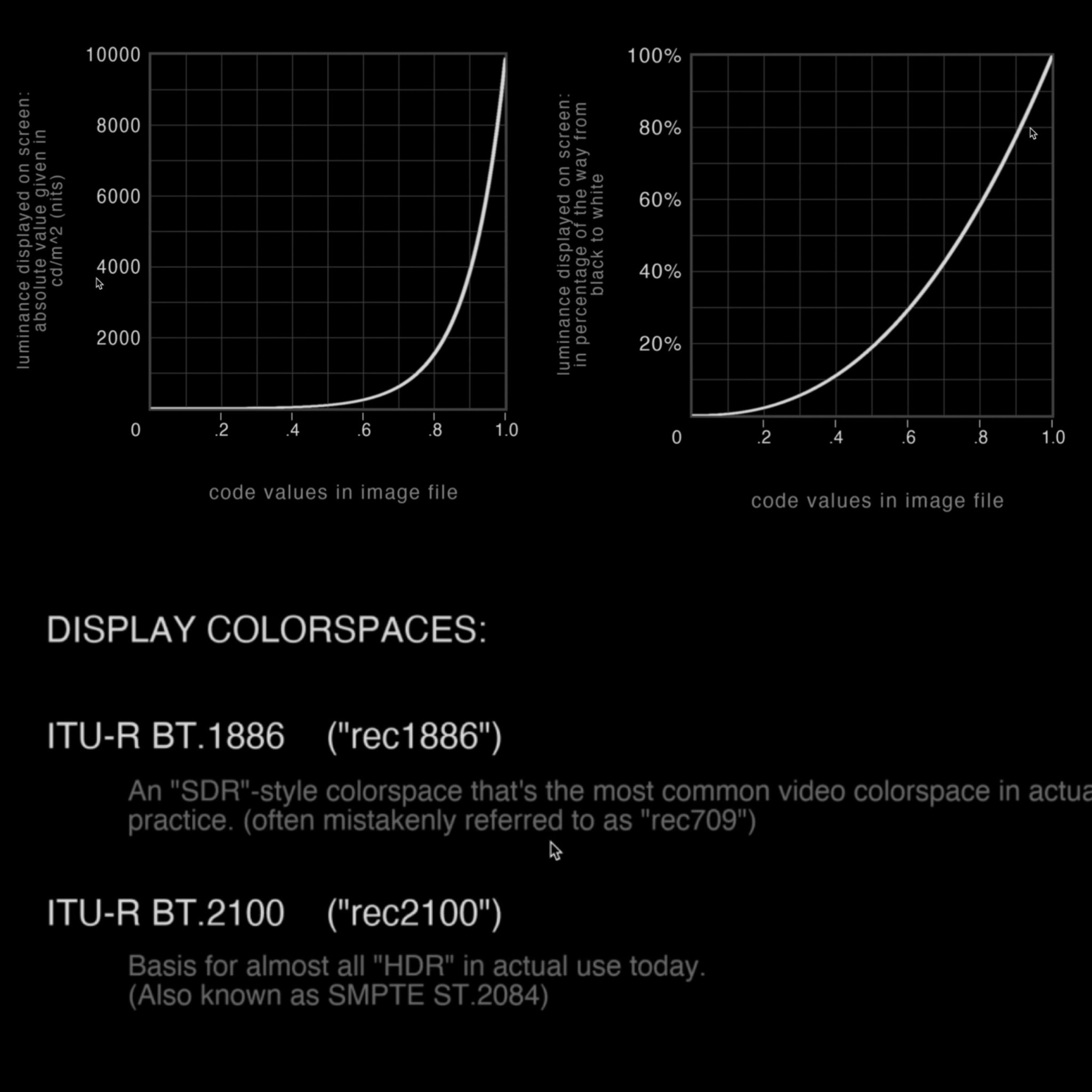
In the above excerpt, Yedlin claims:
Rec.2020 = Rec.1886 + wide gamut
sRGB = Rec.1886 + different gamma
Monitors ‘convert Rec.1886 to Display P3’
Truth: These statements are physically impossible.
REALITY CHECK
- Rec.1886 does not exist. ITU-R BT.1886 exists. Using “Rec.1886” contributes to industry-wide confusion.
- Display P3 is a color space. BT.1886 is a transfer function. One cannot simply “convert” BT.1886 to Display P3 in the manner described.
- Rec.2020 is a color space. BT.1886 is an EOTF. It has no primaries. Therefore, Rec.2020 cannot be “BT.1886 + wide gamut”
- sRGB is a color space. BT.1886 is a transfer function. Therefore, sRGB ≠ Rec.1886 + “a slightly different transfer function.”
SOURCES: ITU-R BT.2020, ITU-R BT.1886, IEC 61966-2-1
While Yedlin’s visual demonstrations are compelling theater, our analysis reveals systematic technical misunderstandings that disqualify him as a color science authority.
DEEPER DIVE: For our point-by-point rebuttal of Yedlin’s latest color science claims, see:
Steve Yedlin’s Color Science Contradictions
Tone

Rick Lang’s critique of Yedlin’s use of terms like “scorch” and “caustic” in his “Debunking HDR” presentation is a valid one. Emotionally charged language like that in a professional setting is counterproductive. HDR highlight handling is a complex technical and perceptual issue involving physiology, display tech & artistic intent; reducing such a complex (and endlessly fascinating!) subject to words implying physical discomfort frames the issue as inherently harmful rather than as a difference that may not align with the speaker’s own philosophy/goals. There’s also the possibility that the audience focuses on the word choice rather than the core concepts.
Yedlin’s audience includes people who’ve invested significant time developing, implementing and creatively using HDR workflows. Using terms implying their work produces results that are physically unpleasant can feel like a personal attack or an outright dismissal of their professional judgement. Not to mention the derisive snickering…
Summary of Yedlin’s Presentation Available For Download
The following is the final paragraph from a ChatGPT summary of Steve Yedlin’s Debunking HDR presentation created by Adam Reign from a transcript. Reign has broken it down into sections and added key takeaways.
As colorists, your job is the artful control of relative contrast. Yedlin’s “Debunking HDR” is a reminder that—regardless of whether your client asks for “HDR approval” or “SDR deliverables” —the true creative work happens below the absolute ceiling. Keep that in focus, and your grades will remain consistent, predictable, and faithful in any environment.
The advice argues that colorists should prioritize relative contrast in the low/mid range & treat HDR highlights as non-creative ‘ceiling’ elements and that this approach guarantees consistency across SDR/HDR deliverables. Although well-intentioned, the counsel oversimplifies HDR grading and contains several flawed assumptions. Here’s why it’s not necessarily good advice:
Highlights Aren’t Just A “Ceiling”: They’re Creative Tools
The core flaw is treating HDR highlights as a superfluous, non-essential, absolute ceiling; as technical ‘overhead’ rather than creative tools. HDR highlights can define a visual language. Think of how highlights on chains and swamp water in Emancipation (2022) reinforce the story’s oppressive brutality, whereas pushing those highlights down to SDR levels would destroy/dilute the artistic intent. Ignoring them relegates HDR to nothing more than ‘bright SDR’, missing out on its enormous creative potential.
Highlight Rendering Directly Affects Color & Texture
We’ve already addressed in great detail how highlight roll off is a critical creative decision (perhaps more thoroughly than in any HDR masterclass!) in the Grading section of our Monster Guide. Treating highlights as merely a “ceiling” ignores the artistry involved in their rendering. Yedlin completely ignores how highlight handling affects color, saturation and texture. Clipping (or rolling off, if you will) 1,000 nits to 100 nits SDR isn’t just brightness reduction – it’s data amputation.
SDR + Highlights
The advice assumes an outdated HDR = “SDR plus highlights” way of thinking. The approach underutilizes HDR as a creative medium. ‘Scene white’ might be useful for technical consistency across deliverables, but it imposes a creative straightjacket that is at odds with the format’s potential for more dynamic and expressive storytelling.
Yedlin: Contentious Visionary or Cautionary Tale?
Yedlin’s brilliance lies in workflow innovation (e.g. exposing lazy HDR implementations, championing perceptual consistency across displays), not his HDR hot takes:
1. Emotional Hyperbole
Using emotionally charged language like “punching through the ceiling,” “scorch,” and “caustic,” framing HDR as inherently aggressive while ignoring subtle uses.
2. Misleading Terminology
Calling BT.1886 a “color space” is technically sloppy. Overemphasizing Rec.2020 when P3-D65 is the industry standard for HDR mastering.
Confusing EOTFs with color spaces is akin to a cinematographer not knowing the difference between a lens and a camera sensor. These are foundational concepts in color science.
3. Reductionist Workflow Takes
Claiming HDR is just a grading style ignores the on-set discipline required (avoiding highlight clipping, monitoring in HDR, lighting ratios that leverage HDR’s potential).
4. Aesthetic Blind Spots
Praises SDR’s “subtlety” while overlooking its technical poverty: 8-bit 100-nit Rec.709 cannot render the luminance/chroma gradients of 10-bit 1000-nit P3, let alone 600 nits.
Highlights aren’t inherently “caustic” — they’re tools. Used poorly? Yes. Used masterfully? See works like Emancipation (2022), Gangubai Kathiawadi (2022).
His window-brightness demo proved HDR’s strength: real-world contrast ratios! Yet he framed it as a flaw.
5. “Marketing” Hypocrisy
Condemns HDR as “marketing” while supervising films with $185M marketing budgets (Star Wars: The Last Jedi).
Overlooks that HDR adoption is driven by audience demand (340+ live UHD services worldwide), not corporate conspiracy.
6. Yedlin’s “Absolutism”
Yedlin falsely frames HDR as “absolute” and SDR as “relative.” Reality is the opposite:
HDR’s extended range allows it to preserve relative luminance relationships across intensities matching human vision. SDR’s narrow range forces destructive compression, distorting natural relativity.
Case Study: Yedlin’s Botched Attack on PQ Yedlin’s “Debunking HDR” presentation reveals deeper technical incompetence-particularly his dismissal of perceptual quantization (PQ) as “inefficient” or “logarithmic.” Key failures:
Testing PQ at 8-bit (a system designed for 10/12-bit)
Mislabeling PQ as “logarithmic” despite knowing log is camera-referred
Ignoring ITU-R BT.2390’s validation of PQ’s efficiency
Full technical evisceration here →
Claim-Reality Analysis of Steve Yedlin’s Arguments Against PQ (ST2084) Using ITU-R BT.2390
We’ll leave you with this truth: HDR isn’t a spec – it’s a language.
 The Daejeon Chronicles
Thanks for making these posts. This idea that HDR somehow destroys creative intent is so mind bogglingly wrong. If anything it gives them too much control and let’s them get away with putting SDR grades in HDR containers, and then force their audience to watch it in SDR whether they like it or not.
Not only completely wrong in his technical understanding but also in his attempt to discredit.
As far as consistency is concerned, check this out: https://jonpais.wordpress.com/2023/11/03/hdr-consistency-across-platforms-devices/?preview=true&preview_id=21052&preview_nonce=7ef1e27847