
I’ve documented time and again how Charles Poynton is willing to embellish the truth to push his narrative, and this time is no different.
During an episode of the Color Mentor podcast [1], Charles Poynton insists that cinema audiences can’t handle BT.2020 colors; that there’s an industry trend of “bigger, brighter, and more colorful” driven by “marketers” to make things look impressive on a spec sheet; that at its core, HDR is SDR; that the film industry is going through the equivalent of the “loudness wars” in music; that the range from black to diffuse white of HDR must be identical to that of SDR or else it ‘fails’; and that SDR must be the foundation of your grading workflow—even when working in HDR.
I evaluate the claims one by one.
Audiences Don’t Watch a Color Space – They Watch a Movie
Quote:
“Can cinema audiences handle these ultra hyper saturated colors and do they find that a pleasant experience? The answer is almost certainly no.”
Claim: Audiences can’t handle BT.2020 colors.
Fact Check: This is just one of many sweeping generalizations Poynton makes on the show. To begin with, exceedingly little commercial content is mastered using BT.2020 primaries. When it is, it typically concerns an infinitesimal 1-2% of the pixels. Not only that, but you don’t build a BT.2020 pipeline to make the entire screen look like a neon rave. You build it because the story demands it.
Case in point: John Daro’s 4K UHD restoration of the Wachowskis’ Speed Racer. Hailed as a reference-quality visual and auditory showcase, the remaster was an unqualified critical and commercial success. Daro noted that the Wachowskis were thrilled with the finalized HDR pass, which fully realized intended color boundaries that were technically impossible during the 2008 master. Daro writes:
“In some rare, highly specific instances, we actually pushed the grade outside the P3 gamut and into extreme 2020 colors. To my knowledge, this is a first for a Remastered Warner Bros. disc. I felt the timing was finally right; with modern display manufacturers like LG and Samsung producing consumer panels capable of rendering these extreme wide-gamut colors, it was time to let Speed Racer completely off the leash [2].”
Marketing Doesn’t Dictate Color Pipelines
Quote:
“There’s this rather large group, unfortunately, of what I will classify—and it’s not necessarily a compliment—marketers, who think we need to go bigger, bigger, bigger, brighter, brighter, brighter, more and more and more colorful.”
Claim: There’s an industry trend of “bigger, brighter, more colorful” imagery driven by marketing to make things look impressive on a spec sheet.
Fact Check: Let’s just pause for a moment to acknowledge that “bigger” is objectively better.
As for the remainder of Poynton’s allegation, industry standards, studios and professionals reject the simplistic “HDR = Brighter + More Colorful” narrative.
The Brighter, More Colorful Fallacy
Paolo Centofanti, senior tech editor at the Italian website Digital Day, had a chance to visit Company 3, the outfit responsible for the post-production of 80% of Hollywood movies and series. He wrote [3]:
“During our visit we had the opportunity to talk at length about HDR with the various colorists and the surprising thing is that everyone wanted to emphasize that although the marketing of TV manufacturers focuses a lot on peak brightness, the benefits of HDR formats have nothing to do with brighter images.”
Colorist Cody Baker explained:
“We don’t want viewers to be dazzled or annoyed. There are rarely shots in which it makes sense to push details up to 1000 nits, if not in a science fiction movie for special effects like lasers.”
When told about the announcement of a new 10,000-nit TV, Baker burst out laughing before erupting with “that’s bullshit.”
Reality Check: The “Brighter” Strawman
Professionals don’t build color pipelines based on marketing taglines. In fact, the international standard ITU-R BT.2390 (2016) directly refuted the idea that HDR is “all about brighter pictures” a decade ago:
“…there are a number of frequent misconceptions about HDR video, such as: ‘It is all about brighter pictures’… The misconception about HDR being simply brighter pictures arises from the fact that the maximum luminance capability is indeed much higher than standard dynamic range (SDR) television. However, this higher maximum is primarily used by the highlight regions of images. While the highlights will indeed appear brighter, they are nearly always small in region, and the overall image may not necessarily appear brighter [4].”
The SMPTE ST 2084 standard flatly rejected the brighter fallacy a dozen years ago:
“This EOTF is intended to enable the creation of video images with an increased luminance range; not for creation of video images with overall higher luminance levels [5].”
Studios Don’t Mandate Brighter Pixels
In 2019, the major Hollywood studios issued a joint statement asserting that the brightness or darkness of each shot of a film is entirely up to the filmmaker:
“It is also worth highlighting that a critical feature of the HDR system developed by DCI is one of creative expression. An HDR DCP need not exercise the entire range of brightness offered by the HDR specification. Despite the peak luminance that an HDR system is capable of, the brightness or darkness of each shot of a movie is always up to the filmmaker. It is not up to the HDR projector or display, which simply provides the full range of capabilities. DCI seeks to ensure that the headroom required to reproduce a filmmaker’s creative vision exists, whether that be the darkness of a cave, a candle, a car’s headlights, a meteor, or sunlight spilling through a window [6].”
Netflix similarly leaves decisions about luminance up to filmmakers:
“Netflix executives make no demands regarding dynamic range, brightness values, contrast reproduction, etc. Instead, they leave the implementation of HDR up to the filmmakers [7].”
The Statistical Truth
HDR video content typically has a low APL (<20%).
In a study [8] of 41 Warner Bros. titles (over 7 million total frames analyzed, corresponding to approximately 83 hr of content) in the HDR Home format that were mastered on a Dolby Pulsar display (0.005 cd/m2 black level and a peak luminance of 4000 cd/m2), MaxFALL (maximum frame average light level) of 98.6% of the frames was below 170 cd/m2 (the display power budget of the BVM-X300).
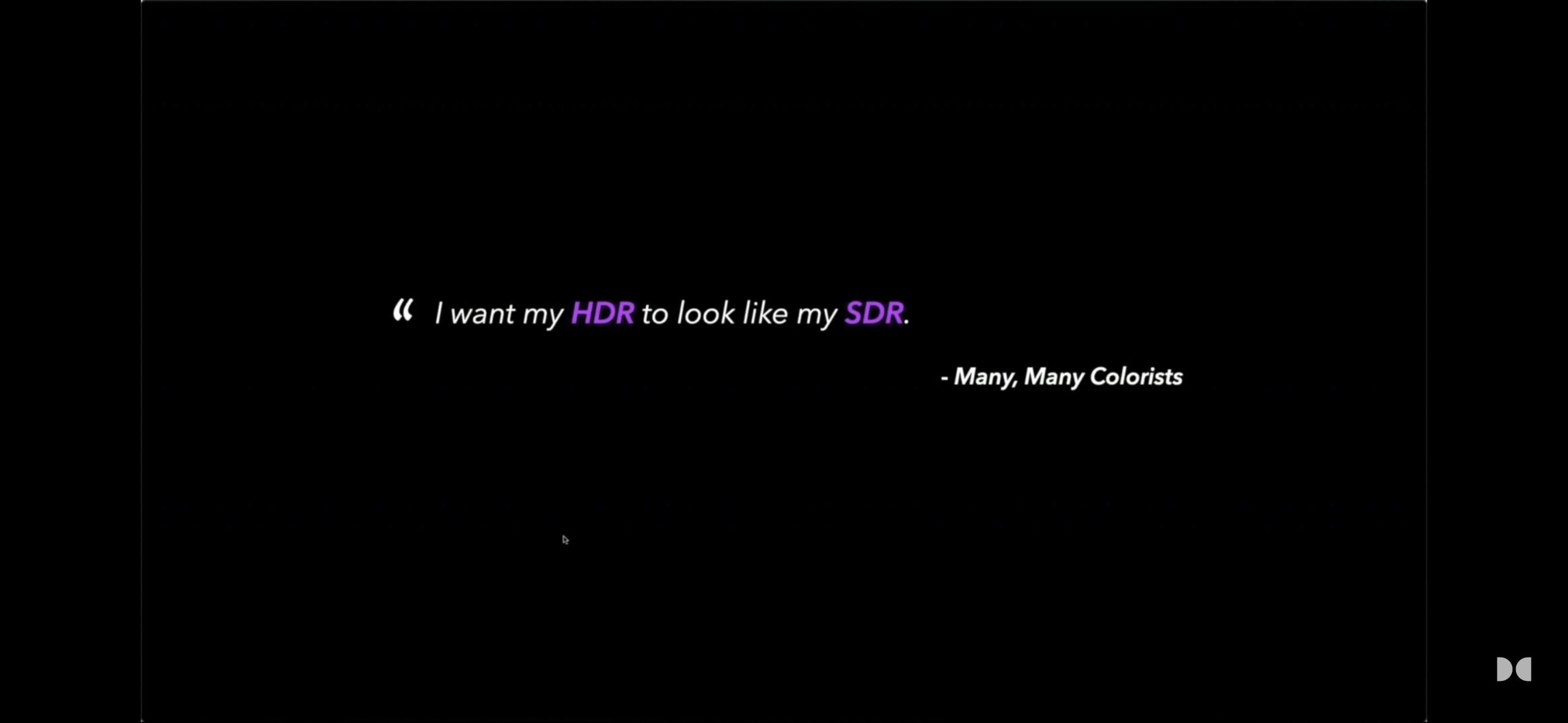
Dolby Dispels “Brighter” Fiction
“I bet you’ve probably heard this one too: ‘I want my HDR to look like my SDR.’ This is a very reasonable statement [9].”
—Samuel Bilodeau, Product Manager, Imaging Content Solutions, Dolby Laboratories
The “More Colorful” Strawman
When asked why DCI specified P3 primaries rather than BT.2020 in their DCI High Dynamic Range D-Cinema Addendum, they replied:
“DCI had to weigh the creative value of BT.2020. We’ve worked closely with colorists in attempts to demonstrate the value of colors outside of DCI-P3, and those attempts have been far from compelling. In general, colorists prefer to reduce color saturation. This isn’t entirely without exception, of course, as there have been some notable examples of studios utilizing color values far outside of DCI-P3 but they’re extremely limited… Nonetheless it’s been difficult to make a compelling case for the real creative value there. So, given all the challenges to achieve 100% BT.2020, the lack of any standard that describes a realistic subset of BT.2020, and the doubtful creative value, DCI opted to retain DCI-P3 as the color gamut for the D-Cinema HDR specification/standard [10].”
Historical Revisionism
Quote:
“Here’s an analogy for you from the music business… Even in the ‘90s, maybe even in the 2000s, there’s a dynamic. There’s modulation. And what you see today is a flat line. They’ve raised the average loudness as high as they can get it to the penalty of putting everything in the same dynamics. Where in the ’90s and the 2000s, pop songs were dynamic… But pop music today doesn’t have that. So it’s a missing of the dynamics and we call this new technology High Dynamic Range. So in principle, it’s there to do dynamics. But the dynamics require high level in a certain part and then a low level in another part. And it’s that playing back and forth between them that literally makes the dynamics.”
Claim: The equivalent of the “loudness wars” in music is taking place in the film industry.
Fact Check: There’s just too much to unpack here. First of all, there’s Poynton’s jaw-dropping, sweeping generalization: “‘90s pop was dynamic… but pop music today doesn’t have that.”
Moreover, contrary to Poynton’s claim, in audio, there is no High Dynamic Range standard as there is in video.
Furthermore, calling ‘high dynamic range’ in music “new” in 2026 is historically illiterate: dynamic range is the default state of acoustic music. Classical music has utilized extreme dynamic range for centuries. Engineers have been able to capture that range for nearly half a century.
Not only that, but dynamic range in music is temporal whereas in HDR, it’s primarily spatial. HDR is not at all about a “high level in a certain part and then a low level in another part.”
Last but not least, Poynton’s analogy is inverted: music history is a timeline of trying to reclaim the natural dynamics we lost during the ‘loudness wars,’ whereas the history of HDR filmmaking is the exact opposite: filmmakers have been intentionally reducing dynamic range almost since the inception of commercially available HDR:
“When high dynamic range first came out, every studio wanted… ‘We want our high dynamic range version of this show to like, you know, go up to 11 and hurt people!’ And you know, over time, if it’s something that benefits the creatives, they’ll adopt it, but then it tones down. Then it just becomes part of their tool set [11].”
—Joshua Pines, Chief Color Scientist, Picture Shop
A tech commentator confirms:
“The biggest blockbusters of 2025, F1 The Movie, Superman, and Jurassic World Rebirth, all have one thing in common: they all look dim. I’m talking about specular highlights barely crossing 300 nits on one of those movies. The other two movies, well, one of them didn’t cross 200 nits, and the other one barely broke 100 nits. Actually, I don’t think it ever broke 100 nits. Isn’t that SDR? While today’s entry-level TVs can handle 1,000 nits, with flagships easily pushing over 3,000 nits. And Hollywood’s newest, latest reference monitor, the Sony BVM-HX3110, was designed specifically for HDR content, handling peak specular highlights of 4,000 nits. And yes, it was used to grade the movie F1. As a matter of fact, F1 was one of the first releases to ever use this monitor. So here’s the paradox: TV makers keep raising the brightness level for HDR content while the actual studios that make HDR content have gone the other way, lowering the HDR brightness. What gives? [12]”
Contrast: A Pillar of HDR Quality
Quote:
“HDR is just SDR plus specular highlights. At core, it’s just SDR.”
Claim: HDR = SDR + highlights
Fact Check: Cf. Yedlin’s reductionist “HLG (in effect if not in name) is just yet another SDR colorspace” and “BT.2020 is an SDR colorspace.” HDR was designed to expand both luminance range and contrast, not just achieve higher peak brightness. Chen et. al.’s groundbreaking study established that contrast is a pillar of HDR quality: HDR = Contrast + Peak Luminance [13].
“HDR Is Just SDR—So Grade SDR First”
Quote:
“You’ve got to get the SDR right in order to get the HDR right. That’s got to be your starting point.” “The most important thing about HDR is make sure you get the range from black to diffuse white correct. That remains critical. You got to make that the same [as SDR], otherwise you fail.”
Claims: (1) SDR must be the foundation of your grading workflow, even when working in HDR. (2) The range from black to diffuse white in HDR must be identical to that of the SDR grade.
Fact Check: Poynton instructs colorists to reverse the industry mandated order of operations.
What is SDR-centric grading?
SDR-centric grading refers to the workflow order: first, a full creative grade is established for the SDR version of the content, and then the HDR version is created from that SDR master. It is a ‘bottom-up’ approach.
How does SDR-centric grading harm HDR?
SDR-centric grading bypasses the need to engage with HDR. It undermines HDR’s potential, resulting in the “overly reserved” HDR that specifications like Sky UK’s [14] caution against.
What does ‘start at the top’ mean?
Starting at the top means the HDR grade is done first. This is the prevailing industry standard ‘top-down’ approach. An SDR version is then derived from the HDR master.
The ‘top-down’ approach is recommended because it makes HDR the primary creative canvas. For optimal results, the industry recommended practice is unequivocal:
Do I grade HDR first? SDR first? Or do both at the same time?
“The HDR should be graded first, followed by a Dolby Vision analysis of the HDR image and a shot-by-shot trim pass of the entire program. It is our experience that – generally speaking – you will get the best results out of both the HDR and the SDR grade if you grade the HDR version first and approach that as the ‘hero grade’” [15]—Netflix
HDR Is the Primary Deliverable
“I think what’s interesting now is that three or four years ago, quite rightly, every director and DP came in here and said ‘Why are we doing the HDR version? No one’s going to see this.’ But of course, that’s not the case now… So I think it’s probably unfair to say that it’s an also-ran now, the HDR. I think actually the primary delivery is the HDR for people. And every 6 months that go on, that tilts even further. So I think now, it’s a big change… there will come a time when the SDR just isn’t needed [16].”
—Thomas Urbye, CEO and Colorist, The Look
For the Best Theatrical Result, Do the Dolby Vision First
“I used to own a post house called Light Iron… we worked on Spider-Man and Pirates… these major cinematographers would come in. And as we saw this transition to streaming and HDR… some of them would resist it… they would say, we’re going to color for theatrical first… I respected that approach… But the cinematographers that said, let’s do the Dolby Vision first… I have put so many hours into this process… you actually get a better result on your theatrical if you do a Dolby Vision first. Because Dolby Vision gives you the ability to see truly everything which the DLP cannot deliver. It can’t produce the resolution and the color and the contrast and the dynamic range that exists inside your original camera negative, which is displayed on a Dolby Vision display… when you corrected for Dolby Vision on a primary display, not only was that almost perfectly emulated in the home theater experience, your theatrical experience benefited from it [17].”
—Michael Cioni, CEO, Strada
During a 2017 GDC presentation about the Frostbite Engine, Alex Fry’s message was categorical:
“HDR is the reference in Frostbite; SDR is just an artefact of the display mapper.” He urged developers to “master your content in HDR and treat the HDR as a reference version by all means… try to master your game in the widest possible space. Master in HDR and then produce every version of that as an artefact.” He concluded: “It’s in all of our interest to try and drive the adoption of HDR. It is a lot better [18].”
Why This Matters
The SDR-first pipeline is a direct path to artistic bankruptcy.
Poynton says the range from black to diffuse white in HDR must be identical to that of the SDR. Colorists might try to keep middle gray (18% gray) anchored at the same perceived brightness between SDR and HDR, but there is no hard-and-fast rule.
Aurora Gordon, a senior colorist at ArsenalFX Color, presented data from over 35 HDR episodes at a 2019 SMPTE conference, exploring HDR’s psychological impact. She compared contrast ratios between the SDR grade and HDR trim pass across three genres (medical drama, superhero comedy, spy thriller). Although the HDR pass targeted 1,000 nits, the mean picture level was actually lower on all three shows compared to SDR—though overall contrast increased as expected.
Upon examination of the contrast of the HDR trim pass, it was found that in some cases, both the key and fill sides increased; at other times, the key side increased while the fill side decreased; and at times (in very dark scenes), both the key and fill sides of the faces decreased – underscoring the necessity of tailoring color adjustments to artistic intent rather than adhering strictly to rigid nit targets [19].
Brightness Serves the Story, Not the Technology
Quote:
“Today, HDR would be mastered at a 1000-nit peak, 200-nit reference – which some people would call diffuse white.”
Claim: HDR is routinely mastered to a 1000-nit peak and 200 nits reference white.
Fact Check: (1) Poynton is conflating mastering monitor peak luminance with the actual peak highlights in the program material. Seldom in narrative filmmaking or episodic TV do we see figures like those. (2) HDR reference white does not exist in narrative filmmaking and episodic television.
“I don’t have a hard rule or setting that I use. [It] depends on the project. I rarely peak things at 1,000 nits. Most people don’t react well to things being that bright. I generally start with a roll off but I could still go up to 600 nits. If it’s a much softer show, we’ll maybe do 300 nits—maybe even less [20].”
—Corinne Bogdanowicz, Co-Founder and Colorist, Light Iron
“David [Fincher] early on was looking at HDR scenes and quickly realizing that for him, a lot of it was distracting. Especially some of these light sources could be so much more prominent than really was intended… This was the case for a lot of scenes. So he sort of determined the speed limit of our HDR to be around 600 nits [21].”
—Eric Weidt, Colorist
“I know of a major — think $100 million+ — 2022 feature where the director came in and said, “ya know what… I prefer the SDR picture. Don’t make it much brighter than that. You can let the specular highlights stray up to 300, 400 nits, but other than that, keep everything about where it is.” Huge movie, already shipped, nobody cared or noticed. And this is a huge A-list director nobody was going to argue with.”
—Marc Wielage, VP/Color & Workflow, Chroma
The Reference White Myth
“…despite ITU recommendations, most theatrical and episodic HDR content does not have a diffuse white level of 203 nits. The diffuse white level in such content usually changes from scene to scene, and is far closer to the typical diffuse white level of SDR content of between 80 and 100 nits at most [22].”
—Neil Robinson, Display & Color Technologist, Apple
FilmLight Image Engineer Daniele Siragusano explains the origin of the “reference white” myth:
“The 200 nits for graphics white are chosen for compatibility with SDR in simultaneous live broadcast of HLG. In simultaneous broadcast you have the issue that the same HLG signal is shown on an HLG and 2.4 gamma Rec.2020 monitor. If you acknowledge the fact that SDR 2020 monitors are typically set to 200-300 nits peak you need to make the diffuse white in the HLG signal brighter. Otherwise the signal would look darker on the HDR monitors compared to the SDR monitors. All of this is not applicable to motion picture and hence we did not follow ITU-R BT 2408 [23].”
This underscores the idea that many early HDR “standards” were about making HDR look acceptable to eyes accustomed to SDR, rather than exploring HDR’s true potential.
The following paragraph, from Section 2 of ITU-R BT.2408, “Reference levels and signal format,” is universally disregarded by those who insist on a rigid application of the reference levels listed in Table 1:
“During set-up, camera controls such as gain and shutter and others may be pre-adjusted to make best use of camera sensor capabilities, i.e. a balance between signal to noise ratio (SNR) and achieved sensor peak capability, and to establish a creative intent. During capture, the exposure may then be adjusted taking consideration of the reference levels listed below as well as the creative intent [24].”
The report explicitly subordinates reference levels to the creative choices of the filmmaker. It is a guideline for technical line-up in live production, not a creative straitjacket.
The “200 nits for white” isn’t a creative target; it’s a compromise for a specific, hybrid broadcast scenario. In film and television drama, the “correct” level for diffuse white is wherever the storyteller puts it.
Footnotes
1. Charles Poynton, COLOR MENTOR PODCAST Episode 13 – Charles Poynton Interview, Color Mentor YouTube channel, Jan. 31, 2026
2. John Daro, Go Speed Go: Remastering the Hyper Color World of Speed Racer in 4000-Nit HDR, John Daro blog, May 19, 2026
3. Paolo Centofanti, Hollywood Colorists: TV Marketing Is Wrong. With HDR The Important Thing Is Not Brightness, January 2024
4. Report ITU-R BT.2390-1 (10/2016)
5. High Dynamic Range Electro-Optical Transfer Function of Mastering Reference Displays, SMPTE ST 2084:2014
6. Digital Cinema Initiatives, LLC
7. Jay Holben, ASC, Netflix Helps Drive the Creative Vision with High-Dynamic-Range Content, American Cinematographer. (Dec. 2019)
8. Ronan Boitard, Michael Smith, Michael Zink, Gerwin Damberg, and Anders Ballestad, Predicting HDR Cinema Requirements from HDR Home Master Statistics, SMPTE Motion Imaging Journal, Volume 128, Issue 3 (21 March 2019)
9. Samuel Bilodeau, Product Mgr., Imaging Content Solutions, Dolby Laboratories, Webinar (Spring 2024)
10. Venue, DCI (Digital Cinema Initiatives) D-Cinema HDR, AVSForum (Jan. 24, 2023)
11. Color Masterclass with Joshua Pines & Maxine Gervais | Color Matters S2 E8, Portrait Displays YouTube channel, Jan. 17, 2024
12. HDR Paradox: dimmer movies 10 years later! What happened to HDR?, Stop the Fomo YouTube channel, Sept. 4, 2025
13. Kenneth Chen, Nathan Matsuda, Jon McElvain, Yang Zhao, Thomas Wan, Qi Sun, Alexandre Chapiro. 2025. What is HDR? Perceptual Impact of Luminance and Contrast in Immersive Displays. In SIGGRAPH ‘25: Proceedings of the Special Interest Group on Computer Graphics and Interactive Techniques Conference. ACM, New York, NY, USA.
14. Ashley Ross, Technical Specification for the Delivery of Content to Sky UK, V1.2, March 2023
15. FAQs, Dolby Vision HDR Mastering Guidelines, Netflix
16. Thomas Urbye, Color Tour Podcast S4 EP06: Thomas Urbye, Noho, UK, August 7, 2023
17. Michael Cioni, S6 E5 of The T Stop Inn, 21 March 2025
18. Alex Fry (Frostbite Team, Electronic Arts), High Dynamic Range Color Grading and Display in Frostbite, GDC (2017)
19. Aurora Gordon, SMPTE 2018: Beyond Better Pixels: How HDR Perceptually and Emotionally Effects [sic] Storytelling, smpteconnect YouTube channel, Jan. 29, 2019
20. An interview w/ Corinne Bogdanowicz, Cullen Kelly YouTube channel (June 20, 2024)
21. Eric Weidt, Colour on Stage: Eric Weidt, FilmLight YouTube channel, Dec. 3, 2019
22. Neil Robinson, EP950 Ultrafine OLED Pro Monitor Best Practices and Additional Usage Information, LG ELECTRONICS (JUNE 25, 2021)
23. Daniele Siragusano, ACES Central, May 2025
24. Report ITU-R BT.2408-9, BT Series: Broadcasting service (television), Guidance for operational practices in HDR television production (09/2023)
Charles Poynton: BT.2020 Historical Revisionism

