Prior to coming in contact with HDR-loathing Steve Yedlin, Cullen Kelly used to be a leading vocal proponent of HDR imaging. Since aligning with Yedlin, he’s done an about-face.
Before Yedlin
HDR represented a seismic shift in how we approach imaging. It was a new language:
“the move to HDR is as significant as any shift in the history of motion imaging. And that includes evolutions such as the shift from 18 frames per second to 24, black and white to color, and standard definition to high definition. […] It represents a fundamental improvement to the way we approach and talk about image mastering, one that better reflects the native language of light and photography [1].”
HDR was here to stay. It wasn’t just a gimmick:
“With today’s rapid pace of technological evolution, it can be difficult to identify which advances are here to stay, and which are simply fleeting trends. Nowhere is this more true than with displays. In the last ten years, we’ve watched gimmicks including 3D, HFR (High Frame Rate), and the mindless grab for ever-greater Ks dominate our horizons, only to quietly fade away. But if there’s one advance in display technology that’s here to stay, it’s HDR (High Dynamic Range). Content mastered for HDR displays may still be in a minority today, but this is certain to continue its rapid shift in the coming years. Soon it will be the rule rather than the exception [1].”
HDR represented human vision more faithfully:
“Technical details aside, the most important thing to understand about HDR is that it doesn’t represent an enhancement as much as the removal of an artificial limitation. In the realm of human vision and physical light, high dynamic range is a default condition, not an added gimmick [1].”
After Aligning with Yedlin
HDR no longer has any creative meaning:
“HDR is just a standard. HDR doesn’t have any creative implication or aesthetic implication. It’s just a standard [2].”
HDR is just a vehicle for Kelly’s LDR aesthetic:
“Many of you guys have probably seen Steve Yedlin’s HDR demo… that talks such good common sense about HDR… Fundamentally for me, I don’t want HDR versus SDR to determine where my highlights sit. I want ME to determine where my highlights sit. So at a default, when I’m flipping from SDR to HDR, THAT shouldn’t change my rendering… So that’s why at the baseline, your HDR peak luminance, your image is going to look very, very similar to your SDR. In fact, it’ll look identical if you’re calibrated to 120 nits like my displays are [3].”
HDR highlights are no more than a gimmick added in post:
“If I flip you in between my SDR and my HDR rendering of your image and I show you what I think the HDR should be, you’re not going to see much change, really. What you’re going to see is some little twinkles and sparkles come to life [4].”
HDR highlights are retinal assault:
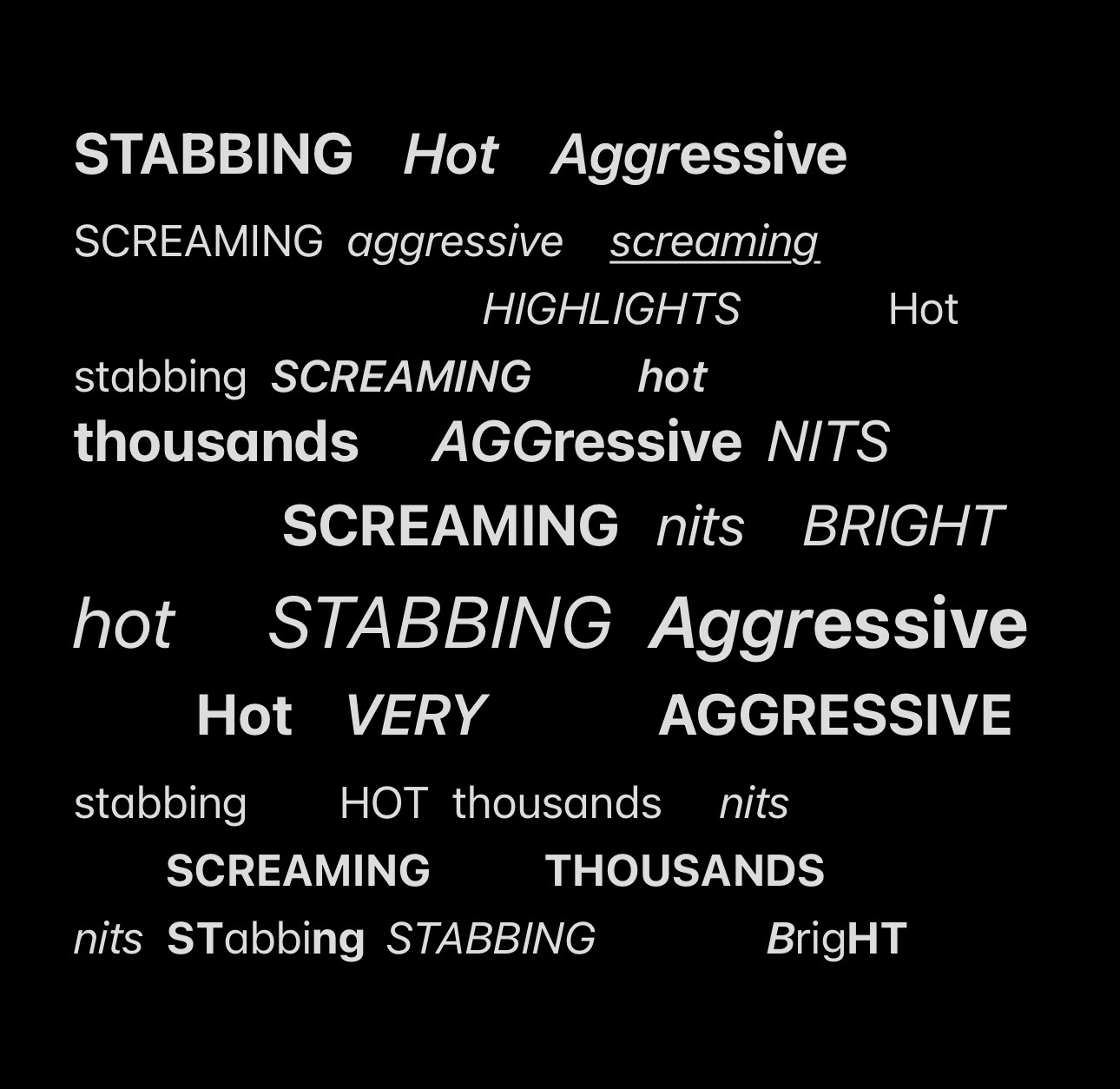
“some of the other things that can feel problematic or not that fun about HDR is you get these really screaming hot kind of aggressive sharp stabbing highlights when you flip into HDR mode like a thousand nits is a very, very bright image. That’s a common HDR display standard [4].”
HDR is a deviation from the “true” creative intent:
“And then you can choose, Hey, we’ve got the HDR, we can do it. Let’s really stretch out those highlights and go a little more sparkly and twinkly or no, let’s maintain the creative intent captured in the SDR grade and not change a thing about it [3].”
Footnotes
- Cullen Kelly, Why You Should Care About HDR, Even If You’re Not Delivering It Yet, frame.io insider, Oct 12, 2020
- Cullen Kelly, Grade School: Senior Colorist AMA, Cullen Kelly YouTube channel, May 20, 2023
- Cullen Kelly, Hollywood film pipelines and Genesis sneak peek, pt. 2, Cullen Kelly YouTube channel, Aug. 12, 2025
- Cullen Kelly, Grade School: Pro Colorist Q&A – Color Management and Apple Displays, Cullen Kelly YouTube channel, Sept. 22, 2023


Leave a Reply