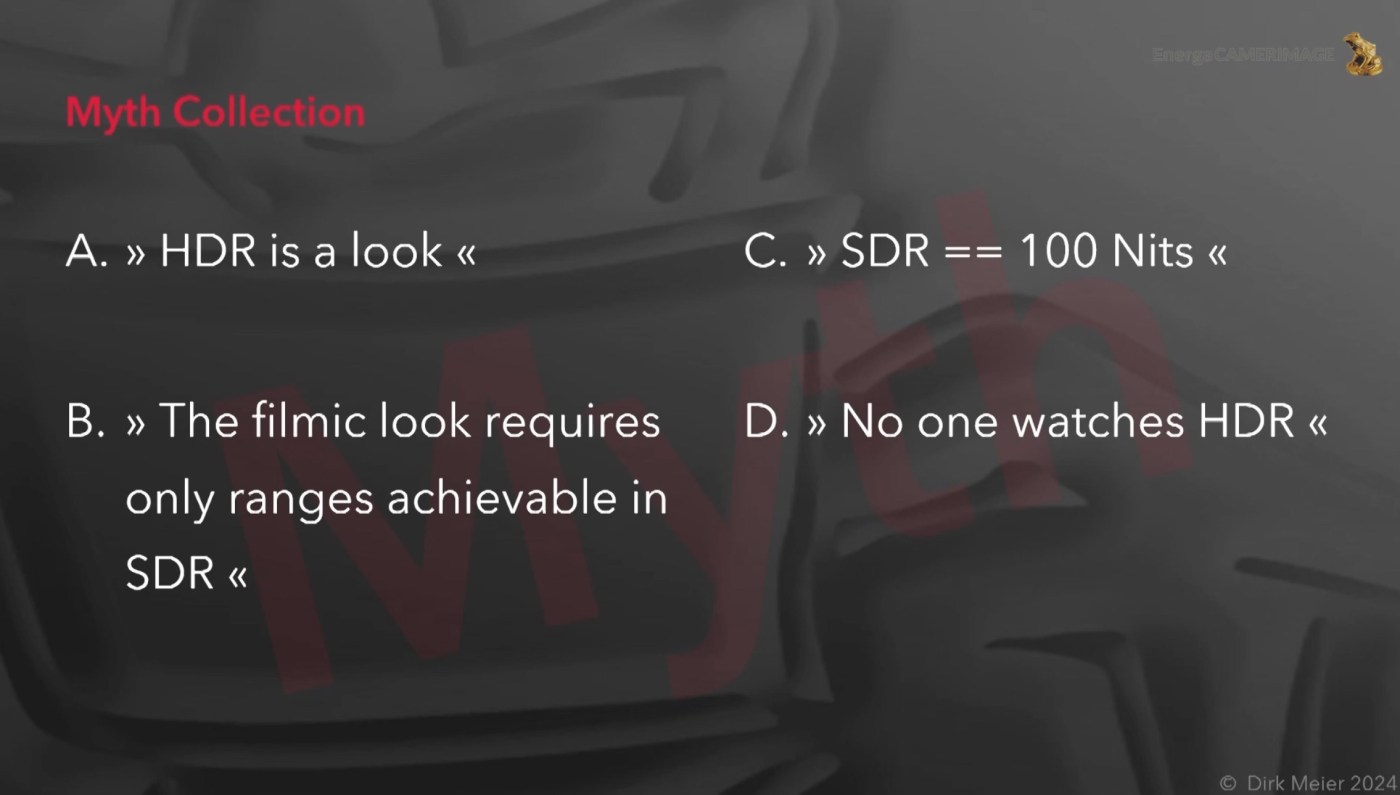
Charles Poynton addresses Myth B: “The filmic look requires only ranges achievable in SDR.”
Revelation: Cinema Is 48 Nits
“So you’ve already heard that I’m the scientist and mathematician, physicist, but applying myself to imagery for years and years and years. So the one thing that’s clear to me is that when I look at images and try to figure out what are the luminance levels measured in nits or how does an image relate to the vectorscope numbers, the first thing that I’ve realized is that the choices largely of the colorist—maybe the DOP—there’s obviously a discussion that takes place between them. The aesthetic choices rule and there isn’t really a lot of hard evidence that would tell me what the numbers are. But just to give you a little beginning notion of that, we all—or many of us technical people—understand that cinema’s got a reference or peak luminance of 48 nits.”
To begin with, you don’t need to look for “hard evidence” in a movie to figure out the peak luminance of a theatrical container: it’s in the standards. Secondly, Poynton asks how an image relates to “vectorscope numbers” to figure out luminance. Lastly, framing 48 nits as insider knowledge among “technical people” at a cinematography festival is absurd. It is literally Page 1 of the DCI specification. Every projectionist, DIT, colorist, and DP knows standard theatrical projection is calibrated to 14 foot-lamberts (48 nits).
Diffuse White in Cinema
“And it was a question that I had years and years ago: ‘where do people making movies ordinarily put diffuse white?’ So diffuse white is then my science word for white shirt white or white piece of paper white. And the answer that I derived is well, there’s a large range because there’s creative choices. But very roughly speaking, we can say that in movies, diffuse white is around 32 nits.”
Calling diffuse white “my science word” to a room full of cinematographers, colorists and industry professionals is cringe.
Headroom in Cinema
“And a little bit of space, not even a stop, is left above diffuse white for the things that sparkle. Well, there’s two aspects of it: the things that sparkle—the specular highlights—and the direct light sources in the frame.”
Film Roll-Off
“And we all know that film rolls off really pretty severely, and that ends up being a desirable characteristic.”
Value judgement. Not a universal truth.
Good HDR Starts With Good SDR
“Concerning the HDR elements, then you would say, well in HDR we’ve still got diffuse white and relevant to point number B [sic], the range from 0 to 32 nits—that’s basically the SDR range-and that shouldn’t change in HDR. In other words, good HDR starts with good SDR, but what’s different is the range above diffuse white.”
Poynton leaps from theatrical projection (48 nits) to consumer HDR (“good HDR starts with good SDR”) as if they were one and the same.
The math doesn’t math. Applying Poynton’s “rule of thumb” to existing theatrical EDR standards makes no sense either.
Jon’s rule of thumb: good HDR begins with good HDR.
HDR Headroom
“And so instead of not even a stop in the cinema and dramatically rolled off, now you have a factor of something between three and five is my engineering sort of rule of thumb. So the peak white can be three times or maybe even five times diffuse white.”
Firstly: there is no theatrical HDR.
Secondly, in narrative filmmaking, episodic TV and video games, there is no fixed HDR diffuse white. The “correct” level for diffuse white is wherever the storyteller puts it.
Lastly, at low APL, HDR highlights can reach luminance levels that are orders of magnitude greater than 3x to 5x SDR reference white.
The Breaking Point of HDR
“And so then you could say, ‘well, if I present you a picture where the specular highlights or the direct light sources are now three or five times diffuse white, that’s dramatically different than the way we see film’. So just at the outset, that means that HDR is likely to look very different. So then the trouble is, if it looks really different, there’s what I would consider the breaking point of HDR.”
Poynton takes the limitations of an old projector, declares it the gold standard of visual storytelling, then claims that pushing highlights to 3x–5x diffuse white hits a “breaking point.” There is zero physiological, optical, or mathematical law stating that human vision or cinema storytelling “breaks” at n x diffuse white.
If Highlights Draw Attention You’ve Failed
“And this is very much a Laurens thing. So Laurens should be here, but he’s not here. So then the argument from Laurens would be-the Laurens Theory would be-if in HDR, the really bright things capture attention of the viewer, then you’ve just failed in storytelling.”
Yet another instance of Poynton the engineer stepping out of his lane to legislate what constitutes effective visual storytelling.
Use Highlights Sparingly
And now for the ultimate anticlimax: after dressing his opinions up in pseudo-math and “science words,” Poynton ends on a purely subjective rule of thumb framed as universal storytelling wisdom:
“And that’s an argument: that to make convincing stories in HDR, you really don’t want to use the really bright elements heavily. I mean there may be a few scenes where that’s appropriate, but it’s not typically appropriate. So that’s the way that I would address it.”
Saying “you really don’t want to use the really bright elements heavily” is attacking a caricature of HDR that no one is actually making.
Mythbusting: Colour, Camera, Cinema, Colorist Society YouTube channel, Jan. 14, 2025.
Camerimage 2024, BVK and CSI hosted a seminar at Camerimage titled “Mythbusting: Colour, Camera, Cinema.” Participants included Professor Andrew Stockman, vision researcher, University College London; Dr. Charles Poynton, CSI, Canadian colour scientist; Dirk Meier, BVK CSI, German colorist and lecturer; and Laurens Orij, Dutch senior colorist.


Leave a Reply