
Yesterday I looked at the SDR section of Practical HDR and Wide Color Techniques in Gran Turismo SPORT [1] and pointed out several instances where color gamut, OETFs/EOTFs, and standards were conflated. The HDR section of the presentation exhibits a similar pattern, this time treating HDR formats, transfer functions, and complete television-system recommendations as though they were interchangeable.
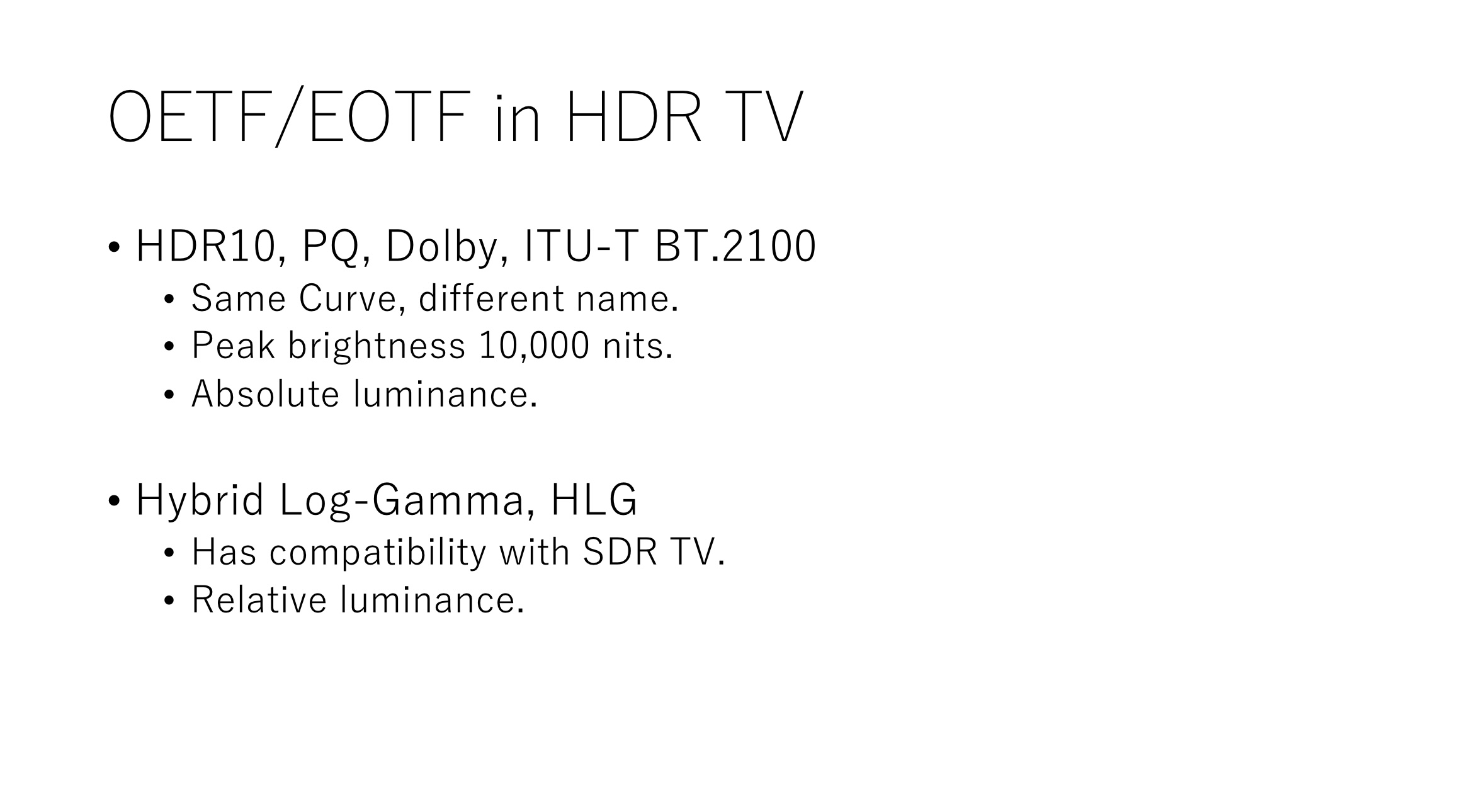
For example, this bullet:
• HDR10, PQ, Dolby, ITU-R BT.2100 • Same Curve, different name.
isn’t just imprecise—it collapses several distinct categories:
- HDR10 is an HDR format.
- PQ is an EOTF.
- Dolby Vision is an HDR format/ecosystem, not a transfer function.
- BT.2100 is the ITU-R standard for UHDTV (HDR/WCG) defining—among other things—Rec.2020 primaries, the D65 white point, and the PQ and HLG EOTFs.
Those are simply not “different names for the same curve.”
Note: The slide says:
“HDR10, PQ, Dolby, ITU-T BT.2100”
That should be ITU-R BT.2100, not ITU-T.
ITU-T and ITU-R are completely different sectors of the ITU.
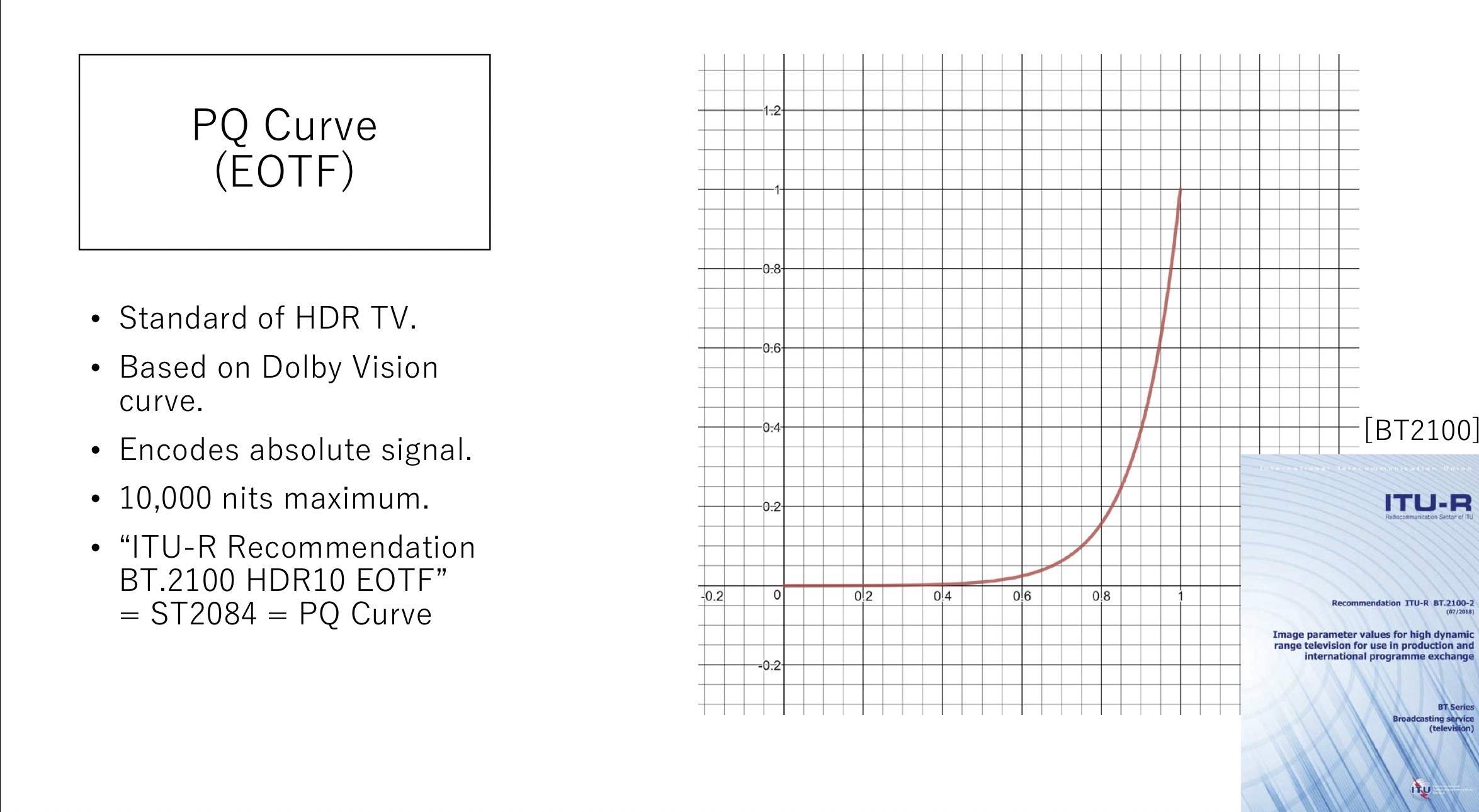
The next slide contains a similar issue:
“ITU-R Recommendation BT.2100 HDR10 EOTF” = ST2084 = PQ Curve
That’s problematic in several ways.
More accurately:
ST 2084
↓
defines
↓
PQ EOTF
↓
adopted by
↓
HDR10
↓
used in
↓
BT.2100
rather than
“ITU-R BT.2100 HDR10 EOTF” = ST2084 = PQ
These aren’t isolated factual mistakes—they reveal a pattern in the way the material is presented. In both the SDR and HDR sections, the presentation tends to flatten a layered system into equivalences:
- OETF = EOTF = gamma
- PQ = HDR10 = Dolby Vision = BT.2100
If someone already thinks that “gamma” can refer interchangeably to an OETF, an EOTF, or a display power law, then introducing PQ, HLG, HDR10, and BT.2100 only compounds the confusion. HDR becomes much easier to understand once the SDR fundamentals have been disentangled.
1. Hajime UCHIMURA, Kentaro SUZUKI, “Practical HDR and Wide Color Techniques in Gran Turismo SPORT,” SIGGRAPH ASIA 2018, Polyphony Digital Inc.

