Advice That Ignores the Reality of Display Limitations
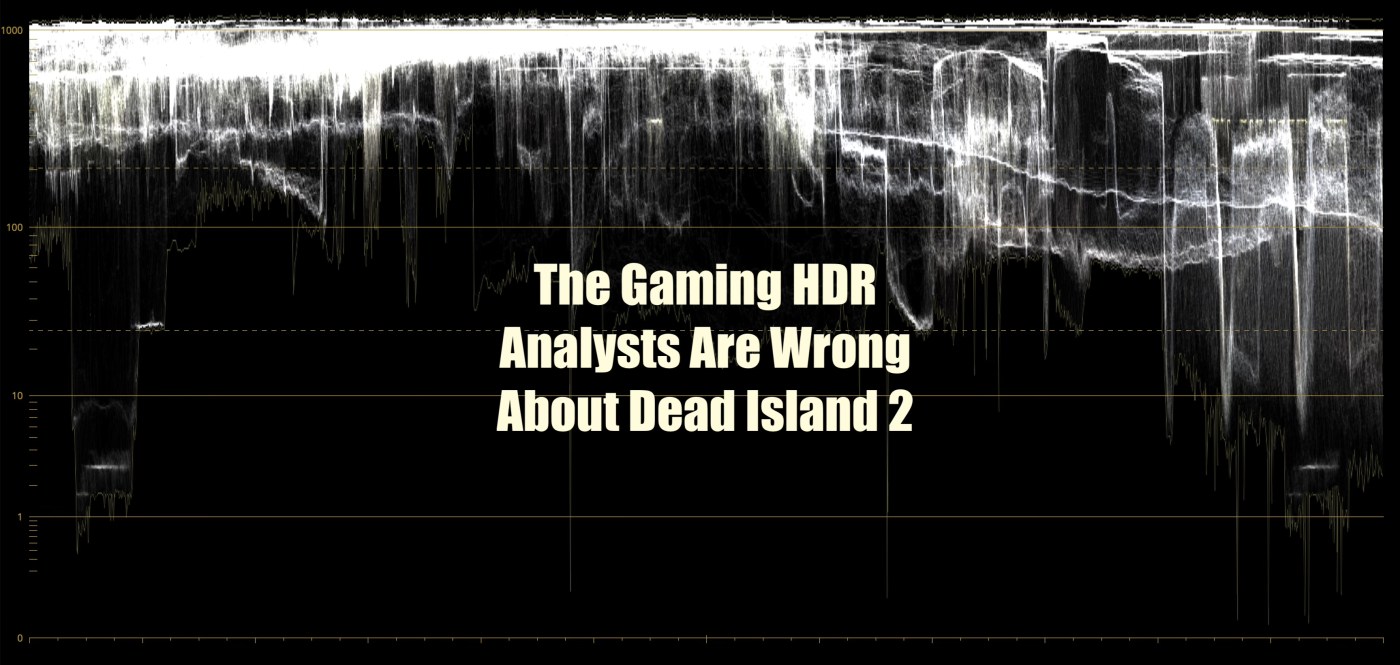
Gaming HDR analysts advise setting the in-game White Point slider of Dead Island 2 to 1150, claiming it’s needed to unlock 1,000-nit highlights. They also recommend setting Brightness to 25, unironically stating that it represents “a balanced exposure for the game,” or warning that significantly reducing it results in black crush. None of these claims holds up to scrutiny.
More is Better
Those recommendations, founded on the seriously flawed philosophy that brighter is better, will inevitably cause the ABL (Auto Brightness Limiter) of many/most consumer devices to persistently dim the display.
Stratospheric Luminance Levels: Origin
The idea that HDR must be eye-searingly bright can be traced back to Dolby’s studies of viewer preferences [1], as well as to the glut of misinterpretations of the data that followed.
The message is further amplified by Dolby’s marketing: “Dolby Vision allows content creators to use even brighter highlights, whereas some other HDR formats limit content creators to use only up to 1000 nits [2].” The implication being that 1,000 nits is hopelessly inadequate. The truth is, the SMPTE ST 2084 (PQ) standard defines an EOTF with a luminance range capability of 0 to 10,000 cd/m2 that is not exclusive to Dolby Vision [3].
What Dolby’s studies were testing was not “HDR” as we understand it in a cinematic or gaming context. They were measuring isolated shadows and highlights in an unnatural, contrast starved environment. In a contrast-free vacuum, highlights needed to be astronomically bright.
The Irony
Dolby’s marketing materials and podcasts prominently feature acclaimed cinematographers who use the Dolby Vision pipeline solely to preserve a low dynamic range aesthetic.
A Welcome Counterpoint
The study, “What is HDR? Perceptual Impact of Luminance and Contrast in Immersive Displays” (Chen et al.) moves beyond the “absolute limits of threshold vision” tested in earlier works (like the Dolby study) to focus on “practically relevant luminances and contrasts [4].” The researchers provide a badly needed corrective: HDR = Contrast + Peak Luminance.
Sensible Grading Practice
Most OLED TVs and monitors can’t begin to approach the luminance levels found in Dead Island 2 – even with the in-game brightness slider turned all the way down to zero. When grading, it’s good practice to ensure that frame average light levels of static content don’t exceed ~200 nits to prevent degradation of the picture.
Comfortable Brightness Levels of Static Images
You might be wondering whether this brightness limitation of consumer displays isn’t a hindrance when it comes to artistic expression. Unless your goal is to intentionally inflict harm on your audience, it’s probably not a handicap.
In a study by the NHK, images with an average luminance of less than 25% of the peak luminance were considered by participants as comfortable, whereas images with an average luminance that exceeded 25% of peak luminance were judged as too bright by many viewers.
Note: “A comfortable overall brightness does not ensure that the content makes good use of the available dynamic range.” – ITU-R BT.2408
HDR Typically Has a Low APL
HDR video content typically has a low APL (less than 20%). In a study of 41 Warner Bros. titles (over 7 million total frames analyzed, corresponding to approximately 83 hr of content) in the HDR Home format that were mastered on a Dolby Pulsar display (0.005 cd/m2 black level and a peak luminance of 4000 cd/m2), MaxFALL (maximum frame average light level) of 98.6% of the frames was below 170 cd/m2 (the display power budget of the BVM-X300) [5].
- Daly et al, Distinguished Paper: “Viewer Preferences for Shadow, Diffuse, Specular, and Emissive Luminance Limits of High Dynamic Range Displays”, SID Symposium Digest of Technical PapersVolume 44, Issue 1. 01 July 2013
- “The difference between HDR10 and Dolby Vision,” Dolby.com
- SMPTE ST 2084: 2014, Reaffirmed 2017, “High Dynamic Range Electro-Optical Transfer Function of Mastering Reference Displays”
- Kenneth Chen, Nathan Matsuda, Jon McElvain, Yang Zhao, Thomas Wan, Qi Sun, Alexandre Chapiro. 2025. “What is HDR? Perceptual Impact of Luminance and Contrast in Immersive Displays”. In SIGGRAPH ‘25: Proceedings of the Special Interest Group on Computer Graphics and Interactive Techniques Conference. ACM, New York, NY, USA.
- Ronan Boitard, Michael Smith, Michael Zink, Gerwin Damberg, and Anders Ballestad, “Predicting HDR Cinema Requirements from HDR Home Master Statistics.” Presented at the SMPTE 2018 Annual Technical Conference & Exhibition, Los Angeles, CA, 22–25 October 2018.

